

How Silicon Valley got rich
And how everyone else can get rich too.
Or subscribe to get every pamphlet too, from $50 a year.



 Join 23,259 subscribers
 his essay is research for my book We Should Own The Economy, which I’m writing in public. Readers can still invest in the project and earn a share of the revenue when it sells 👇🏻

In 1957, eight engineers left their former semiconductor company and convinced Sherman Fairchild to back a new one. This was unusual at the time; entrepreneurship wasn’t a readily available path, and angel investment a rarity. But the Eight had a proven track record and Fairchild was a wealthy heir with a passion for science—he agreed to give them each a tenth of the company plus $1.5 million in corporate funding, so long as he retained the option to buy out their shares for $3 million.
Fairchild Semiconductor began in a garage in Palo Alto, and within two years they had revolutionized integrated circuit technology using silicon. They created “the chip” that would power Silicon Valley and give it its name. The Eight became Silicon Valley entrepreneurs and Sherman Fairchild became one of its first venture capitalists, creating a prototype later investors would institutionalize.
They also became rich.
By 1959, Fairchild Semiconductor was worth $100 million and Sherman Fairchild exercised his option to buy the company for $3 million. He made out with $97 million in corporate value, while the Eight earned $300,000 each for their shares and learned a valuable lesson in equity ownership. Seven of the eight used their earnings to found new tech companies, including Intel, and one became a venture capitalist who funded dozens of companies. All of them created employee stock ownership programs that rewarded founders and early employees with equity.
Known to history as the “Traitorous Eight” for leaving their former company to start Fairchild, the team not only pioneered the chip that would create Silicon Valley but also the equity plans that would become a tech standard. Silicon Valley would mint generation after generation of employee-owned tech companies, with entrepreneurs getting rich from one company and then moving on to found another.
Lured by the idea that they could earn equity in the companies they helped build, engineers flocked to California to participate.
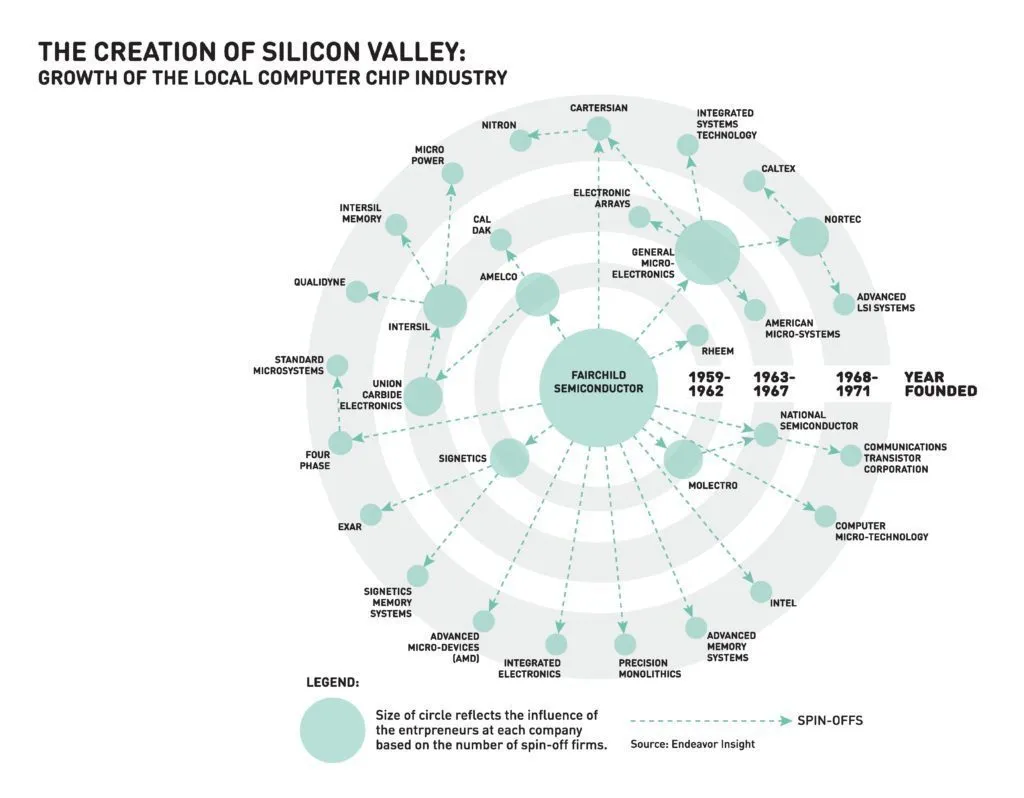
This caused a massive shift in equity ownership. In the early 1950s, only 4.2% of US households owned corporate stock. Companies were largely owned by wealthy industrialists like the Rockefellers, Du Ponts, Mellons, and their heirs; as well as early investors in companies like IBM, GE, and Ford. Sherman Fairchild, incidentally, was heir to the IBM fortune. Then, the Revenue Act of 1950 allowed profits from stock to be taxed at a lower “capital gains” rate (25%) rather than an income tax rate (as high as 91%), making it an effective incentive for high earners. In 1950, virtually no executives were earning equity as part of their compensation packages, but by 1951, 18% were. That’s when Fairchild Semiconductor came in.
As tech companies proliferated throughout Silicon Valley in the 1970s and 80s, so did their stock plans. Reagan-era tax policies further incentivized employee equity, allowing shareholders to defer tax payments until stocks were sold and reducing the taxes paid when they were. As more employees were paid in equity, more of them got rich. When Apple went public in 1980, it created 300 millionaires. When Microsoft did in 1986, 3,000 employees became millionaires. After Google’s IPO in 2004, 1,000 employees held stock worth more than $5 million. By 2007, even employees who had been at Google for a year owned about $276,000 in stock value on average.
As entrepreneurs and executives grew rich from their exits, they founded even more companies or funded them as investors. When PayPal sold in 2002, it famously made megamillionaires out of its executives and launched a new era of Silicon Valley: Peter Thiel used his riches to found Palantir and invest in Facebook, Elon Musk founded Tesla and SpaceX, Reid Hoffman founded LinkedIn, three engineers founded YouTube, and two others founded Yelp.
Employee equity programs created a new entrepreneurial class and fostered a generation of employee-owned companies.
They also led to rampant inequality.
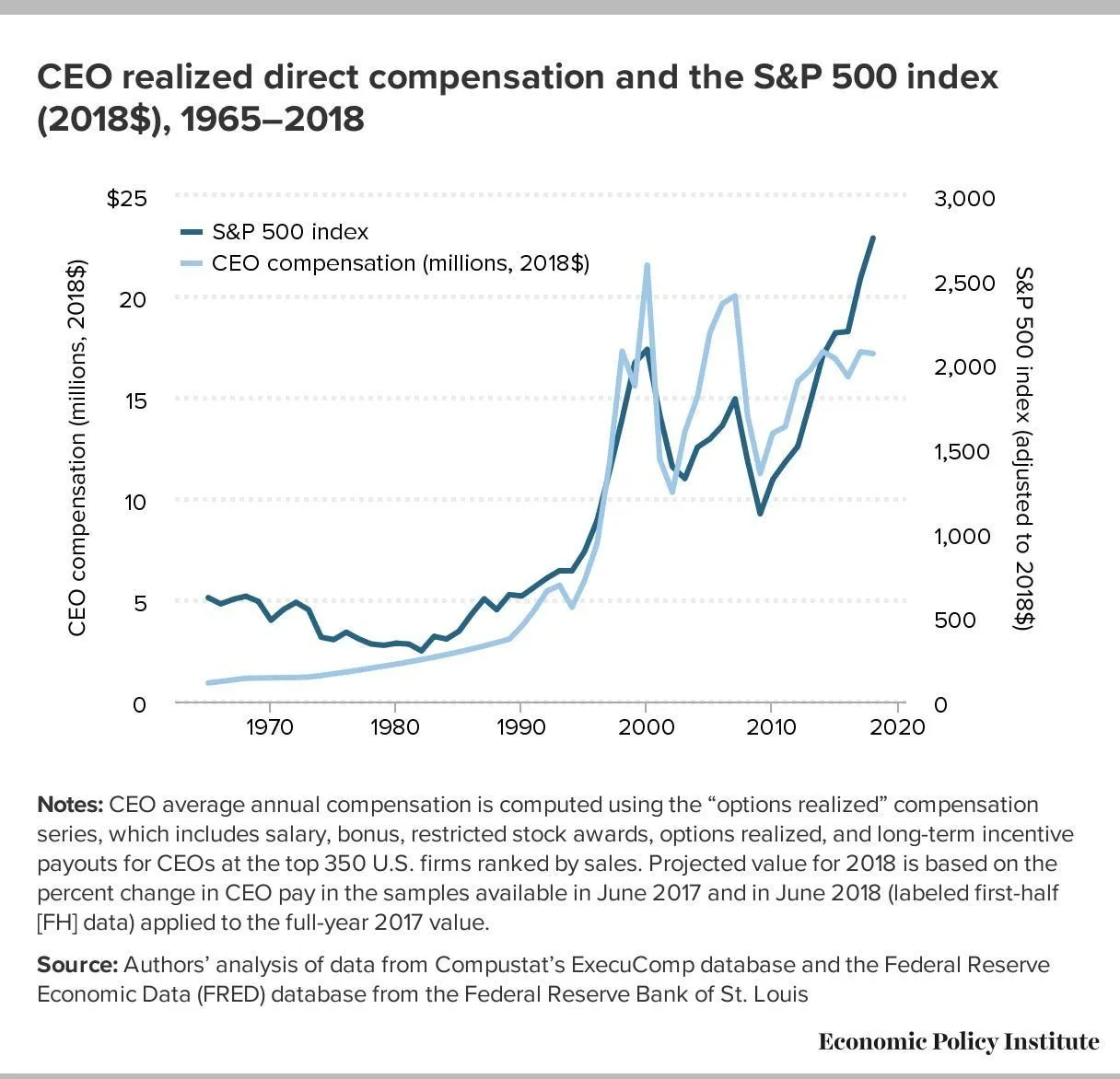
At the same time that workers began earning equity in companies, executives began earning way more equity. Between 1978 and 2023, typical worker compensation grew by 24%, while CEO compensation grew by 1,085%. In 1965, CEOs were paid 21 times the typical worker, but by 2023 CEOs were paid 290 times the typical worker. If a typical employee might see $200,000 in stock gains throughout their career, a CEO might see $50 million, far outpacing any gains made by the middle class.
A Clinton-era reform tried to fix the problem, placing a cap on executive salaries at $1 million, but instead of companies spending more on the rest of their employees, this only caused a larger share of executive compensation to come in the form of equity, unintentionally making the problem worse. When we compare the rise of CEO pay to the rise of the stock market, we can see the one is directly causing the other.
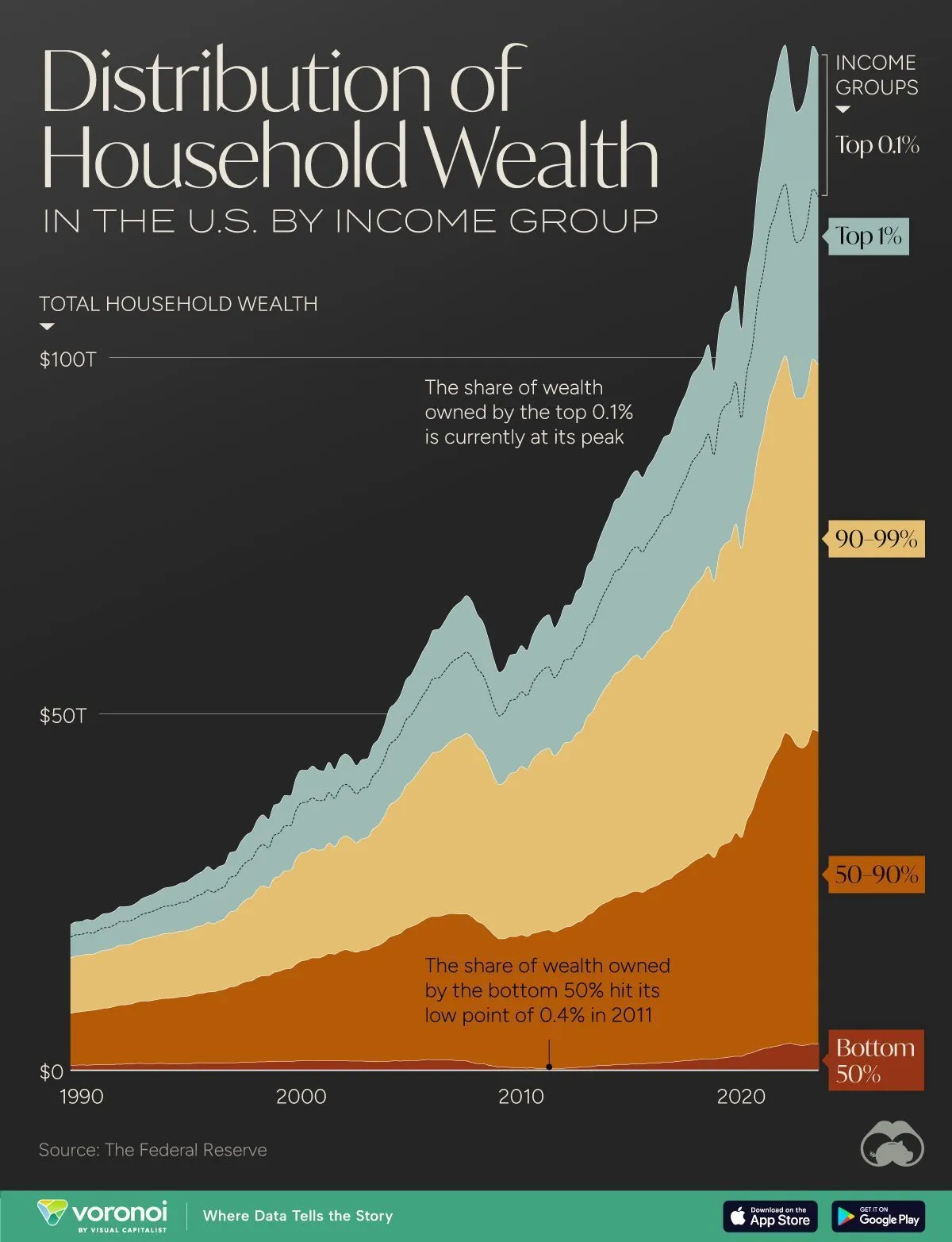
Investors profited most of all. Just as Sherman Fairchild was the real beneficiary of Fairchild Semiconductor, so would the investor class own the largest share of every company on the stock market and thus gain most of the economic value. As a 2021 Harvard study points out: “The wealthiest 10% of Americans own 94% of business wealth, 92% of directly held shares of public companies, and 93% of stock mutual funds.”
As our companies grew, those with equity in them got rich while those with little to no equity didn’t. When the stock market boomed, the wealth of the bottom half barely increased while the wealth of the top half skyrocketed.
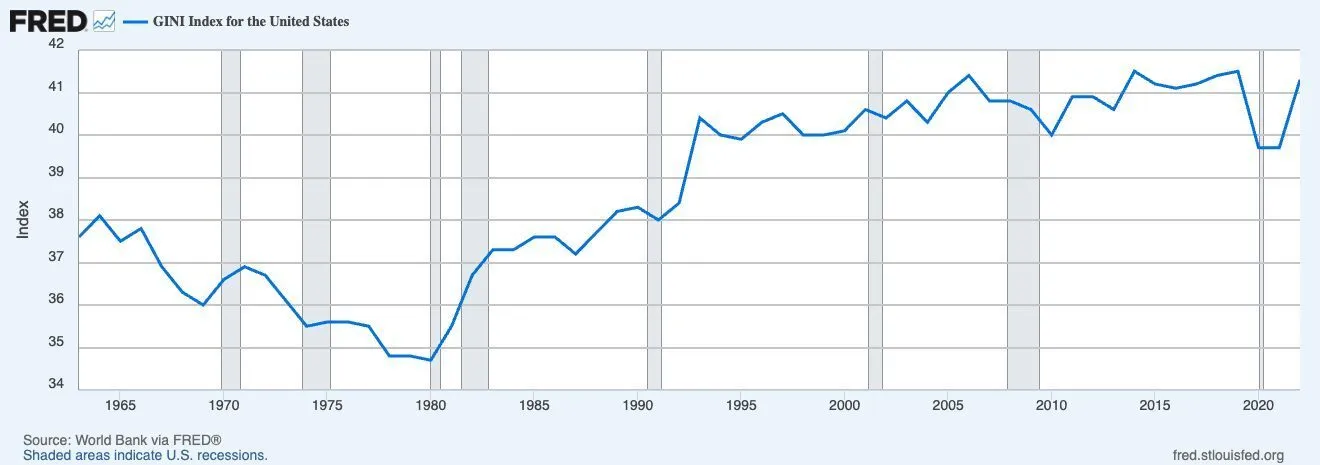
Today, the Gini Index, which measures inequality over time, shows the US has reached historical highs. The index ranges from 0, where everyone has exactly the same income, to 1, where one person has all the income and everyone else has none. Inequality was improving until the 1960s and 70s and that number was going down, but as the top earned more of their income in equity and the stock market grew, the gap widened and it went up. The US has the highest Gini ranking of any developed country.
It could have been much worse.
Without Silicon Valley cutting employees in on the deal, all of our economic value could have funneled to the top instead of just nearly all of it. Before 1950, nearly 100% of corporate value went to the wealthy investing class. Today, 70-99% of public companies are owned by nonworking investors, with 1-30% owned by workers. Employee ownership has been an important and countervailing force, chipping away at inequality by putting wealth in the hands of workers, but it’s not enough.
Our task now is to drastically expand what Silicon Valley started: To increase the share of companies owned by working employees and to increase the share of worker equity that goes to non-executive employees.
That Harvard study modeled what that could look like. If all US businesses were 30% employee-owned, the Gini Index would decrease by nearly 10%, and income inequality would be at its lowest since we began tracking it in the 1960s. The median household net worth would double, from $121,760 to $230,076, and the bottom 20% by income would see their wealth quadruple, from $10,060 to $40,000 on average. The wealthiest 1% of Americans would see their net worth decline by 14%—from $28.4 million in assets to $24.4 million—but the wealthiest 90 to 99th percentile would see their wealth decline by only 1%.
In other words: By granting more equity to workers, we’d see only minor decreases in wealth at the top, but exponential gains in wealth at the bottom.
To do this effectively, departures will need to be made from traditional Silicon Valley stock plans where shares are allocated disproportionately to nonworking investors and benefits shared only in the case of an exit. The Harvard study assumes an ESOP structure, where shares are distributed based on an employee’s compensation level and allocated regardless of liquidity.
This is important.
Most corporate equity programs come in the form of Restricted Stock Units (or RSUs). Employees earn a set number of shares over their first four years, but those shares are worthless unless the company eventually sells or goes public. Exit events are unlikely: Seventy percent of startups fail within their first 10 years; of those that succeed, only 30% will be acquired and 1% will go public. Exits become more likely with more fundraising rounds, but shares get diluted and are inequitably distributed: By the time of an exit, 40-60% of a company is typically owned by investors, with 20-30% owned by a small group of founders and executives, and the remaining 5-20% shared thinly between hundreds or thousands of non-executive employees.
Employees who join already public companies have the opportunity to buy company stock at a discount through an Employee Stock Purchase Plan (or ESPP). An employee with a 15% discount could purchase $10,000 worth of stock and instantly own $11,765 worth—if they turn around and sell they’ll gain $1,765 before tax. This, however, provides the employee with a small and very short-term gain. A 10–15% discount on a few thousand dollars per year is the most an employee can expect to gain, and thus does not meaningfully shift equity into their hands. Conventional financial wisdom is for employees with an ESPP to buy and sell stock quickly, then use the gains to invest in index funds.
RSUs are a good thing, but they are a lottery ticket. ESPPs are good too, but only mildly increase equity ownership for the average employee. Both inequitably benefit investors and executives and give very little stock to working employees by comparison.
At a company with an Employee Stock Ownership Plan (or ESOP), however, shares are worth something immediately, even at privately owned companies. Every year, a third party calculates the value of the company and employees know exactly how much company stock they have and how much it’s worth. Whether the company stays private, sells, or goes public, employees can cash out with the value in their account. And shares are distributed equitably, based on salary level: An employee with an annual salary of $100,000 earns twice the shares of someone who earns $50,000, and only the first $345,000 of compensation is counted on this scale. If the lowest-paid person earns $50,000, the highest-paid person can earn a maximum of 7x more in shares.
ESOPs give equity to employees regardless of liquidity, and shares are more equitably distributed between the top and the bottom, but there’s a major downside: Those shares go into a retirement account rather than an investment account. This eradicates the Fairchild effect: An employee with an ESOP can never cash out and start another ESOP company. They can only retire at 65 and sail into the sunset. That model won’t proliferate the way Silicon Valley has, and those riches won’t go on to benefit the economy at large, just individuals who can own a nice home and have a larger savings account for retirement.
This is a huge miss to me. Especially since 90% of employees with an ESOP account also have a (more diversified) 401(k) account.
If we want to create more equity owners, corporate equity needs to be distributed into personal investment accounts, not retirement accounts, just as investor and executive shares do. Individuals should be able to use those gains to start new businesses and fund existing ones, and see their wealth grow and proliferate into more employee-owned companies, just as Silicon Valley has. The goal here is to create more owners of the economy, not limit who can benefit from it to the already wealthy and the retired.
This has led to a more modern version of the ESOP: The Employee Ownership Trust (or EOT). Here, a company puts 51% to 100% of corporate shares into a trust owned on behalf of employees. As the company earns profits, the board of directors decides how much to reinvest in the business and how much can be distributed to the trust (owners). Employees receive a share of the trust as an annual cash bonus. This is a great option for small businesses who want to share profits with contributors, but individuals don’t become equity owners the way they would with an RSU, ESPP, or ESOP, and they lose access to that bonus and ownership if they leave the company.
It seems to me that all of these models should learn from each other. Why couldn’t employees earn equity in their companies at a more equitable rate, regardless of liquidity, just as they do at ESOPs? Why couldn’t they also cash out their shares and start new businesses with their earnings, just as they do with RSUs or ESPPs?
The Fairchild Eight paved the way, and Silicon Valley proved how motivating it can be when those who labor to create corporate value also share in the benefits of that value as owners. Now we need that equity to benefit more than just a few. We need to give employees a larger cut of corporate equity than we have been, and we need to give nonexecutive employees a more equitable share. We need to improve the equity plans we’re currently offering to make this a better all-around deal for everyone and create more owners of the economy overall.
I’ll be sharing more ideas about how we can do that shortly. In the meantime, I’d love to know your thoughts 👇🏻
Thanks for reading,
P.S. This chapter has been added to the public manuscript for my book which can be found here.
P.P.S. There are two important questions implied in this essay that need to be addressed: Why is inequality bad? (As in, does it matter if the rich get exorbitantly rich so long as everyone is still getting richer?) And what about public attempts at creating more owners of the economy through IRAs, 401ks etc.? These will be addressed in future articles.
P.P.P.S. Mandatory Disclosure regarding that link at the top: The Elysian is "testing the waters" to gauge investor interest in an offering under Regulation Crowdfunding. No money or other consideration is being solicited. If sent, it will not be accepted. No offer to buy securities will be accepted. No part of the purchase price will be received until a Form C is filed and only through Wefunder’s platform. Any indication of interest involves no obligation or commitment of any kind.
Further reading
Here are a few notes from the margins of my research:
For more background information on the ideas in this article, here are a few things I’ve already written on the topic:
A few ways we can expand employee ownership: “120 million employee-owners in one generation”
More about ESOP structures: “Every company should be owned by employees”
The Intel Trinity by Michael Malone
How venture capital built Silicon Valley, from NPR
The history of employee stock options, by Frederick Mijinhardt
“Executive Compensation” by Kevin Murphy
Get every essay in your inbox
Weekly essays exploring a utopian future.
Join 23,259 subscribers

Is there a database of companies with ESOPs and/or EOTs? One challenge is that 7x cap and only applying the % allocation by salary up to $350,000 of salary. Why would the main founders of a company do that when they feel like their risk reward for starting a company is significant ownership (whatever isn’t diluted by taking outside capital)?
We need a 1% pledge but toward more employee ownership as well, maybe there are movements here but I’d be curious to know as well. Orgs like Team Shares ostensibly are trying to buy companies then build a plan toward employee ownership but I that’s anecdotal and I don’t have a good sense for how widespread this is or how we might really incentivize and build a movement around this (or if anyone else already is). Main Street Summit would be an interesting community to survey around this.

There's a rather expensive full database of US ESOPs here: nceo.org › national esop database
But I have the free version as a spreadsheet and can share it with you. Can you join the Slack channel for the project and then I can send it to you and everyone else privately there? join.slack.com › zt 2x9c6c0ya P0FgtZB3VezixDgpOV8NJw
The UK also has a list of their EOTs here: rm2.co.uk › employee ownership top 50 2023
As to the equity cap, how much more equity should the highest-paid employee receive than the lowest-paid employee? I'm not sure that the ESOP's version is the best one, but it seems to me that, outside of founders, there should be some rule of thumb to make the distance between highest and lowest paid equity plans more equitable than they are today?
Well, Substack's verification scheme is a pain, at least when my email is not receiving the applicable authentication code immediately, as happens with phone text messages.
I am always intrigued by those comments that claim X% of the population own Y% of the wealth, But they never provide a set of X's and Y's that they think are legitimate or acceptable.
So let's visit the hunter gather society, where the chief of the clan of 100 people "owns" 2% of the wealth of stone axes, arrows and bows, bone and wood tools, reed baskets, etc. That is about all he and his family can carry around with them anyway. But the other 99% of the population own 98% of the wealth. There just doesn't happen to be all that much of it. If you are not aware of it already, you should spend some time with Michael Magoon's Substack on poverty, prosperity and progress: frompovertytoprogress.com . He provides some background on what it takes to create progress as a prosperous low poverty society.
One aspect this particular essay did not discuss was the command that talent can extract as a new employee [one with a well demonstrated prior performance, anyway]. "I'll come to work for your firm if you give me Z% in stock at the rate of A shares per month, as I help grow your firm." I do agree that the smarter firms might do even better economically if they provided such wealth sharing ownership opportunities. And in really well run firms every employee, even custodial services, has a contributory role, but gaging that relative value is essentially indicated by wage/salary scales [even if imperfectly].
Just don't ignore the role that personal responsibility and a savings/"look to the future" mindset has played in all of these people's successes.
I do need to reread this essay sometime to better cement the various program options into my mind/ memory.
In the terms of the stock market, there is a set amount of shares on the market, and the richest own most of them (and get much richer for owning most of them). Sure you can add more shares to the market (just like you can make more tools in your hunter-gatherer society), but the rich are more able to buy those shares up too and they do, further entrenching ownership only among the most wealthy. But we can certainly cut into that pie a little bit by giving more ownership to more workers. I'm familiar with Michael's work, but you're welcome to point me to a specific essay if there's one you find particularly relevant to expanding equity ownership?
I agree that stock plans should be more transparent to new employees. I worked at a tech company for five years and vested a certain number of stocks when I did. But I didn't know how many total stocks there were, or how my share compared to anyone else. I also have no idea how much the company is worth. So I would have no way of knowing the value of my stock at sale, if it ever did. As of now, they are still worthless.
I'm all for personal responsibility here too, but some systemic restructuring would help. Especially as I'm not advocating for giving money away free here, I'm advocating for giving workers a share of the value they help create. And a bit larger of a share than they are already getting.
I am sure you know all of this, so I am only poking at you for some of your word choices. :-)
"... cut into that pie a little bit by giving more ownership to more workers."
"...not advocating for giving money away free here, I'm advocating for giving workers a share of the value they help create."
No one is going to "give" someone something if they haven't shown that they earned it; and the best place to show that value and contribution is via the marketplace.
"... vested a certain number of stocks when I did. But I didn't know how many total stocks there were, or how my share compared to anyone else. I also have no idea how much the company is worth. So I would have no way of knowing the value of my stock at sale, if it ever did. As of now, they are still worthless." Well, if they are worthless, then just give them to me, or to a 501-c-3 of your choice. Someone will have the patience to wait for a market reckoning on your contribution, even if you are going to forego that potential.
Part of what you want to achieve will require educating folks in HS about some basic concepts of business, value creation, stock ownership as surrogate for the wealth of the firm, etc. I did not get that and was late to the party [by a couple of years] to access my employer's modest profit sharing plan when they made it available. I think it was their precursor to their 401K offering. But 25 years later it was all good.
Now, you want to restructure remuneration packages, especially for start ups, but for any firm, to include both tax deferred income (IRA & 401K type) and access to the potential for F-U money [as some MS employees expressed it].
In the final analysis, the marketplace will determine this, as demographics may favor workers in the future [or at least the more in demand subset]. I endorse efforts to help people obtain their real value/return for their time and talent, but most of us most of the time are not exceptional and have to plug away with IRA type waiting games to realize some level of financial independence in retirement or sooner. That requires a "save and invest" mindset that is not as common as it could and should be.
Personally I think SS could/should be converted to a mandatory IRA equivalent, along with parallel mandatory programs for saving for educational needs and for healthcare needs down the road. It will have to be mandatory because too few will exercise the wisdom and discipline to do this without being forced into it.

This was well done. I did not realize what a diversity of employee stock ownership types there are.

Elle, this a brilliant reframing of how Silicon Valley's most impactful innovation wasn't necessarily the microchip, but rather more about the democratizing of ownership itself. (Sidenote: having had the privilege of learning from you during Write of Passage, I'm not surprised by the depth and clarity you bring to such a complex topic. Your generosity with insights and time during that cohort really showed, and it's evident here in how accessibly you've made these economic concepts. Looking forward to the book and your continued posts.)
Obviously your essay touches on the fundamental tension in capitalism itself: between rewarding capital and rewarding labor. The "Fairchidren" family tree you reference shows how wealth begets wealth in an almost exponential way. But your proposed solutions suggest we might be able to harness that same exponential effect for broader prosperity...
I'm curious to learn more about how you think about the underlying challenges:
- Political Feasibility: Given how entrenched current equity structures are, what would it take to create momentum for more equitable distribution? The Clinton-era salary cap backfired spectacularly—how do we avoid similar unintended consequences?
- The Innovation Question: Silicon Valley's current model, inequitable as it is, has generated tremendous innovation. How do we ensure that more equitable distribution doesn't dampen the entrepreneurial dynamism you describe?
- Implementation: For companies wanting to move toward more equitable equity distribution today, what would you recommend as practical first steps? (I believe you've written a lot on this - I need to dig in)
Thanks for sharing. Great read.
Thank you for such a kind comment David, I really appreciate it!
Some thoughts on your challenges:
Political feasibility: Luckily, employee equity and employee ownership is a bi-partisan issue in the United States. We can and do pass legislation that improve this all the time. Also, it's worth noting that the Clinton error has also happened in reverse. The 401(k) was originally added as a tax shelter, a way for executives to earn salary without paying taxes on it. It was only later that others realized that loophold could actually benefit all workers, not just the top ones.
It is tricky though, because well meaning politics can have bad results. Robert Reisch was the head of the department of labor during the Clinton error and he said it resulted from a bad compromise. Companies wanted to be able to pay execs a lot of money (to be able to attract the best ones). Clinton wanted to cap executive pay. The compromise that gave them both what they wanted actually gave the companies what they wanted. I don't know how to solve that. But it's worth looking into how we can fix it.
Innovation: The Silicon Valley model resulted in lots of innovation. I see no reason why that same model couldn't continue to do so, even as it motivates and benefits a lot more people. Investors and executives can still get rich, but how much better would it be if a lot more people could get a lot richer too? Small tweaks to the system here could have big rewards.
Implementation: Small companies can set up as EOTs or cooperatives, or just do manual profit sharing with employees. Larger companies can become partial or even full ESOPs. When founders want to reture, they can sell some or all of their company to employees rather than to another company or PE. There's a lot that can be done here.
And I'll have even more call to actions coming soon!
Nit: A benefactor does good. A _beneficiary_ has good done unto him. Mr. Fairchild benefited _from_ the company named after him.
Of course, without him it might not have existed at all.
Whoops! Thanks for that. Fixed!

America's system of Venture Capital that is a network of Mafia-like entities ensures that wealth inequality will continue to rise sharply driven by Gen AI hype. The incentives in Capitalism and which AI startups get the most funding determines the technological outcomes. Today the semiconductor chip industry is mostly centered around Taiwan, South Korea, Japan and their complex supply-chain where TSMC, ASML and Nvidia are like a golden triad. Only one of those is American, in fact both Nvidia and AMD have Taiwanese-American CEOs.
Now with America's increasingly authoritarian ownership of AI supremacy, including illegal reciprocal tariffs - the idea of Silicon Valley changing its ways is highly unlikely. Increasingly, just getting full access to the best AI tools include paid subscriptions of up to $250 a month like Google's new Ultra plan.
The United States is therefore likely to keep the world in a purgatory of technological dependency out of self-interest and more powerful like monopoly capitalism led by Tycoons. Many onlooks do not believe that the current system reflects democratic values of old or even actual rule of law.
Yep, there are a lot of problems with the current model. That doesn't mean we shouldn't work to solve it while we can!

Great stuff for new companies. But how would we deal with restructuring the current market that is so wildly overinflated.
I have a few ideas on that here if you're interested. This is something many organizations are already working on! elysian.press › 120 million employee owners in one