
 t was the third grade, a run-of-the-mill afternoon. Our science class was interrupted by a guest speaker—an employee from the national park on the other side of town. He took time off work to talk about ecosystems to a couple dozen chatty kids shifting in their seats, waiting for the bell. I must admit, I was surely no more engrossed than the others in his lecture about energy flows and nutrient cycles. That is, until he pulled a bottle from his briefcase.
A 2L plastic bottle, probably once filled with Pepsi or some other form of liquid gold. It was now packed with soil, rocks, moss, a few small plants, and who knows what else. Mr. National Park explained he built a closed terrarium: a self-contained ecosystem that mimics Earth’s water cycle to sustain the life inside the bottle without any outside interference. He said it hadn’t been opened in 3 years. 3 years! That’s, like, an eternity in kid terms. To third-grade me, he was a god holding the world in his hands. It was pure magic.
I went home, begging my brother to get off the family computer so that I could google everything I needed to know about making my own terrarium. I gathered my supplies: a printed WikiHow article, one of my mother’s mason jars, and an assortment of Outside Things I gathered from the garden. I stuffed the jar, sealed the lid, set my terrarium on my bedside table, and waited. Unfortunately for third grade me, all the plants became shrivelled and gray after a week or so. The gardening forums told me it was root rot, or mold, or the wrong plants, or a combination of everything. Watching that tiny world fail was my first lesson in how fragile ecosystems really are. They’re precise. Every part depends on every other part, and any small disruption ripples outward.
Fast forward to the winter of 2024. I was asked to give my first lecture as part of a new social education program in the city. To me, art and science were two sides of the same coin. Julian Klein, the head of Institute of Artistic Research Berlin, describes research as a process of not-yet-knowing, and the desire for knowledge—an experience that surely applies to the arts as well. He explains that art and science both exist in the same cultural space, on the balance between tradition and innovation.
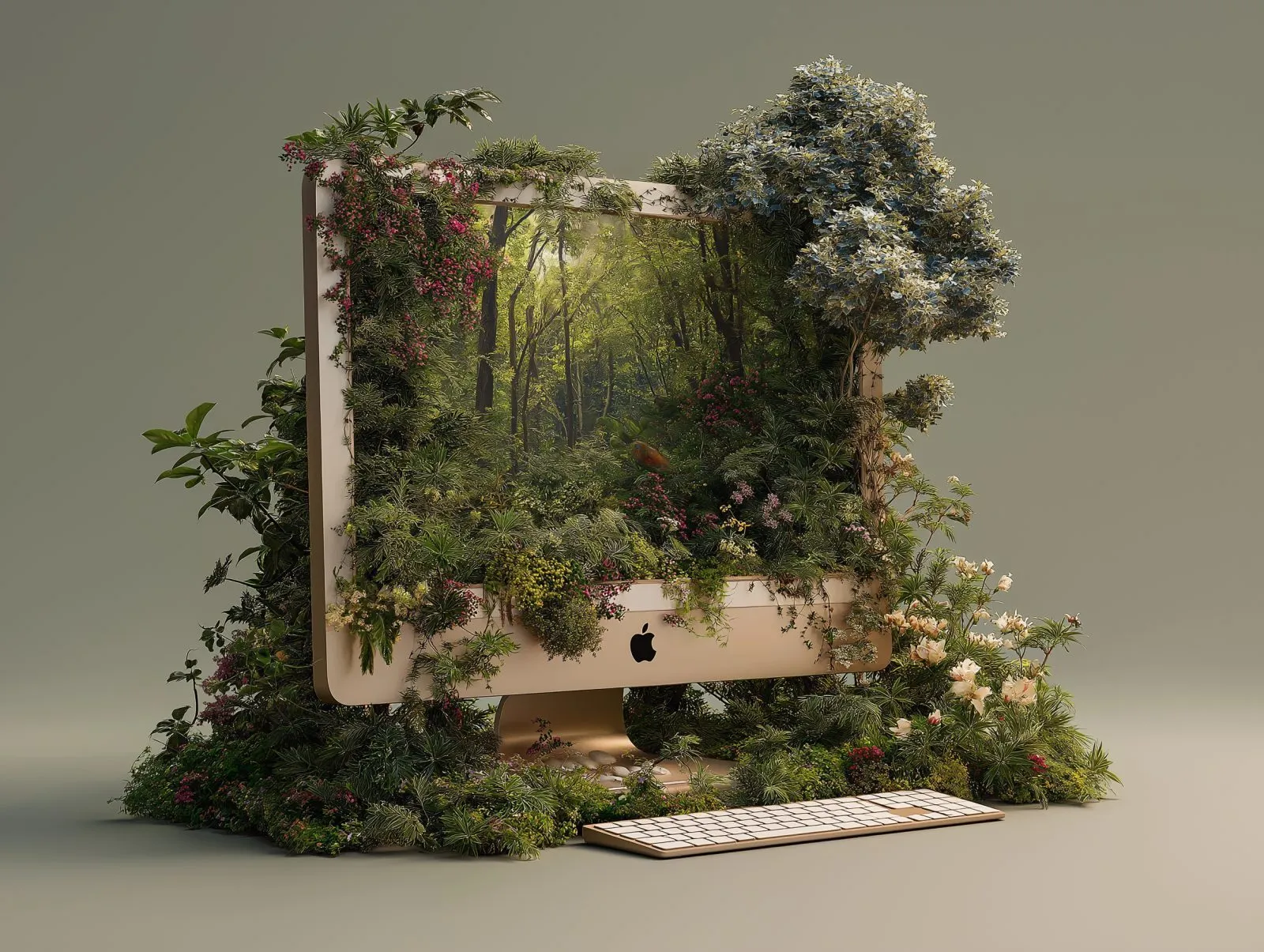
The lecture was titled The Internet’s Root System, an exploration of how our digital space functions as an ecosystem, and what hidden life sustains it. I was pleasantly surprised to hear it had reached capacity. To meet interest, I hosted the lecture as a free webinar, which had more than 250 registrants. It was clear: people wanted to know how to rethink their relationship with the internet and learn how we may tend to it as a system of care.
Eventually, I aim to develop a comprehensive guide for how to care for our internet ecosystems. Here, I will share an amuse-bouche of sorts as to why learning from nature is more important for our digital selves than ever.
Subscribe for free to keep reading.
Get every essay in your inbox
Weekly essays exploring a utopian future.

 Join 23,254 subscribers