

The case for taxing AI slop
A minuscule levy on the largest AI producers can usher in a New Deal for cultural workers in the AI Age.

Or subscribe to get every pamphlet too, from $50 a year.



 Join 23,259 subscribers
 rancisco is working on a highly anticipated book when he learns he will need to be the full-time caretaker for his terminally ill mother. His income from copy-editing has all but disappeared since the release of LLMs. His book contract is in peril. It is saved when his publishers secure bridge funding that enables Francisco to hire a caregiver.
A high school in New Mexico where 65% of the students are categorized as food insecure can fund a year’s worth of visual art and music supplies. Last year, funding for “Arts & Creativity” was cut in order to accommodate tax concessions dealt to a datacenter project in the county.
One of the last remaining independently-owned newspapers in Ohio is on the verge of folding when they get a lifeline grant, enabling them to make payroll. A private equity firm attempted to assume control with the intent to automate web articles using generative AI summaries of newswires.
In Kansas, a public radio station launches a weekly segment focused on big agriculture and its impact on farming ecosystems. Travel, editing, and original music are funded. They stream it online, where it becomes a surprise hit.
As the clock strikes midnight on New Year’s Eve, 25,000 researchers and educators are sent need-based grants to cover rent, materials, and other expenses for the calendar year. There was no short list, long list, or onerous grant application process from a foundation started by a wealthy arms dealer. Anyone qualified as a cultural worker—a term spanning disciplines and research methods—is able to apply for funds. None of them are working on generative artificial intelligence, and most of them view using genAI as an alien interloper into their practice. Yet their work is urgent and enriching. Over half of them report being on the verge of quitting their practice if not for this financial support.
These stories are fictitious, but the struggles they represent are real. In each case, the cultural production in question has come under threat by the rapidly metastasizing presence of Artificial Intelligence tools, known specifically to human creators as “AI slop.”
Where did this sudden influx of funds come from? How were millions of individuals and cultural organizations given grants and emergency lifelines at a time of intense precarity and technological disruption? The answer is surprisingly simple and broadly popular—a minuscule tax levied on the values of multi-billion dollar AI companies—the same companies whose extractive AI models flood our media, news feeds, and public institutions with cheap derivatives.
Why tax slop?
It would seem that “AI Slop” needs no introduction. You hear it on Spotify, where the platform has begun to stream tracks from fake bands whose music is composed by AI. You see it on YouTube, where a recent study determined that a new user will encounter around 21% fully AI-generated videos on their feed. You read it on Amazon, where books written via AI prompt are pumped out at an inhuman scale, flooding recommendation lists and fooling readers. In fact, “Slop” was Merriam-Webster’s Word of the Year for 2025, defined as “digital content of low quality that is produced usually in quantity by means of artificial intelligence.” The term slop is chosen for its lack of care in assembly, the notion that a cheap careless substitute will suffice at a certain scale. As digital platforms re-wrote the incentive structure for creative and cognitive production, capitalists saw an unexploited market. AI Slop, like the platforms that host it without regulation, monopolizes our collective attention. And where attention goes, resources soon follow.
The generative AI models that enable the production of slop require untold reams of human input for training, almost always stolen without permission. AI companies in turn sell the capabilities of these models as a way to produce sub-standard artificial reproductions of this cognitive labor at scale, directly competing with the current allocation of resources to the human creative labor that was harvested to train them.
AI slop disrupts and annoys us in the near term; and the backlash against it is starting to take shape. Less obvious still are the second-order effects of a creative economy where powers that underwrite creative expression, journalism, and research become financially impelled to replace human work with a poor automated alternative.
Some have compared AI and its slop to mold on food. Mold needs nutrition-rich hosts, but as invasive mold grows the host resource is slowly destroyed. Eventually, there is no new energy for it to perpetuate, and the mold dies too.
The labor losses will be outweighed by the larger narrative collapse. If AI Slop proliferates unchecked, precious few institutions will remain to determine what is real or scam; which output is gaming the platform economy or which is the work of those seeking to advance social and cultural exchange, trust, and human flourishing.
It is only through robustly-funded cultural institutions—broadly construed as organizations that produce a good or service where the quality and veracity of the output outweighs the ease of distribution and monetization—where AI slop will meet its ontological death.
How does the Slop Tax work?
Any AI company exceeding a billion-dollar valuation must pay 1% of its revenue annually. These funds go to a cultural endowment vehicle with funds managed by an independent public entity governed by a democratically appointed approval board. These funds will be disbursed at the discretion of the Board and Staff according to the categories defined below.
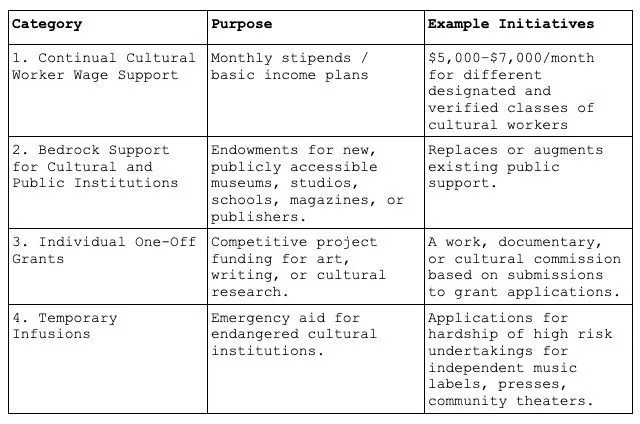
In one estimate, the top ten American producers of AI rake in $16.9 Trillion each year. The Slop Tax, if executed, would produce a windfall for America’s cultural workers to the tune of $16.9 Billion, roughly the same amount we allocated for nuclear energy research, the Food for Peace International Assistance Program, or The Harbor Maintenance Trust Fund’s support for navigation in federal channels serving coastal ports.
Think of The Slop Tax as a post-AI New Deal that steers the excess wealth of a small minority of AI companies back towards a vast mobilization of human creativity and cognitive production. This accomplishes two mutually aligned goals: the material basis and institutional homes for human cognitive output are protected, while the AI labs are guaranteed a steady input of new training data. They will be free to use it as they wish, given that the worst of the cultural degradation infected by AI slop has guardrails preventing the AI models’ cannibalization of human creativity and intellectual property.
Failed fixes
Given its social and economic risks, various attempts to slow, ban, or regulate the use of AI have been proposed. Many are punitive to AI categorically. The Slop Tax, however, is not a ban, but a corrective. This approach does not seek to pause or punish AI progress, as in certain cases these companies make worthwhile advances. But they must be held accountable for the damage that their AI Slop inflicts on the broader economy.
Some 20 years into various failed attempts to re-constitute Silicon Valley platforms for democratic ends we must face up to reality. Countering such an existential cognitive, social, and soon-to-be political threat requires a sovereign megastructure on the scale of the United States government. It alone can guarantee the existential security of our humanist and social institutions, ensuring they remain vibrant, democratic, and publicly accessible.
We hear about the so-called “abundance” that will be ushered in by AI from those with a financial interest in its wider adoption. You can take them at their word, or you can look around. In the years since LLMs have gained popular traction we have yet to see the trickle-down economics promised. Instea,d we see slop of previously unimaginable scale. No matter how transformative AI becomes, even if it is used for a wide array of positive ends, the mean use of AI will regress to whatever capital demands. There is, however, a surefire way to ensure that value is unlocked and distributed on a massive scale. The Slop Tax makes this law. As AI value grows, so moves new wealth into millions of hands — directly via remunerations and credits — and indirectly by being a fiscal backstop for a range of cultural and economic engines.
AI companies must be held accountable for sacrificing the basic tenets of a social contract for short-term gain. There is still time to forge an agreement permitting frontier AI to progress along its research journey while regulating its most odious externalities. A public apparatus to fortify our cultural infrastructure has never been more imperative.
Get every essay in your inbox
Weekly essays exploring a utopian future.
Join 23,259 subscribers

I fully support this simple yet powerful way to help those who are hurt by AI.

Skeptical going in, but I really kind of like this idea. And I'm a frequent and happy user of AI in my work and personal life. But the intellectual thievery and deluge of slop seems to demand a measured response and this modest tax might be a benefit to us all. How do we start this?

There is evidence of “trickle down” and benefits for wide range of people.
- Already AI seems to make high skill jobs more accessible to lower skilled people x.com
- Anxiety and depression symptoms improve 35% and 30%, even meta analysis broadly shows positive effects. theexistentialhope.substack.com › the optimism gap thats shaping ai
You mentioned that a fictional arts program gets cut for a tax concession for a data center. This wouldn’t happen. Tax concessions are tax discounts to attract data centers to come. Even though there’s a large tax concession, the total tax received is higher than if the data center wasn’t there. It’s not a revenue stream that was there but disappeared. Also a tax concession at the state level of usually to help big tax revenues at the city level. The way that data center funding is reported on has been really imbalanced to the point of inaccuracy by lack of context.
All that being said, a 1% tax seems great. Though might be better on something like UBI or Elle’s employee owned business structures which can help with inequality. More writers sounds great but another way to achieve that is more distributed wealth so more people can take on precarious and highly competitive careers like cultural creation. Broader recipients for this tax would also make it more equitable and politically viable.

If “slop” is a negative externality, why not tax AI users instead, like a plastic bag tax at the grocery store, rather than a general revenue tax on AI companies? I’ve also never heard of a data center reducing local tax revenues.

Putting the responsibility at the consumer level is exactly the problem with most anti-pollution fixes - the idea that we have to recycle while plastics companies are free to make the crap at profit. This places the culpability with the massively profitable purveyors of AI slop. Also, why would it be "better" to pass the costs to individual consumers? I'm confused about where this political instinct is coming from?
Well, I see taxes as methods of fixing social problems, not tools for punishing certain groups arbitrarily.
Ok. I suppose I don't think this is either 1.) a punishment and 2.) and even if it is, it's certainly not arbitrary!
In that case, the problem is that your proposal doesn't tax slop. It's just a general tax hike on big AI companies. It could even make slop marginally worse if AI companies respond by reducing R&D. And even if some do respond by raising prices, why wouldn't the actual slop producers (a subset of users) just switch to cheaper competitors?

Spread evenly accross every person who is striving and failing to generate an income as a cultural creative, the tax on AI slop would likely not have any effect on the viability of that career pursuit. For the distribution to have meaningful effects in the lives of the recipients, some selection criteria would need to applied. The question then becomes, who controls that selection process? Whose ideology is enshrined as being worthy of taxpayer support? What opinions, even secretly held or unconsciously held but ferreted out by witch hunters, would be grounds for revoking the cultural creative stipend?

Could we not say this about any social safety net policy, though?
Besides, I believe the intention of incorporating the lil vignette about grants was to cater the idea towards that sort of pooling of the financial resources. That is, people will then apply for grants and access to the support. And yes, there will need to be more nuance to that, some regulations and whatnot, but this is such a newborn issue (and short argument for the taxation system itself) that it makes sense we do not yet have all the answers.
I imagine there would have to be income limits for applicants, perhaps calculated with some of the same equations we use currently (I.e., how many dependents do you have)! And there must be attention to if it is an individual or a business. I am no economist or accountant or anything related to strictly numbers for that matter, but I imagine that in putting our noggins together, we can answer your questions and make a plan. It’s what humans do!

Good idea! I believe the arts provide the cultural infrastructure necessary to make good choices about AI. The technology appeared so quickly and is so powerful that individuals (and the culture, not to mention the economy) just weren’t ready.

A great idea, but unfortunately the politicians who could push through something like this are controlled by those billionaires, so it would be shocking if it even got to consideration.

Fully support this
Seeing some of these plans being worked up for taxation on immense wealth is…weirdly heartwarming? I suppose that says more about our society today than anything else haha. It’s reminiscent to me of Bernie & Ro Khanna’s billionaire tax plan.
Even if we’re at a point where these things cannot immediately (or possibly ever) come to fruition, at least we’re doing SOMETHING. It’s opening the eyes of more people. The wealth that billionaires and their companies accumulate is unfathomably massive and could create the infrastructure of the new world if we make it…
The mold analogy was fascinating! I had never heard that before and I will definitely be recycling that one.
A nice, short insightful article!