

You should own stock in your city
A radical idea for turning city residents into city shareholders.

Or subscribe to get every pamphlet too, from $50 a year.



 Join 23,259 subscribers
 hared Roof is a standard-looking mixed-use development in Seattle’s Phinney Ridge neighborhood: 35 residential units with some ground-floor retail and the amenities we usually see in new developments like this—a gym, bike room, and common spaces. Perfectly lovely, but seemingly standard fare.
But there is something different about Shared Roof, and that is its ownership structure.
The building was funded by ten friends who contributed the capital needed to bring the project to life. Those funders became shareholders in the legal entity that directly owns the building, entitled to dividends as the building generates revenue and to any appreciation in the value of their equity over time.
The really interesting part, though, is that several of the project’s investors are also tenants.
You might expect that to mean they just get a free unit. What actually happens is that they pay market rent, like anyone else, because their role as a shareholder is separate from their role as a tenant. As the building generates value, the corporate structure distributes it back to the people who collectively own it.
Shared Roof is one building on one street in one neighborhood, but the arrangement points toward something bigger: a different way of thinking about how we create, collect, and distribute the value that cities create.
Give me land, lots of land (value)
As a city’s economy grows, it becomes increasingly advantageous to live and do business there. More people and more money flow into the city, driving up the demand for space. As an economy grows, however, land becomes increasingly expensive.
More people making more money cluster in places of opportunity, in part because of everyone else who went there before them and made it a great place to be. This is what economists call agglomeration effects. Perhaps a more accessible way to think about it is as a house party—a party is only as good as the people who show up.
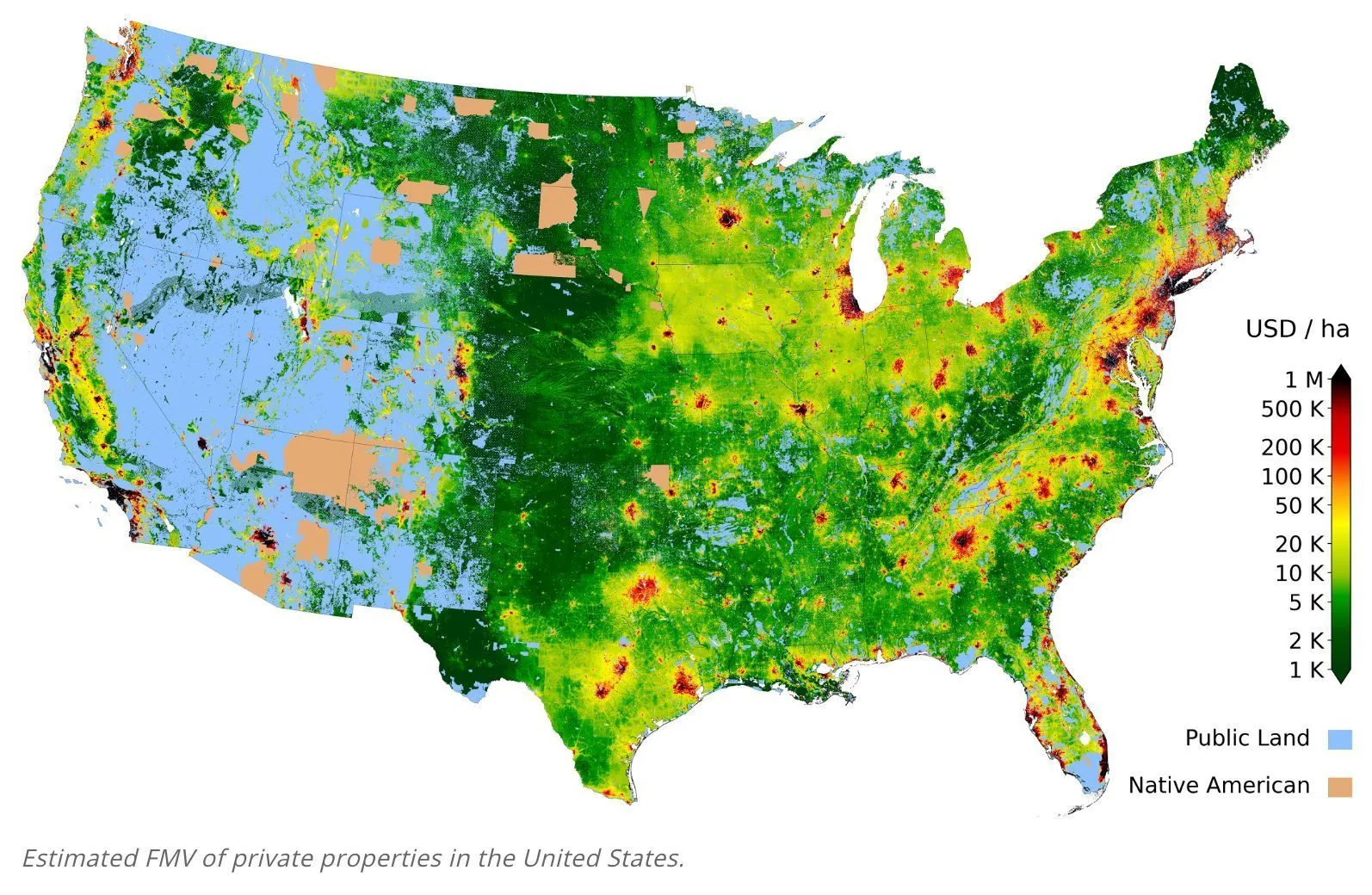
While municipal governments don’t unilaterally control this dynamic, they’re also not just along for the ride. They provide generalized services like sanitation and law enforcement, creating the broad conditions upon which urban growth depends. Local governments drive land values in more direct, localized ways as well. Transit stops increase adjacent property values everywhere from New York to Hong Kong to Paris. Other location-specific amenities like public parks or high-performing public schools have the same effect. The decisions a city government makes about where to invest, what to build, and how to govern itself shape the conditions under which agglomeration either flourishes or stagnates. And those conditions show up, reliably, in land values.
If we understand municipal wealth as really being land value, then the two most straightforward ways for a city government to monetize that value are either land value taxation or municipal land leasing—taxing land people own or leasing out land that belongs to the city. Both work on the same basic insight: when a city grows and the municipal government makes good investments, land becomes more valuable. A municipal government should fund itself from all that value it’s helping to create.
Think about what happens when a new subway station opens. The land around that stop becomes more valuable because it becomes functionally closer to everything else. A land-based revenue model looks at this and says that the value creation enabled by public infrastructure and created by the community as a whole ought to be collected and deployed in the public interest, not privatized by landholders who were simply lucky enough to buy into the dirt somewhere first.
Fully implemented, this creates a virtuous cycle. The municipality collects land value, makes public investments to increase land value, and leaves other types of economic activity relatively untouched (meaning more economic growth and…you guessed it, higher land values). The shift to land-based revenue itself also tends to increase land values — by removing the tax penalty on development and concentrating holding costs on unproductive land, LVT encourages denser use of urban space, which drives up the very base the city is drawing from. The act of switching increases the value of the very asset the municipality uses to fund itself.
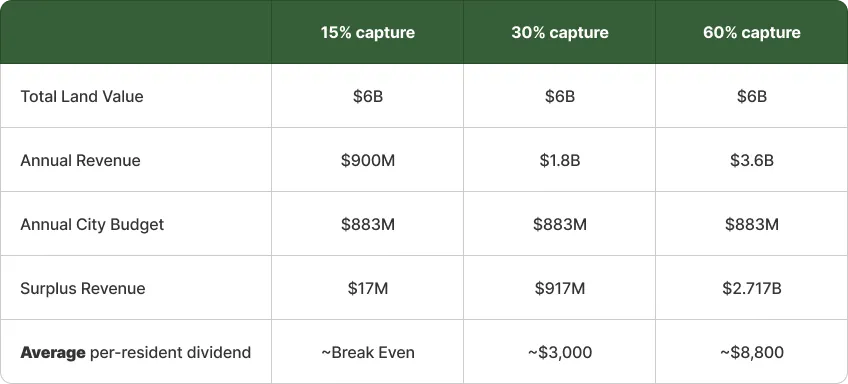
And yes, it’s plausible to imagine a city could make most of its money by monetizing land values. The City of St. Paul, Minnesota sits on over $6 billion in taxable land value.1 Its annual budget is around $883 million. If the city collected 15% of that total land value every year, it would more than cover current expenditures.2 So the business model makes sense and, if this all still seems too fanciful, it’s also just how a mall works.
Ok, back to Seattle. Shared Roof created value by building something that added value to the neighborhood and the city. This is what governments do on a municipal scale. But Shared Roof also remits that value back to tenant shareholders. Let’s talk about how a city could do the same.
Collective ownership of urban life
Imagine a city where residents own shares in a municipal corporation. The corporation generates revenue by monetizing land value (again, by either taxing privately-held land or leasing publicly owned holdings). Excess revenues, after the city’s operational needs are met, flow back to residents as dividends.3 The more shares a resident owns, the larger their stake in the proceeds of the city’s economic growth. And just like a corporate board, the management put in place by the shareholders — a mayoral administration and council members elected by the city’s residents — would be responsible for navigating the tradeoffs between bigger investments and more generous dividends every year.
The key departure from conventional shareholding is how people come to own their shares. In our Shared Roof example, ten friends put in capital and got equity accordingly. Their ownership stake was commensurate with their financial investment. That logic makes sense for a building, but applied to a city, it would simply recreate the wealth inequality we already struggle with today. After all, allocating the lion’s share of municipal wealth to whoever had the most money in the first place hardly seems like much of a change. Instead, my idea is a system in which shares accrue based on tenure. The longer a resident lives in a city, the greater their stake and the more upside they gain from ongoing growth.
Let’s suppose we structure this using a vesting schedule (i.e., a system that grants an increasing number of shares over time). A resident would receive an initial tranche of shares at the age of majority, setting them up to begin adult life.4 Shares would then incrementally accrue each year of residency with a final significant tranche at retirement. This would ensure retirees could actually retire.
For residents who move away, vesting pauses (analogous to a leave of absence at a company with equity compensation). For those who arrive later in life, their schedule is pro-rated.
Shares would carry one right only: a proportional claim on excess municipal revenue. Not voting rights, not governance power. The motivating idea is to create a system of economic ownership operating in parallel with political enfranchisement. Shares would also be non-alienable and non-bequeathable. If they could be sold or inherited, it would take only a few generations for the city’s financial upside to concentrate in a small set of hands.5
A rising tide that lifts all ships
So, what is all this actually for? A way to share in the wealth that cities create that’s not just more equitable, but also pro-growth.
A land-based revenue model reorients municipal governments toward growth. Transit infrastructure, a quality public education system, and even just a competent administrative apparatus that makes things like getting a business license easy all support economic activity and, ultimately, drive up the land values the city monetizes to fund itself.
And this isn’t just an incentive story. It’s an epistemological one. Land values function as a price signal for public investment. A road doesn’t have to be a toll road to generate revenue; if it increases the value of surrounding land, a municipal government would have a legible way to tell whether its spending was actually working.
The more consequential shift, though, is what this does to residents.
Middle-class Americans rely on home values as their primary vehicle for wealth accumulation. And home values, as we’ve established, are really land values. The problem with the way we do things today is that we distribute upside based on who happened to buy the right piece of dirt at the right time. The system is haphazard, exclusionary, and creates all the wrong incentives. A homeowner whose wealth is tied up in their property value has rational reasons to oppose the very things that drive broader urban growth: New housing might be a threat to free street parking. Infrastructure might require increased property taxes. When the change that growth requires comes with no upside for property-owning incumbents, the incumbents have every reason to fight it.
We built a system based on individualized land speculation, and it’s created a relationship to urban growth that’s short-term and myopic. What this shareholder idea is meant to tease out is how we might align people’s preferences with the entire city. When a new apartment building down the street is part of what keeps the city growing (and residents’ dividends along with it), people have a reason to welcome their new neighbors. When people aren’t anchored to a specific parcel they’re hoping will appreciate enough for them to retire off of, their attachment to place becomes an attachment to the city as a whole — instead of a parochial fixation on only a couple blocks.
Similarly, this would lead to residents understanding and supporting longer-term investments. Policymakers would have a much easier time selling residents on longer-term investments if they could credibly promise that every new public investment will benefit them. A new public school benefits residents without children. A commuter rail extension matters even to people who don’t use it. Both increase land values, and therefore dividends. The system gives everyone a way to share in the upside.6
Beyond the welfare state
It would be easy for some folks to read all of this as an elaborate way of doing a universal basic income. But the ideas here aren’t intended to motivate mere redistribution. They’re proposing a different way to think about collective wealth.
Consider the Alaska Permanent Fund. It’s a sovereign wealth fund, seeded by oil revenues and managed by the state, that pays an annual dividend to every qualifying Alaskan resident — roughly $1,000 per person in 2025. Alaskans do not understand this arrangement as welfare. They understand it as a form of collective ownership. This is the relationship I imagine residents would develop with the institution of shareholder ownership. And really, I’d imagine that relationship developing even more strongly.
Alaska’s oil sits in the ground whether any human has done something or not. A city’s land value, that reflection of demand to be in a place, exists because of everything everyone in a city has contributed. The businesses that create the job market, the employees that make the business possible—the art, music, and broader cultural life that economic activity makes possible—exist because of everyone’s collective participation. A party is only as good as the people who show up, and I’d say the same is true for cities. Shareholder ownership recognizes all of that, and ensures the people who make a city great get to share in everything they’ve collectively built.
This is a thought experiment, but it’s a hypothetical whole made out of actually existing parts. Land value capture (whether of the LVT or municipal leasing variety) exists and is only becoming more popular. Sovereign wealth funds are quite real. And, of course, shareholder forms of ownership are commonplace. So perhaps building blocks are more readily available than they might seem.
In the immediacy though, I hope this conversation helps us better appreciate the contours of the problems we face and begin thinking more radically about the types of solutions we could build to carry us into the early days of, if not a better nation, then perhaps just a better world.
- 1
Land Value Return in St. Paul, MN, Center for Land Economics.
- 2
That figure is an understatement as it doesn’t include publicly held land that could be monetized through leasing.
- 3
The most famous companies today don’t distribute profits to shareholders (or do so in minimal amounts). The prevailing theory is that it’s better for management at successful companies to reinvest profits back into making those companies even more successful (and, therefore, the equity held by investors even more valuable). So, if shareholders getting paid a portion of company profits doesn’t sound familiar, it’s because I’m reaching back to an older, simpler version of corporate shareholding.
- 4
We could haggle over different criteria for establishing residency. Most US cities base this purely on whether your declared primary residence is within their borders. For our purposes, we’re imagining a system that gives people a part of the value they create by contributing to the local economy; so, finger in the wind, a six month residency period seems reasonable (i.e. a new adult resident would receive their first tranche of shares 18 months after moving to their new city).
- 5
And remember, everyone gets their own shares. Shareholding would pull land value out of a system where land as wealth gets passed down along family lines and, instead, distribute that value to everyone in the here and now.
- 6
One caveat worth noting: as residents approach retirement, they may prefer larger dividends today over infrastructure investments that pay off over decades. This could amount to a near-term bias the system doesn’t fully solve, even if incentive problems are much improved over the world we live in today.
Get every essay in your inbox
Weekly essays exploring a utopian future.
Join 23,259 subscribers

Jeff, this is extraordinarily provocative and ingenious. Kudos to you for putting this concept together. The best observation you make is that the PARTS of this proposal already exist--and simply require "assembly." I'm an architect writing a substack about Modern Money Theory johnalt.substack.com and will now be giving thought to how the mechanisms of modern fiat money might assist and contribute to the concept you've described. Thanks for your provocation!

In other words, these are condos. It's ben done.

more like a mall where the tenants own equity in the legal entity that owns the entire property
In other words, condos.
A condo arrangement doesn’t separate the cost of housing provision from a claim on residual revenues. A condo arrangement keeps everyone locked in on home (read: land) equity. The thought experiment here is to imagine abstracting away land rents so as to reapportion them on an ongoing basis. Fractional owners in a condo are as illiquid as the owner of a single family home. So the underlying political economy retains all its negative features.
(Not that I have anything against condos in the real world, housing is housing)
I still think it's splitting hairs. There's all kinds of ownership mechanisms.
The thing I don't like about yours, if I'm understanding correctly, is that people are invested, but with no initial investment. Alaska oil is there by nature. Sharing revenue with citizens seems reasonable. But cities are there because they were built. The land by itself is worth very little until it's built out. If you don't factor that, you are ignoring reality.
And, "Excess revenues, after the city’s operational needs are met, flow back to residents as dividends." Have you noticed that city's operational needs are never met? They always 'need' more. So, forget about dividends.
And if I can't vote in this Utopia; if other people are making the plans and I don't get a say-so, count me out.

I love this idea which really incentivizes all long term development which will add the most future value to benefit all residents, regardless if they will personally use the value generating asset or not.

This is an interesting change in weights, with management elected on a per-head basis and the dividends released on a per-share basis. I think it's worth thinking out the dynamics, because it sounds like voters would be more short-term focused than the shareholders would want.
In general, I would rather be a customer than a shareholder or board voter. Organizations listen harder to their customers. So it's really my actions in buying or selling land (taxable assets) that influences the city council and administration.
Also note that while annual budgets sound doable, a lot of capital investment around a city comes from State and Federal grants and funding. At which point, those bureaucracies become the real "customers" of the city admin, not the residents (which angers them but they don't know why). I think it would be hard to institute this vision without cutting that Gordian knot first.
Hey Drea, this is something struggled with in this post. This isn’t really intended as a policy piece, though I get why folks are reading it as a concrete proposal.
What I want to assert is that municipal governments and the communities they serve create value that shows up in land prices. Further, that the best “business model” is one where the monetizes that value. And, finally, that there might be ways to deploy that value to get everyone on board with the type of development that creates even more prosperity. (Contra the current political economy)
So yes - the modern American municipality fundamentally does not work like this and the folks who serve in them don’t think about their finance in the way I’m framing it. But, for my purposes, it’s kinda beside the point.
Here, the specifics are meant to serve as an illustrative tool and preempt a few obvious what abouts. I’m not personally married to specifics.
On the question of customers in my toy scenario though, the residents are both owner and customer. Anybody who does anything in the local economy is definitionally increasing demand for space and increasing locational value. So, same same unless I’m misunderstanding your point.

It's more than a municipal corporation - it's actually a consumer cooperative!
Being a customer is certainly the better position in a competitive market. In a monopoly, I'd rather be a shareholder. A city obviously lies somewhere along the spectrum, and YMMV on what model is more appropriate. Given how high the rents can get in cities that seem badly mismanaged, I'd lean away from the competitive model. That said, I don't see how this proposal would undermine anyone's leverage as a city consumer.

Yes! And even if people, inhabitants, residents, or citizens do not own shares in their city, they could, or likely should, be offered stock in the service provider or providers that administer or operate their city. This makes all the sense in the world.
There is also little to preclude those who want to buy preferred shares in their city from doing so as a further vote of confidence and as a fundraising device. And if that results in those preferred shareholders receiving an extra dividend, which is not uncommon in that class of shares, then so be it.
Though, in an ideal sense, it may be better for common shareholders to have more of a say in the hiring and firing of management, or simply to leave that up to voters regardless of the kind of stock they hold in their city.
Let the cities of the future compete for new citizens by offering not only the best places to live, but places that even pay you to do so, and not merely through those one-off stories about a rural Italian village or a remote Greek island.

If St Paul's lamd is currently worth 6 billion with no land tax, wouldn't charging 15% of its value annually immediately make the land worth much less?
And paying 15% of an assets value in rent or land tax every year seems insane.
If a house is worth 100k, the 25yr mortgage at 5% payment would be around 7k per year, and then I'm free and clear after 25yrs. A 15% annual tax would be 15k, more than double the amortized purchase price, and it never stops.
Hey Joel, this is meant more as a thought experiment, not a proposal that we can go from where we are now straight over to the world I sketched out in the piece.
What I wanted to highlight are the ideas that a) urban wealth is fundamentally land value, b) individualized land ownership creates a bunch of bad incentives, and c) if a municipality collected all those values and used them in the public interested (plus remitted the leftovers back into folks’ pockets) we would all be more on board with the things required to build prosperity.
In that toy world, no one gets privately internalized home equity (in as far as home equity = land value). There’s no 25 year mortgage because the problem that that particular policy instrument was created to solve doesn’t exist. Now, again, there’s no direct route from here to there. If we suddenly expropriated all land values overnight we’d trigger a financial crisis since the privitised value of land is collateral backing a pyramid of financial assets.
The actual incremental step would be to do a tax shift wherein a city raises rates on land and lowers them on buildings such that it’s a wash for homeowners. This hoses surface parking lots and otherwise underutilized parcels, giving the muni an immediate increase in revenue and pushing all that land into more productive use (and also removing a disincentive against incremental construction). And, ofc, leasing out public land at a profit.
After the revenue model is right, it’s possible to imagine the other half of what I was describing which is really just a city-level UBI designed to make longer-tenured residents more interested in growth.
I understand that, and I enjoyed the article overall, but you said, "and yes it's possible for a city to make most of its revenue from land values."
Then you went on to use your St Paul's example at 15% tax rates, value of the land remaining unchanged - which does more to undermine your point than support it.
Chat tells me that there is a substantial body of evidence on tax capitalization that estimates a 15% land tax would lower the lands value by 75% or more.
St Pauls would then need to raise the rate to 60% to generate the same revenues, which will have further price depressing effects, in a vicious cycle.
So it seems like it would be impossible for St Paul's to fund itself entirely from LVT alone.
I am a fan of LVT, but the tax revenues from it literally can't exceed the annual rental value of the land, which is usually 1-2% of its current purchase value.
Let me separate out two things — and preemptively acknowledge that the St. Paul example may have been a bad rhetorical choice given what I was trying to do with the piece.
1) Is a world where a city generates most of its revenue from land rent possible?
I still think the answer is yes. Stiglitz’s Henry George theorem is the classic theoretical version of the argument. Battery Park City is a close-ish real-world example of a public entity capturing land value through ground leases. And at a more mundane level, this is also a riff on how malls — and, famously, McDonald’s — make money: control valuable locations, then monetize the location value over time.
Obviously, that then turns into a separate debate over what a city ought to be doing, how much that would cost, and what “covering most operational expenses” actually means.
2) Is it remotely conceivable that we could go from here to there?
That is a different question, and your point about land prices is important here.
Yes: if a city aggressively raised an LVT overnight, it would lower the private sale price of land as future land rents are de-capitalized. So we agree on that.
But the private market sale price of land is not the same thing as the annual rental value of the location. Under a serious LVT, sale prices fall because less of the future rent stream is available to private owners. The rent stream itself has not necessarily disappeared; more of it has been shifted into public revenue.
So I don’t think the [economic] “doom spiral” you’re describing is quite right. It would be a problem if assessments mechanically treated post-tax sale prices as the entire tax base. But conceptually, a proper land-rent assessment would be trying to estimate the gross annual value of the site, not simply taxing the de-capitalized resale price over and over again.
The real problems are [political-economy] issues
One problem is that a serious LVT would devalue land as collateral, and land currently backs a huge amount of financial assets.
A second problem is that many landowners cannot actually realize the full productive value of their land because land-use restrictions prevent more intensive development. So if you tax land as though it could support much more productive use, while still legally forbidding that use, you just get a tax revolt instead of more development.
So to bring it back to the piece: I still believe a city could run a mostly land-based revenue strategy. I do not believe we could flip a switch overnight and get the benefits I’m gesturing at. Part of the issue is the transition problem you’re calling out. Part of it is the political economy of existing land use regimes and the present degree of land-based financialization.
My reason for invoking St. Paul was to give readers who have never thought about these issues some frame of reference — a rough sense of magnitude for how much urban land is actually worth. But I agree that, if read as an immediate policy model rather than a thought experiment about a different municipal revenue structure, the example should raise the kinds of questions you're asking.

The City of Edinburgh (Edinburgh Council) is introducing this in September. Not for everything - focusing on greener initiatives I think. But interesting to see it starting.

This power hopes when everything around us makes little sense.

Fascinating idea on how to rethink home ownership, belonging, and funding government.

This idea appeals to me because it treats residents as actual participants in the value of a city, not just consumers of services or obstacles to development. So much urban wealth comes from the collective life of a place: the workers, the schools, the small businesses, the transit, the culture, the people who stay long enough to make a city feel like itself.
Right now, too much of that value gets captured by whoever bought the right patch of dirt early enough. This idea feels powerful because it asks a better question: if residents help create the city’s value, why shouldn’t they share in its growth?
I also like that the proposal rewards tenure without turning the shares into another inherited asset game. That matters. Otherwise, we just reinvent the same inequality with shinier paperwork, and please, we already have enough expensive nonsense wearing a reform costume.

The source of funds for the city is taxation on land value. How does a person pay the taxes if they don’t have the liquidity? That is, they are land-rich but cash poor.
Many people borrow against the equity in their property to be able to make personal decisions about how to run their own lives and improve their properties. Businesses do the same to be able to make decisions on how to improve their own businesses.
Once you start taxing someone’s wealth you take away their ability to make decisions that they individually believe are needed. The individual still takes the risk but now has no incentive.
Moreover, your model neglects to deal with accountability. Look at all the failures of government, the graft and corruption (CA train, CA fire suppression and utilities), USAID, US SNAP scams, Medicaid fraud, and on and on). Yes a person is sacrificed here and there but there is never any real accountability.
Collectivism is always and necessarily de minimus. On the contrary, as has been demonstrated everywhere governmental collectivism has been implemented, it does not create a rising tide. It creates a swamp. How’s New York doing with Mamdani?
Utopias fail because they don’t account for reality.
Hey Tim, thanks for the read!
For the liquidity bit, I'll say the the idea I'm thinking through here is a world without privatized real estate equity. In this world, no one is living in, say, a house on a 5,000 sqft lot in an inner ring suburb. The built environment, and how people inhabit it, would look much much different. Which is to say, the system I'm imagining would mean no one could ever be land rich and cash poor. The point is to produce the opposite, thereby enabling people to have the resources they need to take all the risks we both agree are so important for society.
Now, if you own a house and lever up to get cash and start a business, if that business fails you just lose your house. I'd prefer a world where that value doesn't stay locked up in land and, instead, is used to make everyone more liquid all the time.
Now, as for the corruption issue, two responses here. First, this is a work of semi-speculative institutional design. If you're interested in conversations of organizational efficacy or state capacity, that's a whole separate topic (which I'll be writing about later this year at Urban Proxima!). Second, there are plenty of examples of well functioning institutions. The Hong Kong Metro Railway Corporation Limited, the Battery Park City Authority in NYC, the West Falls Community Development Corporation...these are just a few I happen to be familiar with.
But let's talk about “governmental collectivism”. What I’d offer to you is we, in the United States, already live in the quickly desiccating corpse of post-war collectivism.
Coordinated government policy at all levels conspired to create the land use regime we live in today on the basis of a centrally planned mortgage market whose explicit goal was to enable homeownership at a level that undirected credit markets would have never been able to achieve. Now, we could argue about whether this was good or bad policy (obv I have critiques), but if we want to describe the world I’ve sketched our here on a napkin as collectivist, we also need to acknowledge the degree of central planning that went into the system of homeownership we have in the U.S. today.
If you're interested, I have some thoughts related to the topic here: urbanproxima.substack.com › how we build housing is how we build
I don’t think the economics would work well in your model. Let’s take your example from Seattle. On a small scale that collective ownership may work because that small group owns the property and is assuming all the risk. If/when maintenance is required or if they want to improve their own businesses property they can leverage their equity to cover the costs. Where is all this cash coming from in your model? Government redistribution? And then why improve properties. There is no incentive if property is collective. This has been proven time and again.
Collectivism comes at the cost of individual liberty.
Yes, as you mentioned, government can develop the environment to enable economic growth (and they can and many time do the opposite as well), but it is the individual who takes the risks for the rewards that build value. Take away the rewards and you take away the ability to build value and innovate and improve things. We need systems that enable (or get out of the way) personal agency.
I'm not seeing the incentive problem. A developer still builds on the land and has every incentive to monetize their physical capital to whatever extent the market will bear.
There's plenty of real world precedent for separating land ownership from ownership of the buildings/infrastructure, too. This is, again, just how Battery Park City got built (to name a single example).
Without a free market, how is value determined?
Will your model rely on experts in a central committee to set prices? Whose values determine what people should have? Why should your values dominate that person who owns the 5,000 square foot lot? And then what are you going to do to enforce your system?
We seem to be talking about different things. The most mundane example I can provide is the classic American mall, and even that is arguable more “centrally planned” than the hypothetical in the post.
Oh, also, another fun one is MacDonalds (contrary to popular belief, they’re more a real estate company than they are a burger company - corporate’s real customers are the franchise owners who are obligated to pay them rent on corporate owned real estate. People buying burgers are on the other side of the franchise owners).
Nothing about there being an overarching, final landlord precludes the price system from coordinating the distribution, development, and use of real estate.