

An American case for building new cities
We need to remember how to build things.

Or subscribe to get every pamphlet too, from $50 a year.



 Join 23,259 subscribers
 ities are platforms for prosperity. They’re what happens when people come together, foster economic opportunity, and build everything else good about human life on top. Suffice it to say, I have opinions on the matter and they’re resoundingly pro-urban.
A question was posed to me, though. Namely, should we be building new cities?
My short answer is yes.
Cities are good and we need more good things.
My longer answer is that no existing city is perfect and many of the challenges that need to be addressed through reform could be avoided entirely if we were starting over with perfect hindsight. What’s more, properly executed, building new cities could add energy to already active urban reform movements. They’re a chance to prove what’s possible to normal people and rally them to the cause of creating the better versions of the cities we have today.
The most obvious way to make the case for city-building is to simply point out that existing cities aren’t perfect and reforming them is hard.
In the US, San Francisco has been the poster child for urban dysfunction for several years now. The city famously took 27 years to build bus rapid transit. It also takes longer than any other city in California to do the paperwork to allow new housing.
How is it that the epicenter of global tech can be so bad at seemingly basic functions?
Well, in the case of the Van Ness BRT, the city suffered from poor planning and disputes with contractors. It also ran into a slew of unmapped underground infrastructure including a long-lost (but definitely still in-use) water pipe that workers accidentally ruptured, flooding a major intersection and costing the project month’s worth of time.
As for the box-checking necessary for building permits, a gauntlet of mandatory public hearings and a presumption that the answer will be “No”, until proven otherwise creates a sieve through which only a scant few projects ever emerge to become actual housing.
That said, San Francisco, unfortunately, isn’t actually that special. Cities across the US are uniformly incapable of executing on major public works projects. They all also run permitting processes similar to San Francisco’s highly “participatory” system, each born of the post-war urban consensus that growth was suspect and cities themselves might actually be bad.
All that is just political and organizational infrastructure, though. As hard as it is to rework social systems, reshaping atoms in the built environment might be even harder.
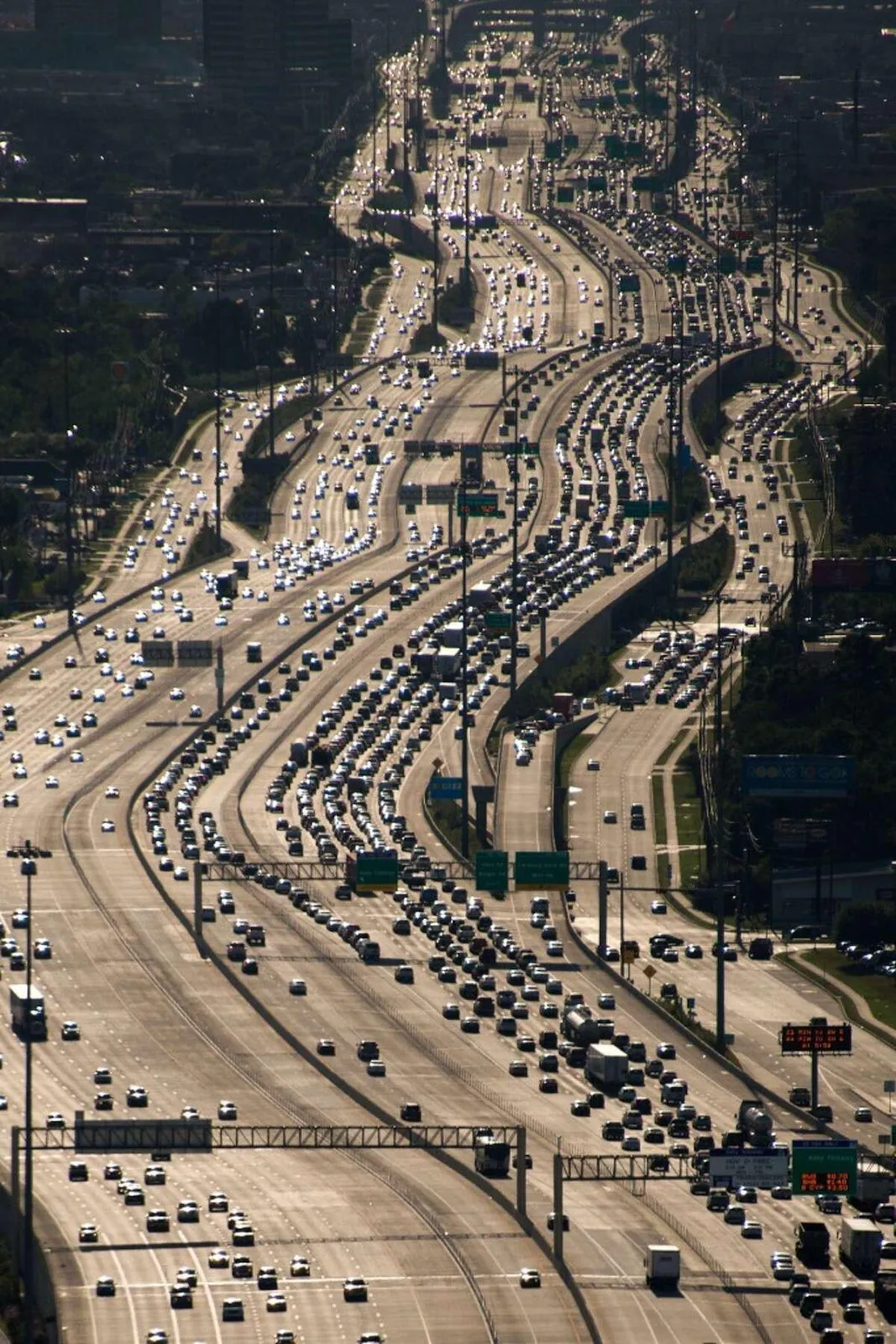
Post-war urban development in the US has been decidedly car-centric.
We reshaped the built environment to make cars make sense but, in many places, we’ve reached the point where personal automobile use no longer scales. Shifting back to higher capacity forms of transit, however, is hard. There’s no magic wand we can wave to instantly replace 27 lanes with a multi-modal transit system built around commuter rail as its backbone.
In existing cities, we struggle against the dead hand of the past. In new cities, perhaps we wouldn’t have to.
California Forever, a proposed new city project in the outer reaches of the San Francisco Bay Area, is a great example of how that could play out. From day 0, the entrepreneurs behind the project have made it clear that they want to build a place where people can walk their kids to school, safely bike to work, and actually afford the house they’ll return home to in the evening.
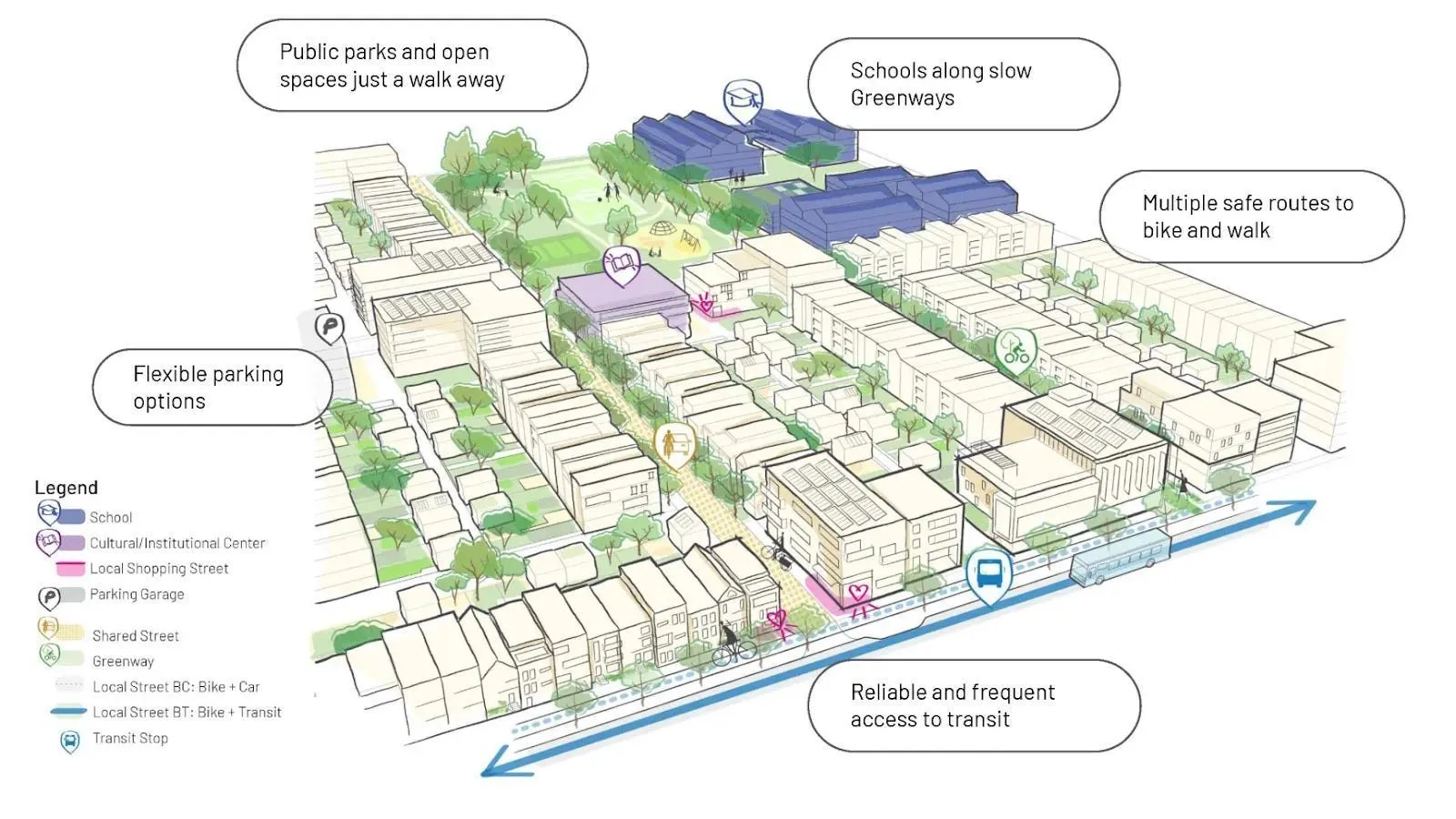
Achieving those goals will require design choices like mixed-use zoning, dedicated transit lanes, protected bike lanes, and levels of density sufficient to maintain affordability.1 While reformers in cities across the US have been working on making these changes to existing cities, a project like California Forever could bypass those challenges completely.
That’s both because there are no stroads to unmake and because there’s no ossified political system to wrestle. Starting from scratch can free us from the decisions of dead men.2
Up to now we’ve been talking about avoiding the past’s mistakes. But new cities offer another type of opportunity and that’s to get to the future faster.
Once upon a time, everyone in the professional development community was enamoured of something called M-Pesa. The mobile-based payment system allowed people in places like Kenya or Mozambique to transact digitally using nothing but their cell phones.3
What’s this have to do with anything? Well, it’s a great example of people being able to leapfrog legacy tech. In the absence of branch banking, consumer credit cards, or land line telephones, people in places all over Africa jumped straight to a mobile payment system. Deploying technology in new cities might allow us to do much the same thing.
With technology, there’s no evolutionary path society is obliged to tread or tech tree we have to climb. If we’re starting from scratch, we can skip outdated urban infrastructure and go straight to what works. For a more urbanist-relevant example, though, let’s consider the power grid.
Electrical systems in existing North American cities were built with certain assumptions which did not include the complete electrification of the economy (or even electricity as the main power source for personal automobiles). Neither did it assume the massive increase in electrical demand from modern data centers, especially since the advent of the LLM.
A new grid for a new city, however, could deploy the most up to date technology, built for what we now know modern energy demands will be. Again, starting from scratch can not only unburden us of the past, it can also help us speed run our way into the future.
For all the good that can come from building alternatives, there’s another angle here as well. Fast-forward fifty years and I suspect most Americans who live in cities will be doing so in ones that already exist today. Even under the most supportive conditions imaginable, city building is as capital intensive as it is time consuming, and that’s even if we can get the underlying economics right. There’s only so much that we can do in the span of decades.
That said, building new cities that exemplify everything we want existing cities to become could help further the project of reform. If we can demonstrate what’s possible — and how good urban life can be — we can accelerate the reform movements already underway.
There’s a certain subset of human beings that will read a white paper or blog post series and come out the other side with strong convictions about things like nuclear energy, high-speed rail, or ranked-choice voting.
In this regard, we are not normal.4
Most people decide they like something on the basis of personal experience.
Want to turn an American on to urbanism as a lifestyle (or just get them excited about commuter rail)? Send them to Barcelona or Tokyo for a week. Or have them be born a New Yorker. Lived experience is the strongest basis for individual opinion.
The best way to demonstrate to people what we could and should demand from existing cities is to create the version of the world we want to see. Building these examples in the US would be significant as well.
Even the most pro-urban American vacationers often return from abroad convinced that what works in Spain or Japan could never work here. It's as if people believe there’s some ineffable element of Spanish or Japanese society that makes them preternaturally good at trains (there is not).
But the sense that we’ve somehow lost the ability to do new things is a real and pervasive sentiment in our culture. In some ways, I think that was a self inflicted wound.
For over half a century, we’ve told ourselves that the places we live have to be built a certain way. Car-centric sprawl with nothing but single-family homes as far as the eye can see has physically separated us from both each other and everywhere else we might want to be.
Further, we’ve convinced ourselves that once laid out, nothing should ever change. Ever. So of course we believe we’re incapable of doing anything new or building anything better; we’ve literally bound ourselves in rules designed to prevent exactly that for over three generations.
If we want to change the minds of Americans across the country, we need to build the change we want to see. And in so doing, provide Americans a positive vision of what they can demand in and from the places they choose to call their home.
So, once again, I say yes — let’s build some new cities.
If we can create better urbanism for more people sooner, I’m all for it. The easiest freeway to tear down is the one you never built. Much the same goes for tech—sometimes, starting fresh is better than upgrading.
On a deeper level, though, we stand to reclaim something that we seem to have lost. We need to believe that we can still build something new, that we can still get something right. My hope would be that building new cities might not only provide immediate material benefits, but cultural ones as well. And, in so doing, put us back on a path to not just creating new, but also improving old.
This essay is by Jeff Fong, author of Urban Proxima. It is part of CITY STATE, a collection of seven writers exploring autonomous governance through an online series and print pamphlet.
- 1
Land costs are a major driver of overall housing costs. When a city allows for denser development (i.e. for housing to exist on smaller plots of land relative to the structure), it contributes toward maintaining affordability.
- 2
And women (though, in fairness, they were mostly men).
- 3
That’s not to say M-Pesa is a perfect system. Criticisms have been levelled against Vodafone, the phone carrier who provides the service, for exercising monopoly power and levying high transaction fees.
- 4
Does this count as a fourth wall break? Pseudo fourth wall break?
Get every essay in your inbox
Weekly essays exploring a utopian future.
Join 23,259 subscribers

I like the idea of new cities. I lived in Reston, VA for many years, which is something between a planned community and a small city. (As you probably know, it's not incorporated in Virginia as a county, city, or town.) I loved Reston's vibe and the (for its time) mixed uses.
I wonder about two things. First, I'm big on Jane Jacobs and James C. Scott, both of whom have a distrust for utopian cities. Scott has it out particularly for cities built from scratch, such as Brasíila, where mixed use doesn't happen. I probably need to get my urban planning up to date; I know it has swung in Jacobs's direction in recent decades.
My second hesitation has to do with aesthetics. Here I turn to my suburban experience in a neo-traditional neighborhood. The look was better (in my opinion) than the standard suburban single-family neighborhoods surrounding ours. But there was an artificiality to our neighborhood. It sort of said, "We wish we were an old New England town, but we'll do the best we can under the budget constraints and the state's and county's strictures," such as road widths and zoning, which prevented narrow roads and foot traffic.
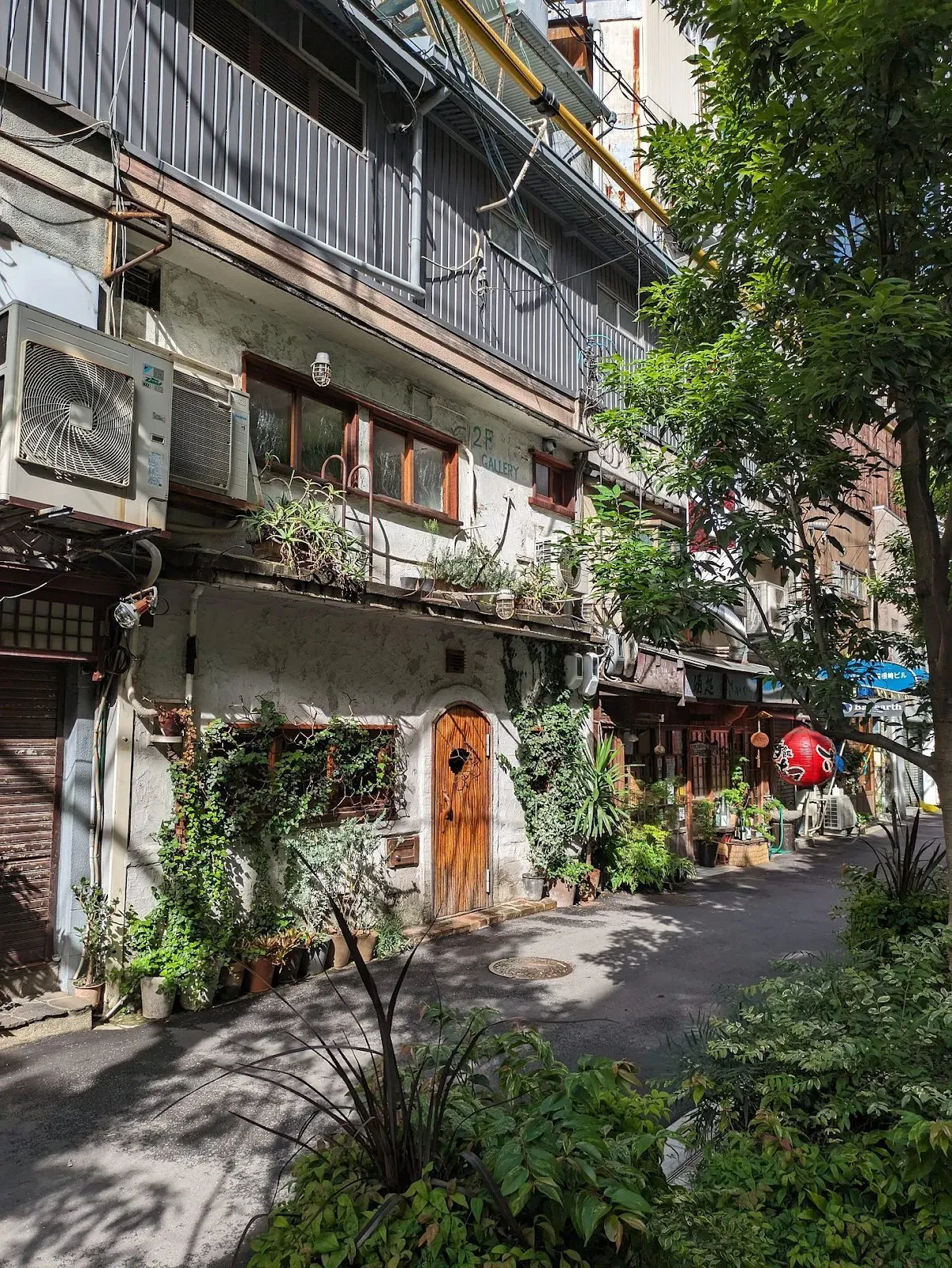
I love that photograph of “Ghibli-Hobbit” architecture, but how can you build something to look as if it were built by accretion over decades, as “Ghibli-Hobbit” architecture does? Trying to look like something from the past didn't entirely work in our suburban neighborhood.
Of course, you're talking about entire cities and not just neighborhoods. I love the mixed uses, walkability, and transit systems that your diagram suggests.
Thanks for your cool and stimulating thought experiment here.

Hey Bryce, you're hitting on an important question (that's frankly not well developed in my post). Specifically, "what things are planned at what scale?"
In the abstract, we can think about examples like major infrastructure as falling into a class of things where transaction costs of coordinating piecemeal are prohibitively high, so we should have a single provider. Things like individual buildings, though, we can - and ought to - leave much, much more up to individual trial and error. Preserving those degrees of freedom in architecture and use (i.e. you can choose to use your garage as a garage or as a neighborhood coffee shop) is how we open up the possibility of that accretive development.
And here's the punchline (that, again, is probably not clear at all from this essay) - in my view, city building should not be an attempt to erect some Potemkin village that we hope real people will eventually fill in. Instead, it should be an exercise in building a platform (in terms of physical infrastructure and governmental institutions) that enables people to arrive and co-create the place they'll all share over time. Of course, there are varying degrees of planned development (I'm actually didn't know about Reston, but I'm read up on The Woodlands if you're familiar), but the idea is platform, not product.
If you have the inclination, I lay that idea out more fully here: urbanproxima.com › urbanism as a service
Jeff, thanks. "Platform, not product" and trial and error to stimulate "accretive development." I love it.

I believe that our major cities would be in different locations if they were built and populated based off of access to energy and resources instead of economic opportunity. Originally, economic opportunity was a function of ample resources, but rapid advances in technology have disassociated the two and made some cities outgrow their regional capacity. All that to say, I think as we truly account for circular, sustainable economies in our urban centers, we will approach a network of interconnected villages (which Elle wrote about recently), or Ebenezer Howard's "Garden Cities," which I touched on in my City State article. I'm all for urban growth and new cities as long as they are ecocentric. I think the new model would be starting from scratch with novel power sources, closer to living biocities than the power grid model.
On a different note, Tomas Pueyo proposed ten new US cities. The first one is a provocative thought exercise that I really enjoyed. I haven't read the rest but your article reminded me to revisit his series. I thought you might enjoy diving into it as well.
Here's the link to the first one: substack.com › p 154874624
Hey Stephen, I'm not convinced we can ever decouple cities from economic opportunity. Our point of divergence, though, might be that I don't see economic opportunity as necessarily related to material resources.
Boom towns built around extractive industries rarely take-off; they seemingly fall into a localized version of the resource trap. More often we've seen cities emerge in places or around infrastructure that facilitates commerce and, consequently, a diversified economic base.
I get into it a bit in this section of a diff post, but full disclosure I'm echoing Alain Bertaud, full stop. urbanproxima.com › where do cities come from
I agree that cities and economic opportunity are inextricably linked, but I wonder how we can get out of large-scale environmental crisis driven by consumer demand. I think at the minimum, cities have to be self-sufficient in their water and energy supply. As it stands, many US cities get their water and energy from far-off places. We're doing fine right now, but I don't see this ending well in the long run. On top of that, a 2025 report found that 54 of the 75 largest cities are running off a deficit. I think we need to update the model, which is why I found your article inspiring. I'll check out your link, looking forward to reading more from you.

I think that any new city that will be built, should be harmonious with nature. The buildings shouldn't be glass and steel, nor should they be heat sinks. They should have plenty of green spaces, and be designed for walking, cycling, or skating, as a means of getting around.
They should be designed to capture and reclaim water, and should be designed to accomodate gray water when watering grass and plants. Also no new city should house more than 300 thousand. The cities should be able to be fed using local farmers and ranchers.
But that's just me talking.

As an old guy, I wonder what happens to the old cities...This feels like it could be just another version of white flight that could lead to old city blight...
Hey Jonathan, I appreciate the read and the comment.
I hope it came through that I don't see the prospect of building new cities as an alternative to continuing to improve the ones we've already got. To the comment you I think you're more likely making, though, there are definitely different versions of "building new cities", some which I could imagine being dystopian (building large scale gated communities does not prosperity make).
That, however, is such a complex topic I ended up writing an entire series on it. If you're interested in my take on the good version — what I mean when I speak positively about building new cities here — check out this post: urbanproxima.com › urbanism as a service
I have a daughter and DIL in Oakland, CA along with two grandchildren. I am forwarding your link to them for their thoughts.
I hope to have more time to study the model personally in the future. I just need to stay in my lane of expertise which is more in community development rather than city development.

Jeff! It's been too long! Well done, sir. I hope you're well.
Max - what's up dude!

New cities, yes, but California Forever— wealthy developers who are disconnected from local needs and using their fortunes to “buy” local support—is not a great example of how to do it: hcn.org › the california forever debate moves…
Hey Paul, do you take issue with the proposal itself or the way the company has gone about things to date?
I would say a bit of both. The proposal as I understand it contains a lot of unenforceable promises to do things to assuage local concerns, but is still very much focused on the needs of wealthy developers, the tech industry and high-income professionals rather than affordable housing or appropriate density.
Again, I don’t know a great deal about the project and all the pro/con. Obviously, building a whole city from scratch would HAVE to include large developers with the knowhow and capital to actually do it. But I think the community itself needs to have a large voice if such an effort isn’t to end up as just gentrification writ very large.
To my understanding, the plan is to develop agricultural land into housing (along with all the necessary infrastructure that goes with it). Further, that the team has a specific vision for a development that bakes in mixed-use zoning and multi-modal transit to a degree that we haven't seen since prior to WWII.
In as far as this is an accurate description of what's proposed (and what the team would actually do), this all sounds great to me. So, is your presumption that future windfalls from development ought to be preemptively taxed through a community benefits package?
No.
I think where we may part company is the idea that there’s more to a community than zoning and taxation.

Yes we need to build new cities but it's not a matter of remembering how to build things, it's more a matter of thinking differently of how to build. New cities can't just be bedroom communities, there has to be areas of commercial and industrial development to keep jobs close to home. In the 60's I managed properties in inner city Detroit where there was a white flight to the suburbs. The flight was not necessarily racial, but because the outdated factories were moving out of the downtown arena and many people wanted to be closer to work. Tech type institutions like we have in Silicon Valley can't be a sole source. There are still manufacturing plants needed. Over time many will become obsolete and there will be a repeat of Detroit. We can't assume all people will want to live on top of one another either. But build, we should on the best sustainable platform and this old man wishes you and people like Elli will keep pursuing it.
Hey Robert, 100% on the same page with respect to /not/ just throwing up bedroom communities. Looking at the history, I see the entire paradigm of separating (most) uses as a nearly century old sin in North American planning in need of redress.