
Digital nomads could create network states
Here's how.

Or subscribe to get every pamphlet too, from $50 a year.



 Join 23,259 subscribers
 think digital nomads are the closest thing we have to a network state, Balaji ‘s concept of a future world of decentralized nation-states.
In the age of the internet, where influencers bring together millions of people, the idea of forming a digital society and then turning it into a real state becomes plausible:
They have a real sense of belonging to a global community.
They are united with other digital nomads in an international way that isn't always true of other professions, like say, fellow plumbers, in a bond that transcend borders and languages
They speak English, made almost compulsory by their extensive travels.
They show solidarity among themselves, being expatriates in foreign countries, and subject to the same problems.
They have identified hubs of their own: Lisbon, Tallinn, Cyprus, Dubai, Cancún, Bali, Chiang Mai...
They have numerous online communities in which they forge links, converse, exchange good tips, and share places to visit, ways of conducting their business or their job remotely, etc.
They regularly organize formal and informal events for their fellow digital nomads.
They even possess many of the characteristics of a nation—all they need to become a network state is to recognize that they are part of a group that has the potential to have a political identity. Once they have this consciousness, they can create a state to represent and protect them.
Here's a realistic first step that could get us there: Create an online union of digital nomads.
Imagine a community of digital nomads with around 50,000 members. This is not a difficult number to reach with today's tools and social networks. Although it's not compulsory, a membership fee could be paid in cryptocurrency, which could then be converted into tokens (issued on Ethereum, for example), enabling participation in the online life of the community and voting on important decisions. This participation would ensure that individuals are committed to the community: Someone who pays a membership fee is more committed than someone who just pressed a "subscribe" button for free.
The membership fee/tokens will encourage nomads to participate in the decisions of the community. They will also prove we have committed members: "As you can see at this Ethereum smart contract address, we currently have 27,892 active members who have paid their membership fees."
Once this community has gathered online, we could start with simple actions, such as negotiating favorable conditions for health insurance tailored to digital nomads, discounts at Airbnb or certain hotel chains, partnerships with brands, etc. But that's not where it gets interesting...
Imagine we want to obtain favorable terms with potential host countries for our community. We could carry out a survey to identify countries with which members would like to negotiate advantageous conditions for setting up shop. The process begins by surveying members to find out their average income and willingness to relocate. Then, these members could make a commitment, perhaps by transferring a certain sum in cryptos to a dedicated account, as proof of their seriousness.
The process could work as follows:
Conduct a poll, or organize a vote, to determine which countries to negotiate with first.
Similarly, conduct a survey or vote to determine the ideal conditions desired by members. To help organizers negotiate, they could indicate, for example:
Their preferred corporate income tax rate.
The maximum rate they would be willing to pay.
Get members to sign up (eventually with crypto stakes in a smart contract), so they can transparently prove to the authorities that a certain number of community members are willing to move in. This could work as follows:
If at least one of the countries for which the member has voted offers compatible conditions, the amount at stake remains blocked until the person has moved to that country. After a certain number of days following the signature of the agreement, e.g. 180, if the person has not moved, the amount is paid to the community, which may then transfer some or all of it to the host country.
If none of the countries agree to the the conditions indicated, he gets his stake back.
This mechanism proves that the members who voted are involved and not just tourists.
Armed with this information, community leaders can then enter into negotiations with several governments. For example, in discussions with the governments of Portugal, Indonesia, Caribbean countries, etc., they could propose a deal: "We have 5,000 people earning an average of $120,000 a year, ready to come and live in your country. What conditions can you offer us?"
Five thousand people may not sound like a lot, but with $120,000 a year, the true average of what digital nomads were earning in 2023, they are in the top 1% of highest earners in most Western countries. If a country taxes the incomes of these 5,000 people at 10%, that's an additional $60 million in revenue every year. If it taxes them at 20%, that's an additional $120 million in revenue every year. Plus indirect taxes, such as VAT on purchases, and taxes paid by individuals and companies selling goods and services, which will probably double tax revenues.
That's just for 5,000 people. Double these figures for 10,000 people, multiply by 10 for 50,000. A country could earn over $1 billion in additional tax revenue by attracting just 50,000 digital nomads, taxed at 10%, which is an excellent deal for both parties.
Are you beginning to see just how attractive it is for countries to attract digital nomads to their soil? And how this could be a major leverage for an online syndicate?
By adding a touch of competition between countries, mentioning parallel discussions with other governments, this union could negotiate better tax conditions, simplified visas, and other benefits for its members.
This concept is not yet a fully-fledged State, but it represents an important step in that direction. It's a more accessible solution, enabling us to start building bargaining power with governments and securing favorable conditions for community members. Later on, we could even establish a special economic zone reserved for members of the community or by facilitating the use of special economic zones for members by making access conditions more flexible for those who are foreign to the country and have Internet businesses. This forms a solid basis, a proto-network-state, which could eventually evolve into something bigger and more structured.
This strategy puts free market principles into practice in a governance context, while harnessing the advantages of digital technology and modern mobility. It also offers a concrete way of testing and refining governance models before moving on to a larger, more ambitious scale.
Possible types of benefits we could negotiate, from the easiest to the most important:
Purchase land and real estate to create a special economic zone with tax benefits.
A special status for members of the community, with, for example, visa facilities and specific tax breaks, possibly linked to the special economic zone.
The possibility of creating a Free City with a certain degree of political autonomy, but which respects the constitution of the host country and its penal code, like Próspera in Honduras.
Eventually, diplomatic recognition of the community as a network state, with, for example:
Acceptance of passports (to be created) at border crossings
Negotiating a bilateral tax treaty
Recognition of a degree of political autonomy on certain lands purchased by the network state in the host country, such as Próspera, or the Knights of the Order of Malta in Italy.
Note that any existing Free City would make a partner with whom it should be relatively easy to forge agreements. All of the above should be relatively easy to negotiate with Próspera, for example.
We can therefore relatively easily create an online syndicate of several tens of thousands of digital nomads, gradually offering the following services:
An easily accessible online community to help each other and share tips.
Regular virtual and physical events.
Joint trips to destinations of interest.
Health, travel, comprehensive and other insurances at negotiated rates.
Reduced prices on services such as Airbnb, global e-SIM cards, hotel chains, brands favored by community members, etc.
A legal and tax service specialized in digital nomads available to members (either included in their membership fee, or available at a reduced price for members).
Such a service would be of particular interest to members as most lawyers are single-country and therefore lack the experience to meet the specific needs of digital nomads.
Partnerships with fintechs specializing in digital nomads.
Access to apartments or buildings in popular community hubs, purchased through community crowdfunding.
This crowdfunding could give access to tokens on a blockchain that would entitle the holder to X number of days of occupation per year, depending on the amount invested, for example.
Partnerships with health clinics and practitioners (physical and mental) in nomad hubs, giving members easy access to care wherever they are.
Temporary nomad villages, in locations emerging as popular destinations for nomads, with a local partnership for high-quality Internet, affordable housing, workspaces and shared services.
An application that provides easy access to these services and makes life easier for members, with additional services such as rating the best cafés available in a city for working on the computer.
Such a union would already be extremely useful, offering numerous services that will make their equivalents offered by traditional states obsolete. It could then gradually become a minimal network state by adding other services:
Easier access to special economic zones (SEZs) in host countries, as seen above.
An "e-residence", like Estonia or Próspera, giving access to its digital infrastructure.
An ability to intervene on behalf of the community if members see their social media accounts banned, or bank accounts closed, to negotiate with the players in place to reopen the account. This could be particularly useful, as the relationship between digital nomads, digital giants and banks is a David vs. Goliath situation. And banks are particularly poorly placed to understand the needs of digital nomads, and their lack of physical address for some, for example.
Access to one or more Free Cities and other politically autonomous SEZs.
The creation or co-creation of a SeaSteading city, possibly off the coast of a favorable host country.
The development of an internal economy, with, for example, a marketplace facilitating business between members, and the encouragement to use one of the cryptocurrencies favored by the community.
The creation of an internal online tribunal to resolve disputes between members or with third parties within a framework of trust. This tribunal could be based on participatory justice principles, where members vote for arbitrators and establish common rules.
The creation of a mutual insurance company with which members can contribute to a common fund to support those going through difficult times (accidents, illness, financial losses). This fund could be governed by community votes to ensure that aid is distributed fairly and transparently.
Make agreements with various countries to allow digital nomads to benefit from flexible temporary residency statuses, facilitating changes of residency according to their projects, which could be combined with advantageous tax offers and temporary housing programs to facilitate itinerant life.
Consular services, including passport creation and renewal, once the union has begun to obtain diplomatic recognition from other countries.
Eventually, guaranteed access to a free, uncensored Internet wherever a member is on the planet, thanks to a partnership with a company owning a fleet of satellites, or even a fleet of satellites belonging to the network-state, possibly in collaboration with other network-states, Free Cities and floating cities.
The union will be able to recruit experts in the creation of e-residency programs or special economic zones (yes, these do exist) to support its transformation into a network state. Once the union obtains diplomatic recognition from at least one traditional state, it can call itself a network state, and start issuing passports to its members.
It may sound like science fiction, but then again, it's been around for a long time: the Order of the Knights of Malta is a proto-network-state that has existed since the Middle Ages, and has diplomatic recognition and its own passport!
Note that everything can be done gradually, allowing us to build our communities slowly and gain experience as we go. At some point, it could be possible to create a real social contract, as in Próspera, for members, which will extensively cover all the rights of members and the services offered by the network state.
There's no need to impose this on all members—it will be possible to propose different levels of membership, for example:
Free access: gives you access to free online community games and discovery events.
Basic membership, e.g. €100 per year: gives access to deals negotiated with certain partners, to other events, to reserved parts of the community
Premium membership, e.g. €2,000 per year: full access to the online community, travel insurance included, VIP events, etc.
Citizen of the network state: a percentage of income, or a higher membership fee, in return for access to passports, consular assistance, SEZs in countries with which the network state has negotiated agreements, etc. This would give the right to tokens enabling participation in governance mechanisms. This would entitle members to tokens for participation in governance mechanisms.
Yes, it will be possible to have à la carte citizenship—the concept of monolithic, all-or-nothing citizenship will seem irretrievably obsolete. The concept of citizenship could be more fluid than today, not necessarily being permanent, but more like a club membership. It could be understood that you couldbe a citizen of several network states and free cities, and your mobility will be taken for granted and built into the system from the outset. It's understood that you can move to the competition if it offers better value for money.
Eventually, we could envision a network-state for digital nomads, with hundreds of thousands, even millions of digital citizens. It would be possible to educate these citizens to implement the seven flags, to varying degrees depending on the desired involvement, to protect them from their initial nation-state.
Imagine how difficult it would be for a nation-state to take on millions of people practicing the seven flags, and protected by a network-state giving them access to all the services listed in this chapter.
The network state could thus protect its citizen-customers from untimely taxation by training them, but also by negotiating specific tax conditions, and ultimately tax treaties, with certain states. This could increase the network state's bargaining power to negotiate favorable terms with certain states.
In terms of military defense, a network state with a patchwork of terrains all over the world, some fully subject to the laws of the host countries, others semi-autonomous, would have many advantages:
Land fully subject to the laws of the host countries will be defended by the host countries.
The same applies to semi-autonomous areas, but the network state could play a more active role in defense.
Above all, losing a territory will not be as important as for a nation-state. The notion of territory for a network state will be fluid, even if some territories will be more valuable than others. Losing a network state's only Free City, for example, would certainly be a major blow. To better protect itself, the network-state can form alliances with Free Cities, other network-states, and certain states, starting with those of similar size—as is the case with Singapore and Israel, both small countries surrounded by potentially hostile countries, and which this common characteristic has brought together to the point where they now have a special relationship and collaborate on the development of many military technologies.
It's also conceivable that some Network States might choose to have no territory at all, and provide their services to all members wherever they may be in the world.
Digital nomads already possess the foundations needed to materialize a network state: a strong collective identity, physical hubs, a decentralized economy and proven digital tools. Their transition from community to proto-nation to sovereign entity is based on a three-stage strategy:
Community structuring: Create a digital syndicate with governance via blockchain tokens, cryptographically encrypted membership fees and shared services (insurance, tax benefits, legal support).
Geopolitical negotiation: Use the economic leverage of their high incomes to obtain special economic zones, privileged tax status and partnerships with existing free cities like Próspera.
Gradual sovereignty: Deploy parallel state services (e-residency, arbitration tribunals, passports) and gain diplomatic recognition by accumulating bilateral agreements and alliances with micro-states.
This process, though ambitious, is based on historical (Order of Malta) and modern (cryptonations) models, adapted to the digital age. The fluidity of their territorial belonging and their global dispersion become assets: a nomadic network-state can implode the traditional link between citizenship and territory, while locally negotiating enclaves of sovereignty.
The real catalyst lies in collective political awareness. By transforming their mobility into a geo-economic lever, and their communities into competitive service platforms in the face of nation-states, digital nomads could embody the vanguard of a new form of governance - decentralized, opt-in, and aligned with the realities of the 21st century.
To explore how nation-states are being disrupted by the Internet and new technologies, and how you can play your part in this new world, feel free to follow me on my Substack Disruptive Horizons, where I publish excerpts from my forthcoming book on the subject.
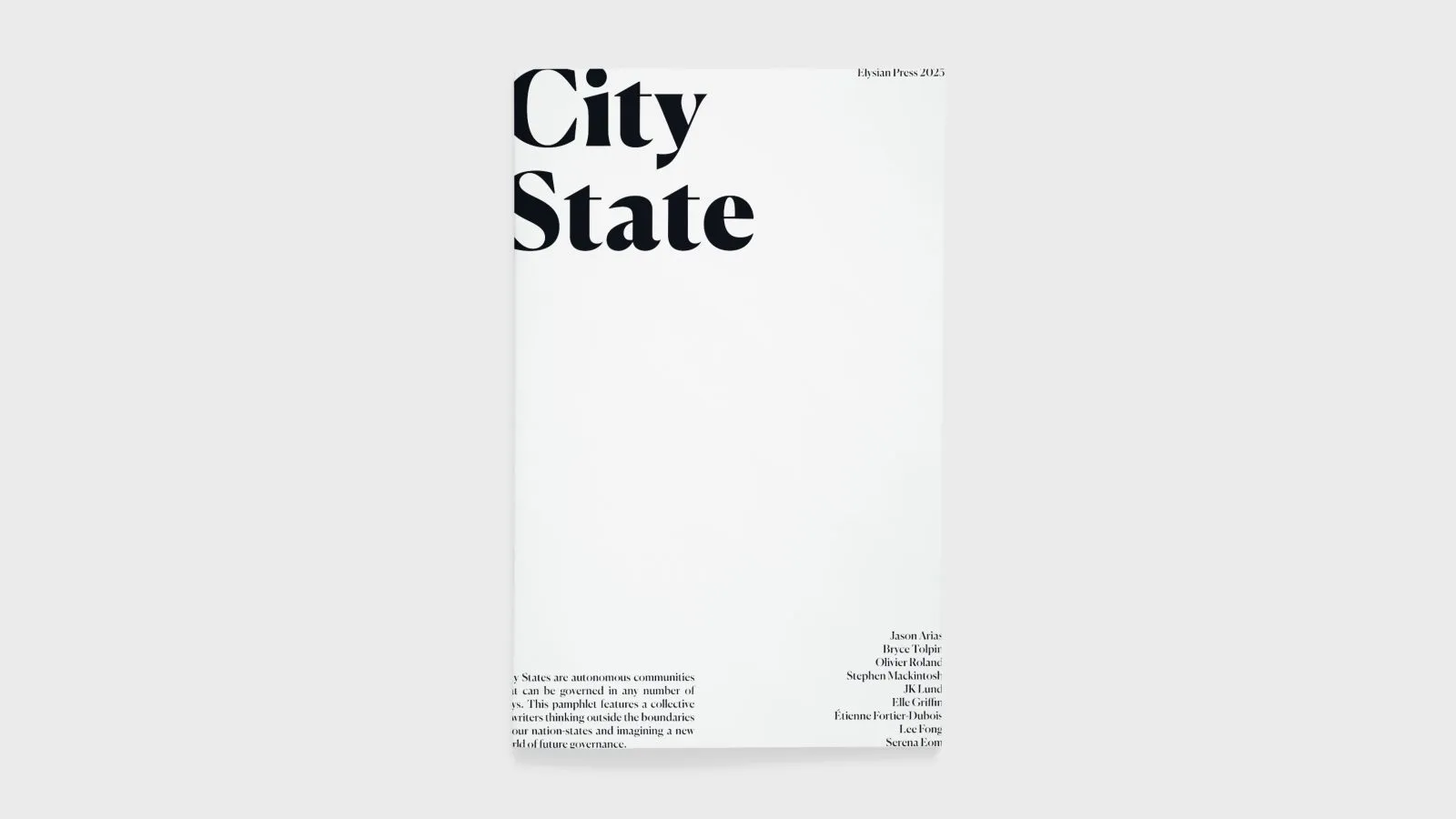
This essay is by Olivier Roland, author of Disruptive Horizons. It is part of CITY STATE, a collection of seven writers exploring autonomous governance through an online series and print pamphlet.
Get every essay in your inbox
Weekly essays exploring a utopian future.
Join 23,259 subscribers

This article a great thought experiment that, to me, implicitly calls into question the imagined communities (see Benedict Anderson's famous book by that title) we call nation-states. What's more real, a nation-state or a community formed by digital nomads? My daughter helped to start an online community that led to a small, physical community of a few friends. What would it be like to scale that?

Hey Bryce, I've thoroughly studied Benedict Anderson's book and cited it numerous times in my own work.
If you're interested in seeing a series of articles where I explore the main factors currently disrupting both the nation and the state, here is the first one of the series : disruptive-horizons.com › digital nomadism disrupting nation states
You may be interested in this one too : disruptive-horizons.com › how the internet is eroding nationalism
Feel free to share your thoughts with me—it would be very interesting.

Nice idea, but blood and country are powerful forces, and just because you think you can simply buy military and judicial protection from client states, there's nothing you can do if they decide to throw you out or take possession of your property and freedom.
Here's the excerpt from the article that addresses this: :
"Above all, losing a territory will not be as important as for a nation-state. The notion of territory for a network state will be fluid, even if some territories will be more valuable than others. Losing a network state's only Free City, for example, would certainly be a major blow. To better protect itself, the network-state can form alliances with Free Cities, other network-states, and certain states, starting with those of similar size—as is the case with Singapore and Israel, both small countries surrounded by potentially hostile countries, and which this common characteristic has brought together to the point where they now have a special relationship and collaborate on the development of many military technologies."
I'm not sure if you're reacting to it or not ?

As someone who's spent a long time thinking about political institutions and remains deeply skeptical of BS and his what, why, and how for the Network State...this post made me soften my perspectives on a few things.
I appreciate that you start out with a description that amounts to organizing people to take collective action to secure better terms from corporations (and possibly even governments). That's a different presentation of the idea than the typical "failure mode for western civilization" rhetoric that often gets deployed. Actually, if you read Yoni Applebaum's book, Stuck, he makes reference to a whole ecosystem of community groups (Rotary, trade unions, etc) which used to be in every major metro in the U.S. and that people relied on as they'd relocate to wherever happened to be booming economically at the time.
Again, I think the thing you're doing here that's interesting is articulating specific use cases (health insurance, affordable lodging, right of entry) that are real and tangible in a way that's often missing in these conversations.

Since I recently read Patchwork and the Network State and have spent time thinking about it, I see several challenges. I will list some of the major ones here, and I assume you have answers to them or will address them as part of your book.
While the idea of digital nomads forming network states is innovative and exciting, it is also fraught with challenges. Below are the most likely points of failure that could derail this ambitious project:
Building a Cohesive Community Among a Diverse Group Will Be Extremely Challenging: Digital nomads come from various countries, cultures, and value systems, making it challenging to create a unified community with shared identity, political goals, and governance. Conflicting values may arise, as what appeals to one group of digital nomads could alienate others, leading to fragmentation. Additionally, some members may join solely for benefits like tax breaks or discounts and may not actively participate in governance, leaving decision-making to a small, unrepresentative group. Without a strong, shared culture or history, fostering a sense of belonging and loyalty to the network state could also be challenging.
Host Country Instability Could Undermine Agreements with Digital Nomads: Negotiating favorable terms with host countries is only the first step, but maintaining those agreements over time could be difficult. Leadership changes in host countries could lead to new regimes that revoke agreements, demand higher taxes, or even seize the network state’s assets for personal or political gain. Host country citizens might also view digital nomads as outsiders receiving unfair privileges, which could result in political pressure to revoke special deals or expel the community. Furthermore, political decisions are not always rational. Even if revoking agreements would harm the host country's economy, leaders may act out of populism, self-interest, or misinformation.
Digital Nomads May Struggle to Achieve Equal Rights and Legal Protections: As non-citizens, digital nomads may struggle to secure the same rights and protections as locals in host countries. Despite contributing significant tax revenue, they could be treated as outsiders with limited legal recourse, creating a "second-class" status. Additionally, they may face discrimination or inadequate protection under the law compared to local citizens, especially in countries with weaker legal systems. If locals resent the network state’s presence, law enforcement or political leaders may side with the majority, leaving digital nomads vulnerable to harassment or expulsion.
Nation-States Losing Revenue Could Retaliate Against the Network State: The network state’s ability to offer tax advantages to its members could provoke retaliation from their home countries. Countries losing revenue might introduce new laws or policies to discourage remote work abroad or incentivize citizens to return. Digital nomads may face accusations of tax evasion or be forced to pay additional taxes in their home countries, reducing the appeal of joining the network state. Home countries might also pressure host nations to revoke privileges granted to the network state, further undermining its stability.
Financial Instability Could Derail the Network State's Operations: Its reliance on cryptocurrency and membership fees makes its financial foundation inherently volatile. Cryptocurrencies are subject to extreme price fluctuations, hacking, and regulatory crackdowns, which could make them an unstable choice for transactions and governance. Additionally, if the network state depends heavily on high-income members for its revenue, it could collapse financially if those members leave, stop paying fees, or lose interest. Failure to deliver promised perks, such as tax breaks, insurance, or access to special economic zones, could also erode trust in the project and lead to mass defections.
Achieving Sovereignty and Diplomatic Recognition Will Be Incredibly Difficult: Even within special economic zones (SEZs), achieving sovereignty is an unprecedented and politically sensitive goal with significant challenges. Gaining diplomatic recognition as a sovereign entity may be nearly impossible, as most governments are unlikely to legitimize a new form of governance. Also, host countries could revoke SEZ access or impose new restrictions, leaving the network state without a physical foothold. Without independent territory, the network state would rely on host countries for governance, law enforcement, and infrastructure, severely limiting its autonomy.
Public Perception Could Turn Against the Network State: The network state risks being perceived as elitist, exclusionary, or exploitative, harming its reputation and long-term viability. Special deals for digital nomads might alienate local populations, fostering resentment and protests against the community. The project could also face criticism as a dystopian or elitist venture, especially if it appears to prioritize wealthy expatriates over the needs of local citizens. By negotiating low taxes and other benefits, the network state could be accused of exploiting poorer host countries, further deepening global inequality.
Overambition and Unrealistic Expectations Could Lead to Failure: Transitioning from an online community to a fully-fledged network state is highly complex and unprecedented, and overambition could lead to failure. The network state could lose credibility and momentum if it fails to achieve its ambitious goals. Managing a rapidly growing, globally dispersed community could overwhelm the state’s infrastructure and leadership, leading to operational failures. Furthermore, the network state's founders and leaders may face overwhelming challenges, such as managing internal conflicts and navigating external negotiations, which could result in burnout and mismanagement.
The most probable points of failure in creating a digital nomad network state are community fragmentation, host country instability, and financial volatility. Without strong cohesion, stable agreements with host governments, and a sustainable economic model, the network state could struggle to gain traction or maintain long-term viability. Additionally, external pressures from nation-states, public backlash, and technological vulnerabilities could further complicate its path to success.
Wow, thank you for your extremely detailed and interesting comment. I couldn't respond earlier because it requires a lengthy reply. I'll start responding now and finish another day.
Here's my answer point by point:
First of all, I completely agree that creating network states will indeed be a real challenge—it's clear, just as making the United States into what it is today was an enormous undertaking. However, comparing these two tasks, I believe creating a network state will be less difficult, perhaps even significantly easier, than the challenge that was building the United States.
- Building a Cohesive Community Among a Diverse Group Will Be Extremely Challenging:
The first concept to grasp is that the very notion of a nation and the feeling of belonging to one is among the many things disrupted in the age of the internet and globalization. I've written an extensive article on this topic, which you can see here : disruptive-horizons.com › how the internet is eroding nationalism.
Today, we can observe that many people feel closer to members of their online community than to their own neighbors. Moreover, a United Nations study indicates that the more frequently someone uses the internet, the less they feel a sense of national belonging, and the more they consider themselves global citizens. You can view the reference in article linked above.
Given these factors, it's not a significant leap to extrapolate current trends and realize that the idea of primarily belonging to a nation—historically strongly linked to a territory, although also tied to a common culture—is becoming less important.
From this point, it isn't difficult to imagine the emergence of network states.
- Host Country Instability Could Undermine Agreements with Digital Nomads
The foundational concept behind network states begins with a patchwork of territories distributed globally, patches as small as an apartment or a building.
If a country starts mistreating residents of the Network State with which it has signed an agreement, those residents will simply move to another country.
The fierce competition between countries—which is already happening—will ensure that a good quality of service will be provided overall by countries entering into agreements with Network States, even if there may be some stupid decisions here and there, like in Venezuela.
- Digital Nomads May Struggle to Achieve Equal Rights and Legal Protections
This is not a big problem, because a major idea behind Network States, and other alternative forms of governance such as Free Cities, is to create an environment in which many forms of governance can be tested to discover what is the best next stage in human society.
Here's an excerpt from my book about this :
"The idea is to eventually have :
- dozens or hundreds of free cities and network states around the world
- Each of which would allow a different social and economic model to be tested, without the need for a revolution, and without having to subject those who disagree to the “tyranny of the majority” (or minority),
o because they would all be populated on a voluntary basis.
o Would you like to set up a Marxism 2.0? A libertarian city/network-state? A deeply pious city/NS that follows the teachings of your religion's holy book to the letter? A city/NS, on the contrary, that rejects all religion and focuses on a spiritual life based on science? Do yourself a favor, put it together, test your ideas against the reality on the ground, and see if you can make your project into a viable city.
- This creates a friendly competition in which dozens or hundreds of different social and economic models can be rapidly tested in the field, encouraging a Darwinian selection process that will naturally lead to the emergence, at a speed unprecedented in human history, of successful models from which other societies can draw inspiration.
This proposal is already extremely innovative: it puts an end to revolutions, and to out-of-breath systems that are well past their sell-by date. Instead, we're creating an ecosystem that encourages everyone to set up a concrete experiment to validate that their ideal societal model works, or to join the free city that proposes the model closest to their ideal."
So if a state or network state does not offer good value for money in terms of services, its residents will simply leave and join a better provider of governance services.
To be continued...
Thank you. I will wait for your Part 2.

Made this to force myself to understand it - still have reservations about Balaji’s version but imo I think we should knick the concept and make it for everyone. We may need to have one that works sooner rather than later youtu.be › BEIHwGBBbok

You lost me at crypto.

Me too, but I think it could be done without it, and many digital nomad visa programs could step in to handle that part. Plumia, for example, or Selina hotels.
Hello, crypto could help but is completely optional in this scenario.
Not sure it’s optional as the “nation state monetary system” is irreparably broken. Besides, btc (and other crypto projects perhaps) give the individuals and the collective monetary sovereignty.

crypto becoming as legit as tradfi before our eyes
if you don't use that you make that new nation-state an easy target to sanction and block financial operations and assets of or get completely dependent on another nation's infrastructure
look past headlines
I agree, but as long as it is a online union there is no need for crypto, although it would help pave the way for the next steps

One of the problems that I *believe* we face is that to have political power, in any given region, is the number of people who join us. While 50,000 people wouldn't be so hard to attain, they would have to be VOTING CITIZENS of that particular country/jurisdiction. History has shown that while large numbers are valuable, if they can't vote to elect a particular politician into office and keep that politician in office/power, then what use are these people to that politician? Politicians, historically, trade their ability to represent a given demographic with that demographic's ability to keep them in office; otherwise, that population has no use to that politician.
I’m a citizen of Liberland, a similar concept. I love all things related to individual sovereignty, empowerment and freedom from government tyranny.
Let me know if I can help in any way!
Interesting. Did you use your Liberland citizenship in any way that you felt is useful? I’m under the impression that it is mostly symbolic
Not yet. Speaking to the ppl there about helping with a first energy project. I will say the political leadership team is quite committed - tireless even - and I believe something will come out of it.

The general solution you propose has been, in one form or another, implemented many times. As far back as we have historical records we have records of groups which:
* are outside the entrenched power structure
* have shared interests
* discover their interests can better be protected by pooling resources
* evolve a control structure which allows leverage of the the pooled resources
Their stories are many and varied, as are their levels of success. Some went on to become the entrenched power. Some were quickly crushed and disbanded. Many, maybe most, found some success early only to be be eroded from the inside.
I've been following DAOs for a long time. Like you and the ideas you reference, I see that the technologies of blockchain and ubiquitous internet give us an opportunity to create influential structures untethered to geography and difficult to control by the self-delineating autonomy of nation states (where the real power still resides). The potential is awesome, but the visionaries see only why they will succeed and never why they will fail.
You mentioned, almost in passing, that there would "dedicated account" and "community leaders". Yes these are necessary. You mentioned transparency and governance, again required elements. But this is where all the visionaries have stopped, and never, I mean n-e-v-e-r, actually solved the real problem.
There is an assumption among all crypto/DAO proponents that all you need is democratization and transparency and the governance will sort itself out. This is like a religious belief in that it is, in their minds, the final answer, and that no amount of actual evidence from the real world will sway their belief.
As soon as you create common resources, influence, and roles with authority, you create an irresistible conflict of interest which will either corrupt the role holder(s) or attract ruthless people to assume those roles. Once there is enough power and influence in the roles, the roles themselves will resist any further bounding. This means that if you don't solve the conflict of interest problem prior to anyone assuming a leadership role, you've sown the seeds of the groups demise.
I think your ideas are fantastic, and I don't see them limited to digital nomads, though your reasons why digital nomads are a great candidate are valid. What I don't see is a solution to the age-old problem of how we pool resources and influence without putting someone into a position which where their personal interest is not aligned with the groups interest.
Very interesting take. I need to think more about this, but is it a problem if this structure doesn't solve this particular problem ? There are many other problems it can solve.
Sure but it's self limiting. Less power means easy to fend off corruption using standard governance techniques, but less the organization can do for its members.
Conversely, more power means more benefit to the members but only if the members' interests remains the focus of the representatives.
I'm a member of TrustedHouseSitters, through which I get a great deal of value but in a very narrow domain, and one in which there is little to no value in trying to influence the governance. The organization itself is messy for profit company and almost worthless, other than maintaining the website. But that relationship is sustainable - as long as the website works I'll keep paying my annual fee, as long as maintaining the website costs less than the aggregate annual fees TrustedHouseSitters will keep doing it.
If TrustedHouseSitters ever tries to be anything else, like negotiating favorable rates for something, or changing some country's visa policies, they will change and complicate their value proposition, necessarily expending resources on the new direction and putting the original stable relationship at great risk.
If we pick a specific problem and see a way to reach the sufferers with a solution, we could create a stable organization. But that's probably best done by existing companies or entrepreneurs. To create a community with clout, and I'm with you that it can and should be done, we have to start with the governance first, then solve the other problems after that.
P.S. I think healthcare is the killer app of a distributed community. It's need is universal as is the availability of healthcare resources. It could get a community off the ground by itself, but (I've been in healthcare for 30 years) healthcare is complicated. If only we had some new technology which models complex terrain and can produce agents for answering questions and solving problems :-).
In fact, this problem will be solved by an important feature of the new world that is emerging: mobility.
It will be taken into account from the outset in the design of network states, so that it will be considered obvious from the start that citizens of network states will leave if the quality/price ratio of the services provided is poor.
This is what will align the incentives of leaders with those of citizens—network states will function as private governance service providers.
They will have to be managed like companies that provide services to their customers. If the leaders of a network state start to look after their own interests and reduce the quality/price ratio, other network states will fight to attract their customers and offer them a better service.
This new social contract is already in place in Dubai, Singapore, and Prospera, and is working very well.

Simplistic nonsense. Digital nomads have almost no financial clout, are generally asset poor and represent a skewed demographic. Whilst a workspace hub club might seem attractive and have some merit, it all comes down to visas and tax and even very poor countries are much more interested in retirees than nomads. Who is going to put the person who steals your macbook in jail or provide your social security when you can't work through illness? Insurers aren't really interested in that sort of thing for such a tiny market. The Balinese, Thais and Mexicans want your rent and your business, but when the cash flow stops, they want you gone. I've been a nomad of sorts for around 15 years, and whilst it can be a great lifestyle, it doesn't confer super powers on what is a small, largely irrelevant, niche economic group.
Digital nomads are estimated to be between 35 to 40 million in the world today, and their average annual salary is $120,000. They are in the top 1%.
Oliver, Let's say that you are right and Digital Nomads are estimated to be 40 million. The problem here is that the world has 8.2 billion people. That would make us 0.005 % of the world's population. That is not a large voting bloc.
Let's also assume that you are right about having an income of $120,000.00 (USD) each. That would make our combined income roughly 4.8 trillion dollars.
Now, if all of that spending power was located in one place, say.... Malaysia, we MIGHT stand a chance of having some impact, but as a group, we are spread throughout the world, so that dilutes our purchasing power & our ability to impact political power to get representation.
Also, keep this in mind, generally speaking, we are not citizens of the countries we reside. Therefore, we have no voting power. For a politician to want to represent us, we would have to have the ability to keep such a politician in office through our vote. And, again, as a group, we currently can't do that.

Network state it's not Balajis concept. He is promoting it, but he just hijacked the term
Who created it ?

This is an incredibly insightful and well thought out vision! But I can't help but wonder if the global elite would ever allow this to happen. Seems to me it doesn't serve their purposes of keeping us isolated, distracted and sick. It would need to serve their purposes or there would need to be a major disruption to the balance of power.
Indeed. As I shared in "10 Principles of History for predicting the future" disruptive-horizons.com › 10 principles of history for predicting :
"9th principle to be learned from history (and which also applies to the example of the Catholic Church shared above): when an established power is disrupted, it does not surrender without a fight, even if the outcome of the battle is set by external conditions over which it has no power."
For the possibility that the global elite would try to prevent this, see the 4th principle : "States that win temporarily by succeeding in banning or stifling a technology lose in the long term because they do not benefit from the fruits of that technology, to the extent that centuries later, the consequences of the accumulated backwardness are still visible."
Awesome, thanks for sharing. I've saved this to read shortly. I look forward to it!

I'm struggling to understand the logic behind this idea. I'm assuming that a 'network state' aims to provide the benefits of a nation-state (land, healthcare, services), without the traditional land borders and national identity that comes with traditional nation-states. However, I also don't see how network states could be much more than just networks of people with a shared profession. For example, digital nomads only really share the identity/values of global nomadism, which presumably means having little attachment to 'place', or a physical community, and a shared (high income) profession. I don't think that digital communication, a shared sense of 'belonging to nowhere', and buying into a network (paid membership), provides a stable enough foundation for community-building in the same way as physical communities rooted in a sense of 'place' (with shared hardships and obligations).
Also, I really believe that in countries where these 'network states' would be established, local people will be alienated and angered. I don't think that local communities would be partial to rich Westerners paying governments and piggybacking onto local services, buying up land and housing (and driving up prices) and establishing 'special economic zones with tax benefits'. Digital nomads have no real stake in the surrounding communities, and the ability to pack up and leave if things get tough. Honestly, the whole idea starts to look a bit like entitlement and 'tech bro' utopian fantasies.
Hey Faye, thank you for your comprehensive comment and thoughts.
The first concept to grasp is that the very notion of a nation and the feeling of belonging to one is among the many things disrupted in the age of the internet and globalization. I've written an extensive article on this topic, which you can see here : disruptive-horizons.com › how the internet is eroding nationalism.
Today, we can observe that many people feel closer to members of their online community than to their own neighbors. Moreover, a United Nations study indicates that the more frequently someone uses the internet, the less they feel a sense of national belonging, and the more they consider themselves global citizens. You can view the reference in article linked above.
Given these factors, it's not a significant leap to extrapolate current trends and realize that the idea of primarily belonging to a nation—historically strongly linked to a territory, although also tied to a common culture—is becoming less important.
From this point, it isn't difficult to imagine the emergence of network states.
The foundational concept behind network states begins with a patchwork of territories distributed globally, patches as small as an apartment or a building. Such small-scale beginnings are unlikely to provoke locals.
Even if they do, it will simply encourage this emerging global community of millions to migrate to more welcoming locations, possibly poorer countries that may better embrace digital nomads and their network states, due to the significant economic prosperity these communities will bring with them.

4. I think my main doubt comes from the inherent competition that may arise between traditional states and network states: in other words, if we would build a network state (not that I would be eligible by any means), why duplicate existing structures instead of envisioning the next stage in human society?
A major idea behind Network States, and other alternative forms of governance such as Free Cities, is to create an environment in which many forms of governance can be tested to discover what is the best next stage in human society.
Here's an excerpt from my book about this :
"The idea is to eventually have :
- dozens or hundreds of free cities and network states around the world
- Each of which would allow a different social and economic model to be tested, without the need for a revolution, and without having to subject those who disagree to the “tyranny of the majority” (or minority),
o because they would all be populated on a voluntary basis.
o Would you like to set up a Marxism 2.0? A libertarian city/network-state? A deeply pious city/NS that follows the teachings of your religion's holy book to the letter? A city/NS, on the contrary, that rejects all religion and focuses on a spiritual life based on science? Do yourself a favor, put it together, test your ideas against the reality on the ground, and see if you can make your project into a viable city.
- This creates a friendly competition in which dozens or hundreds of different social and economic models can be rapidly tested in the field, encouraging a Darwinian selection process that will naturally lead to the emergence, at a speed unprecedented in human history, of successful models from which other societies can draw inspiration.
This proposal is already extremely innovative: it puts an end to revolutions, and to out-of-breath systems that are well past their sell-by date. Instead, we're creating an ecosystem that encourages everyone to set up a concrete experiment to validate that their ideal societal model works, or to join the free city that proposes the model closest to their ideal."
3. You are moving from nomad statehood to a digital community and now to an online syndicate. I like the testing of various ideas, even if they somewhat contradict one another.
2. The idea of negotiating with countries to settle down sound like the modern age version of the Hun or Mongol invasions. Instead of knocking down the doors, one asks nicely 🙂
Some thoughts while reading the article: 1. Should it be called a "state" if it is founded by nomads? I feel a contradiction in terms between the passive nature of a state and the dynamic character of life as a nomad 🙂
A nation-state is just a nation that has given itself a state. If you can envision a nation being nomadic, you can envision it having a state.

Sorry. Way over my head. Have no idea what you're talking about, sounds confusing and very complicated, but am sure enough people of same ilk can make something of it somewhere over the rainbow. Maybe something on Mars and the moon?
I completely understand! This article is an extract from my book, and this passage comes after 573 pages that lay the groundwork.
I've done my best, with Elle's help, to change the beginning of the article to better introduce the subject, but the fact remains that its thoughts are built on a foundation of several hundred pages and it can be difficult to understand it without having read them first.
I think this is essentially what Praxis is trying to do! I occasionally see them in the news that they're talking to various governments but haven't heard much about concrete plans since their launch.
Praxis is just one of the many Network States projects in progress, you can see an overview of the others at thenetworkstate.com › dashboard