
 he New York Times caused a stir recently when, in an article about pandemic book sales, it disclosed that “98 percent of the books that publishers released in 2020 sold fewer than 5,000 copies.”
Though this statistic was shocking to many, it is not new information. People don’t read books—and the ones that do aren’t buying them. To make matters worse, “books that publishers released” are only the “success stories”—those books that scored hard-won Big-Four publishing contracts—and those are already a small piece of the book publishing market.
According to Bookstat, which looks at the book publishing market as a whole, there were 2.6 million books sold online in 2020 and only 268 of them sold more than 100,000 copies—that’s only 0.01 percent of books. By far, the more likely thing is to sell between 0 and 1,000 copies—and that was 96 percent of books last year.
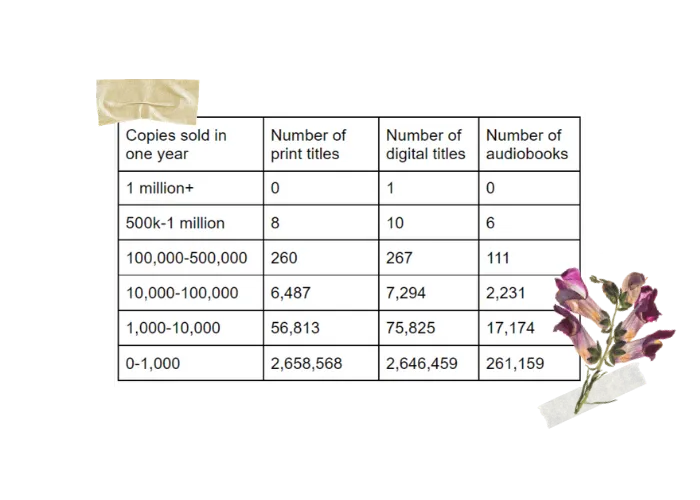
(Even on the high end, there were only 11 books that sold more than 500,000 copies—which is paltry when you consider that the 10 best-performing Netflix films last year saw more than 68 million views—in their first month. If even our best-selling books hit only a fraction of the audiences of best-performing films, books as a medium just don’t have an audience—or rather, they have a very niche audience.)
As an author, this is distressing. If I can spend two to three years writing a novel and my best-case scenario is having it sell a couple hundred copies on Amazon, perhaps it’s time to face the music and realize that writing books—like knitting or playing the harp—is nothing more than a hobby. Something I can do for fun on the weekends but should never hope to earn a living from.
And yet, I can’t help but wonder if somewhere in the middle lies a sweet spot: books that sell between 1,000 and 100,000 copies—that are loved by a small but devoted few. That might not sell enough to make it in the big world of publishing contracts and screenplay options, but could sell enough to be profitable—if only creator economy technologies are used.
Subscribe for free to keep reading.
Get every essay in your inbox
Weekly essays exploring a utopian future.



 Join 22,002 subscribers