

Every company should be owned by its employees
Central States Manufacturing as a model for exiting to employee-ownership.

Or subscribe to get every pamphlet too, from $50 a year.



 Join 23,259 subscribers
 here are 47 millionaires working for Central States Manufacturing and they’re not all in the C-Suite. Many of them are drivers or machinists—blue-collar workers for the company.
How? The company is owned by its employees. Every worker gets a salary but also a percentage of their salary in stock ownership. When the company does well so do the employees—all of them, not just the ones at the top.
And the company is doing well. “When we sat down eight years ago, we said we want to be a billion-dollar company and have 1,500 people, we are on track to be both of those this year,” Tim Ruger, president of Central States, tells me.
That’s right, this manufacturing company will become one of only 6,000 companies earning more than $1 billion in revenue. But unlike Walmart, Amazon, and Apple, it’s not just the executives getting paid out.
“It’s not like 80 percent of the company is owned by management and the rest is owned by employees, it’s really well spread across all functions,” Ruger tells me. “We've got a number of people that have been here 15, 20 years and they have $1 million plus balances, which is really cool for a person that came out of high school and runs our rollformer. You can’t do that everywhere.”
He’s right, and because you can’t do that everywhere there is a huge wealth disparity in America. Even though the economy has been on an upward trajectory for a century, the wealth it generates has funneled to a much smaller population who owns it. After a 1990s bill meant executives started getting paid in stock options while the rest of their employees earned a static salary executive pay skyrocketed with the market while their workers’ pay stagnated.
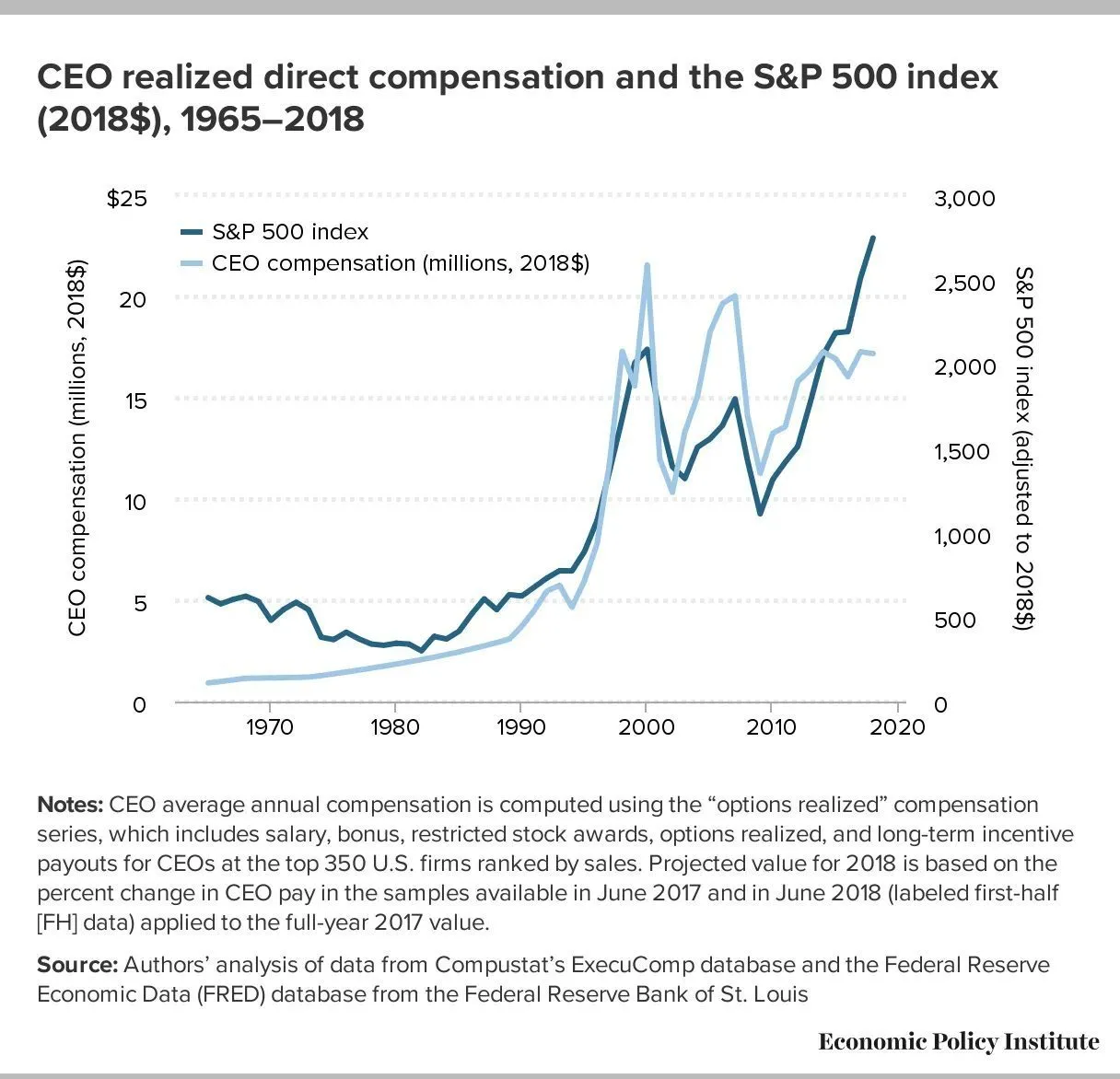
If employees had also owned part of the company their pay would have skyrocketed with the market too, but they didn’t. “It's hard to build true wealth for yourself if you don't have some type of ownership in something, and it's hard for most people to get ownership in something,” Ruger says.
Upping the minimum wage won’t fix that. As Nathan Schneider says in his book Everything for Everyone: “One way or another, wealth is going to the owners—of where we live, where we work, and what we consume.”
So why not make workers the owners?
There is a growing movement to do just that. Central States is one of 6,533 companies that have formed an Employee Stock Ownership Plan (or ESOP) in the United States, and that number is growing by about 250 companies annually. That’s 14.7 million employees who have ownership in companies worth, collectively, $2.1 trillion.
Every year, those employees get a percentage of their salaries in company stock. During Central States’ worst year, employees earned the equivalent of 6 percent of their pay in stock, during their best they earned 26 percent. Last year, an employee earning $100,000 a year received $26,000 worth of stock in their account. As the company has grown the value of that stock has averaged 20 percent returns annually, outperforming the stock market.
These stock accounts are in addition to traditional retirement accounts, not instead of them. Noelle Montaño, executive director for ESCA, tells me 90 percent of employees with an ESOP account also have a 401k or other retirement account, which means employees earn upside without any downside. Employees without an ESOP don’t have that kind of advantage—50 percent don’t have a retirement account at all.
Just like Jeff Bezos can sell a portion of his Amazon stock to buy a new house, employees at ESOPs can pull money out of those stock accounts to pay for tuition, medical bills, or as a downpayment on a primary residence.
“We have several in production and drivers who have been here for over 20 years that have multi-million dollar accounts,” Chad Ware, Central States’ CFO tells me. “We’ve had several folks take out enough money to buy a home outright.”
An ESOP account functions a lot like a second 401k, but invested solely in the company. Employees can pull out whenever they’d like, but outside of those approved uses they will have to pay taxes and an early withdrawal fee to remove the funds before the age of 59 ½. After they leave the company or retire, the complete balance of their accounts will be paid out to them over a six-year period.
This means the company needs to have that cash on hand to pay out, and this has to be budgeted into their annual cash flow. But it also means the employees are incentivized to participate in the wellbeing of the company.
On the stock market, executives are expected to produce quarterly results, often to the detriment of their companies’ long-term success. After Boeing famously rushed the rollout of its 737 MAX aircraft to meet quarterly expectations, fatal crashes and safety concerns killed 346 people and cost the company $20 billion. Companies like Wells Fargo, Sears, and Bausch Health have similarly cut corners to inflate short-term results at the expense of their long-term health.
But an employee at Central States doesn’t care about one good quarter, they care about a good 10 years, and a good 50. If the company’s products turn out to be inferior next year their stock in the company will tank, if the company goes bankrupt in 20 years it will go down to zero. It’s in their best interest to act in the long-term interest of the company, and to grow it sustainably rather than quickly.
“One of our CEOs likes to say that these companies are not looking to hit home runs, they're looking to hit singles and doubles on a regular basis,” Montaño tells me. “When the C-Suite goes into work every day, they see the receptionist, the person on the factory floor, the guy who's building the building or digging the ditches, and they know that those are the shareholders they are responsible for. They take that seriously.”
Every month, Central States executives share the company’s P&L with employees, and every year they share the financials of the business at annual shareholders meetings, where employee-owners can participate in discussions about the future of the company. After a new plant was struggling with sales in its second year, one employee-owner raised his hand at a shareholder meeting and said, “This isn’t helping our company, and it’s not helping my share price, can we discuss the closure of this plant?”
“It was a great conversation, I love the fact that it’s not somebody else's problem,” Ruger says. “They're thinking like business owners which is what you want, right?”
It’s worth noting: Employee-owned companies are not cooperatives. “We are employee-owned, not employee-run,” Ruger clarifies. Business decisions are still made by executive leadership even as employees are incentivized to help the company become more successful.
As a result, ESOPs are generally healthier companies. “These companies do better at employee retention, they do better at retirement benefits, they default less often on loans,” Montaño says. “Our companies did better during the Great Recession, they did better during Covid.”
There are serious benefits to the company for operating this way. ESOPs are a viable alternative to unions—there is no rift between the owners and the workers, workers are the owners! They are also exempt from paying income tax—though they tend to spend those dollars on their employees instead.
“It helped us grow when we were smaller. Now that we're larger, what we're paying out each year to our employee-owners is probably more than we would pay in tax, quite honestly,” Ruger says. “But if I have to choose who we pay our money to, I'd rather pay employee owners than give it back to the government. I think it's probably the right way.”
He brings up a good point. I’ve mentioned before that I do not think the answer to our wealth disparity is to “tax the rich.” Don’t take Jeff Bezos’ money and give it to the government, better distribute Amazon’s earnings among its employees—not just to its founder.
“I think our taxes are way too burdening and we don’t do a good job using the money. I wouldn’t mind paying more if we were using it well, I just don’t know if we are,” Ruger says. “Why redistribute the wealth after it’s already been earned, why can’t we earn it beforehand? It naturally levels out the haves and have-nots.”
It’s worth noting that the “haves” still benefit from this equation.
“Most ESOP companies start because the founder wants to exit or cash out, but they don't want to sell to a private equity firm that will run their company into the ground or slash and burn employee headcount,” Ware says. “A lot of owners built a company and were in the trenches with the people beside them. They want to take care of them, but they also want to cash out. A good option is to set up an ESOP, and that's exactly how Central States got started.”
Carl Carpenter founded Central States in 1988, but sold it to his employees when he retired in 1991. More specifically: He sold a portion of the shares of his company to an ESOP trust, which holds the company's shares on behalf of the employees. In 2011, the company bought the remaining shares and became 100% employee-owned. Carpenter sailed into the sunset with a nice retirement package even as he allowed his employees to start building their own, and I don’t see why every founder shouldn’t do the same.
“There are real benefits for an owner turning the company into an ESOP,” Ruger says. “They personally benefit from the sale when they exit the business. Additionally, there are some real tax benefits to turn it into an ESOP—they pay a whole lot less taxes when they sell the company.”
The only reason they don’t do it more often is because they don’t know about it. “The number one issue is education,” Montaño says. “If you're looking to sell your business and you go to your accountant or lawyer, they may not say ‘Have you thought about an ESOP?’”
It’s also not a quick process—founders interested in selling to their employees need to plan ahead. A feasibility study needs to be conducted to ensure the viability of an ESOP plan and an independent valuation of the company needs to be conducted to determine the fair market value of the shares. A trust needs to be defined and structured, and a trustee appointed to oversee it on behalf of the employees. “If an owner just wants to get out, an ESOP is not for them,” Montaño says.
That might be changing, ESOPs have bi-partisan support in Congress and moves have been made to improve education about ESOPS and make the transition easier for founders. “We have support from Members of Congress across the political spectrum.... It's capitalism at its best,” Montaño says. “A year and a half ago, there was legislation mandating the Department of Labor to open an Office of Employee Ownership, and they've taken a more robust interest in ESOP companies and recently appointed someone from the employee ownership community to this important role.”
In 2022, only 34 percent of families in the bottom half of income distribution held stocks, while 78 percent of families in the upper-middle-income group did—95 percent of families in the top one percent held stocks. But employee ownership changes that equation. As the process becomes easier and education about ESOPs grows, more and more founders will exit by selling their companies to their employees, and the result is that more and more of the wealth will be owned by everyone who works, not just the person they work for.
As the stock market gets richer, so will we all, and that’s a future I’m excited about working toward.
“I'd love to see it more and more and more,” Ruger says. “It's really generating wealth for people, I’m convinced we're going to change generations.”
This is a continuation of my capitalism series which is figuring out how capitalism can work better for everyone while serving as research for my utopian novel. I hope you’ll join us in the comments for further discussion!
Thanks for reading,
P.S. If you enjoyed this post, please share it or recommend my work to your subscribers! That’s how I meet new people and earn a living as a writer. Thank you so much for your support.
Get every essay in your inbox
Weekly essays exploring a utopian future.
Join 23,259 subscribers

Fascinating! Cool to worker ownership gain popularity in a variety of ways

Great topic. Having just spent 2 weeks in Finland and seen firsthand the day to day, physical and emotional results of a different system, the need for alternatives to American-style capitalism has never been greater. This series on the history of capitalism and where it's headed (or could be) is brilliant. It's Season 7 of the excellent podcast Scene on Radio. Highly recommend: sceneonradio.org › podcast

Oh amazing! Thank you so much for this rec!!
every season of this podcast is better than the last

Looking forward to more in this series. Do you have any recommendations for the best places to start learning about ESOPs?
Ask ChatGPT about them? Always my first step on anything I want to learn 🥰 But this website is also an incredible resource: esop.org

ESOPs may encourage people to stay at their jobs longer. Most politicians may see this as a good thing. As a big advocate for Anglo American capitalism, I would consider it to be a modestly bad outcome. Employees who work at top firms have a lot of valuable tacit knowledge which they can take with them and spread it around in the economy. Contrary to popular belief innovation itself doesn't generate growth, technology diffusion does. By encouraging more people to move jobs you're speeding up the diffusion process. That's why European will beat the Americans. For context Germany and UK would be the poorest states in America. Fortunately the FTC recently banned the use non compete clauses for most employees enabling in more dynamism in the American economy.
Higher retention levels is certainly a "bad outcome" for owners, who would like to fire senior employees and bring in new, cheaper employees as a way to drive increased profitability.
To be sure., managers could soften the blow, somewhat, by telling workers they're not being laid off but, rather, are being given an opportunity to engage in technology diffusion.
That's complete horseshit. Retention is good for companies and often good for employees. Training and HR is a bitch. Labour mobility is good for the economy and not individual firms.
I believe you were the one arguing that "ESOPs... (encouraging) people to stay at their jobs longer..." was a "modestly bad outcome."
I'm confused: Are you saying that higher retention is NOT a bad outcome?
Your invective, aside, we CAN agree that retention IS good for employees, who like to not be laid off, so they can get paychecks to pay for food, rent, and other expenses.
I'm saying that people moving jobs more is good for the economy but higher retention is good for currently dominant firms.
youtu.be › yZHYiz60R5Q
This is a good video on worker cooperatives and policies to promote them. There is also co determination which also present in continental Europe and Scandinavia.
Thank you! I will take a peek.
Most Employees don't intend to stay with a company for any longer than it takes to gain a certain skill, then they'll jump ship.
Now, if each employee decided to stay with the company a lifetime, then yes, they should have some say in how it's run. I would guess that if they are lifers, then they'd invest in the company and be diligent about the day to day operations.
They'd attend SH meetings and pay attention and actually try to find ways to make the company better.
I'm not sure that continuity matters? If you have an equity plan at a startup right now, you might only stay with that company for two to three years before you move on to the next one. But you still keep that equity. And you get equity at your next startup too! You might work for 10 different companies and have equity at each one.
Also, in the case of Central States, it's employee owned but not employee run. Employees are incentivized to help the company be successful but they aren't ultimately responsible for its success.

Former VP HR here and one of my specific area of interest was organizational culture and retention. I’ll be brief and succinct, so this isn’t comprehensive. One overwhelming metric that matters to a lot of employees is community membership, a place they belong, where everybody knows their name. Create that in a place where they can earn a good income and the short-term employee “problem” solves itself. Not for everyone, but enough. If they are building something for their family, their job, their third place, themselves… why would they want to hop to the next thing after 2-3 years if the place they work at knows the growth point for an employee is 3 years and there would be something different to learn after that? People leave companies mostly because they are bored, the income potential is capped or the environment is toxic. But people want — need — to belong (introverts, extroverts, doesn’t matter… community is everything)
The 2-3 year job hop is a symptom of the greater problem of no employer loyalty and wealth hoarding at the top… meaningful community solves that by a lot.
I agree with that, the cooperative I visited last week had virtually no turnover.

The problem is decision making. And order. Decentralized systems are the most powerful and have the most potential by far. But what is the best way for the group to come up with ideas and make decisions?
We would argue it is Human Swarm Intelligence systems. We have been running businesses by at the very least trying to listen to crowd, and the results have been amazing,
We are building the system now to run businesses (and governments) without top down centralized power structures (because those are too easy to corrupt).
This is how we can use them to run decentralized businesses open.substack.com › fix any business using human swarm
Or this video can really give you a clear idea of the technology and potential here:
In the case of Central States Manufacturing (and most ESOP companies), they are employee-owned but not employee run. Which I do think comes with a lot of benefits.

I used to work for KeHE Distributors (Tree of Life in Canada) ✨Really big ESOP company. I left to pursue entrepreneurship among other things. It was still a demanding job that owned my time at a level I was still uncomfortable with but an amazing experience all around. Bob's Red Mill and KeHE have worked together a long time!
Thank you for sharing your experience!
Co-ops and profit-sharing models are my ideal. However, the downside is that employees also share the risk. Sure, when the company does well, the workers do well. But when the company does poorly, the workers also take a hit. Sometimes businesses fail no matter how hard you work. I personally think this is a risk worth taking, but it's still a risk.
There’s no such thing as stability in this kind of a market. If not risk of failing, there’s risk of getting laid off when the going gets tough. All in all, if you want to feel valued as an employee, you need to own both the success as well as the failure and that’s enabled by such business models. Kudos to the company!
Good point.
Totally, not to mention 90% of employees with an ESOP also have a 401k. So even if ESOP is an add-on, not their only savings for retirement. In this case it’s less risky than a traditional employer who only provides a 401k!
Here's a ~150-year-old UK example of employee ownership via a trust, to the extent staff aren't called employees, but 'partners'. They're the 3rd largest non-share traded company in Britain. Profits are paid as staff bonuses. en.wikipedia.org › John Lewis Partnership
Amazing! I’m headed that way in a week, I’ll see if I can get some interviews! Thank you!

This is a great review of Central States and ESOPs. Another one of my favorites is Bob's Red Mill. It is interesting though, that the industry liked to call Bob a 'philanthropist' and not a 'businessman'. When asked why he did an ESOP, it is basically because he felt it was the 'right thing' to do for the employees, some of whom he had worked together with for 30 years. That is beautiful, and yet I think there is something in that detail that needs further uncovering. Was he a philanthropist, or a smart businessman who cared about the legacy of his product? You could easily say that Bob was not so much motivated by profit as he was motivated by the meaning of his work, and I have met many other successful business owners who claim the same.
But how do you convince a person who is strongly motivated by profit, to do something that would lessen their personal financial gain? One way, which you hint at here, is that if the 'legacy' of a company is important to the owner, employee ownership is a logical way to keep a company going with its heart and soul intact. I think the track record is quite strong for ESOPs in this manner, especially when they aim at 100% employee ownership. If I am not mistaken, Bob's Red Mill doubled their profits after they moved to employee ownership.
As usual in reading your work, a lot to chew on. Thanks for these deep-dives!
It's not just the owners you have to convince. It's the workers.
ESOP participation is, one way or the other, deferred comp. And if workers can make more money with their deferred comp in the stock market at lower risk (which portfolio theory and the current S&P averages say they will) it becomes a harder sell.
Hey Dave. Interesting to hear this. The track record of ESOPs delivering profits through employee equity is pretty extraordinary from the examples I've seen. I guess like all things, it depends on the business itself, and the mindset of the employees. However, I would be surprised if there were many ESOP offers that were shot down by employees. That would essentially mean the employees believed in the value of other people's work (aka: the market) more than they believed in the value of their own work which, well, sounds pretty sad to me!
I don't think anyone would turn down a chance to be gifted equity in the businesses where they worked. I mean - those shares are worth money, and people wouldn't turn down money, let alone the pride of ownership and other psychological income.
However, if a worker had to choose between a company that paid $100K a year plus $20K in deferred comp which went into an ESOP (which might be illiquid, and certainly wouldn't have the diversification of a stock portfolio), or $100K a year and a $20K retirement fund contribution, the calculus might be a little different.
By the numbers the value of an individual company might underperform a diversified 401K. Returns would certainly be much more variable (a single stock is more volatile than a portfolio). That money might be more illiquid, as well.
All that is to say that, if a worker was focused on maximizing return (to retire as fast as possible) they might not find an ESOP compelling.
Now, as a retention tool, supplemental to the 401K ("gifted" to employees) an ESOP could be INCREDIBILY motivating. And it could level out salary disparities between management and workers which have become stupidly large.
All of this is good stuff and, probably, accretive to long-term shareholder value (workers or anyone else who owned shares).
But they money has to come from somewhere. If you were to do an ESOP conversion on many existing public companies, you would probably need employees to do some kind of buy in.
It would be really cool if you had workers who were so super stoked about their firms that they would jump at the chance at becoming owners despite the disadvantages I've outlined above.
Still, I would imagine that workers would be considering all their possibilities for how they might invest their money, which would include a stock market that is delivering monster returns at the moment.
I see where you are coming from Dave. To your point, yes I think the vast majority of ESOP companies either have a separate 401k, or they manage a combined retirement plan where a 401k is bundled with the ESOP. So in that sense, the ESOP really is additional on top of a 401k.
That is exactly what I find most encouraging about ESOPS: That they don’t require an entrepreneur to be altruistic, just a good businessperson. In benefitting the business and the business owner, it benefits all!
I'm proud to say that my father was an innovator in this space. ESOPs have been around for a while, and my dad was one of the first guys to do modern ESOP installations. He did them, personally, for thousands of companies over the course of his long career -- from small family-owned businesses to major auto companies.
He originally got into ESOPs for the idealistic reasons put forth in this article. He's no socialist, but is, perhaps, a more compassionate capitalist. He figured that, theoretically, there was no reason for workers to "seize" the means of production to have control over their working environment when they could just buy shares in the companies where they worked. They could then share in the control -- and the risks and rewards -- of their businesses as fractional owners.
Alas, today, most ESOPs are done for transition planning, and not idealistic reasons. That was because employees wanted to share in the rewards when times were good, but didn't want to share in the risks when times were bad.
That's not because workers were self serving... at least, not any more self-serving than anyone else. It's because workers already bear a disproportional level of entrepreneurial risk by working at a firm (i.e. they could be laid off) and, with the stock market returning more than 9 percent a year on average, they could be making their retirement millions faster by taking the same amount of deferred compensation discussed in the article and putting it into the stock market.
Today, we live in an environment where short-termism provides access to more, cheaper money; an alternative-investment backed competitor (let's call it "Eff All The Employees LLC") can raise a lot of money, fast. That new business may not be sustainable long-term, but the money it raises could be used to underprice and outspend a more prudent competitor that uses a long-term approach that values retention (ESOP-backed firms, included).
Investors LOVE companies that are more profitable -- short-term profits or long-term profits, notwithstanding. Those companies drive the big stock market gains that allow people to retire sooner.
Those investors include workers... even though they bear more entrepreneurial risk and uncertainty than ever.
ESOPs are valuable as a retention tool, and to encourage long-term value creation. Unfortunately, we don't work in a marketplace that rewards retention and long-term value creation.
I truly wish that ESOPs were an engine that could drive a market reorientation but I'm afraid that it's just another collectivist structure that can't stand against a business culture that emphasizes profits above everything else.

Is there a good book about the mechanics of how ESOPs work?
Are you thinking about something that's non-technical? I ducked the family business, but I'd be happy to ask my dad.
I”ll settle for whatever you think is best.
For example, how is CEO selected? How is on-boarding of new employees different?
Do employees get say in hiring middle managers?
How do layoffs work?
Can a group of people just start its own ESOP?
Etc
I'm thinking of writing one. But in the meantime, I have some more essays coming out shortly. And to answer your questions: ESOPs are employee owned, NOT employee run. Meaning employees don't have a say in how a CEO is selected or how employees are onboarded. Employees don't have a say in hiring middle managers and they can be laid off (though this is rarer at ESOPs—Central States chose not to lay anyone off during a hard year and instead their equity was just much lower that year. I'll ask my sources about whether a group of people can just start its own ESOP, but two-thirds of ESOPs are created by the founder selling it to their employees.
That said, this works very differently in a cooperative and I have a piece coming out about that too!
Thank you so much for sharing this. May I ask who your dad is? Also I wonder if it matters whether an ESOP is created for altruistic means or not? As long as it is created isn’t it better than the alternative?
Also it’s worth noting that 90% of ESOP employees ALSO have a 401k, so the ESOP account is an additional benefit, not the only one that will support them!
Here's my dad, although he's not really working anymore: zweifler.com › about.
There are many reasons companies typically install ESOPs that have to do with transitioning a business to a family member, selling it in a tax advantaged way, or giving profit participation to key employees. (The main reasons listed on the website are here: zweifler.com › esop)
I didn't get the sense that it was a driver of more compassionate business practice when he was doing these. That isn't to say that more compassionate businesses don't have ESOPs but the compassion seemed to lead the ESOP, and not the other way around.
I wasn't sure, either, whether ESOPs made the company better able to resist more rapacious, short-termer competitors, especially in an environment where an acquiror can overleverage a company, lay off most of the staff, and pay themselves out, all in short order and legally. (To be sure, ESOPs can inoculate a firm from being acquired in this fashion.)
I mentioned your article to my father yesterday. If you ever want to revisit this topic again, or go a little deeper, let me know and I'll see if I can connect you.
Thank you for all the great insights in your newsletter.
I don't think an ESOP makes a company more or less able to compete—it's still a company that needs to compete on the market. Being an ESOP just means that if it does well the employees do too, not just the shareholders at the top.
I'm still very much researching the subject though and I love the perspective that your dad helps companies transition. Would he be willing to talk to me about that for a follow-up story? If so, could you introduce me via email? Mine is elle@elysian.press.
Thanks so much!

It's an interesting discussion but there are drawbacks to the model. One would be, well, greed.
And I'm talking about the one that is somehow innate for most entrepreneurs. They have an idea, they want the company to be run as they want, and they want to be owners. The ESOP means ownership is diluted so I assume important decisions must be made with the support of the people. And, let's be honest, most of them don't know business.
I am pretty sure neither Jobs nor Bezos would have started companies if this was the only viable model.
Most owners already have very diluted stock, but it's diluted by investors. There's no reason owners can't still own the majority stake even as they sell the rest to employees. Or they sell it to their employees as their exit strategy.
ESOPs are also not cooperatives, they are employee owned but not employee run. It is still the business executives in charge.
Ok I have an answer on the dilution question. I asked Steve Storkan, executive director of Employee Ownership Expansion Network (or EOX), about this and he said that while it’s true that stocks get diluted as new employees become owners, the company is also hiring more people because it is richer. He said: “The value is replaced because we are growing. I may not be getting as many shares, but hopefully the stock price is growing because we're growing. So I don't feel like most ESOP participants feel the dilution as they grow.”

Super interesting. I didn't even know this was a thing! Makes so much sense to me, especially in regards to the distribution of wealth. I agree with your take that this is better than just "taxing the rich." Thank you!!
In what is discussed here, the silent assumption is that a majority stake is owned by employees. Many companies have an ESOP to make them a little less prone to aggressive takeover bids, while the employee ownership at ~20% has no influence on the direction of the company. In a majority employee shareholdership structure, we could also implement promotions being dependent upon a democratic component, e.g. 50% determined by a vote on the work floor. Today's legacy corporations are set up to promote those who were born in the right country club, infused with some pre-vetted, not-too-rebellious specimens of a different skin colour. Merit hardly plays any role. Maybe it could in a majority ESOP structure, but then we should also do away with ESG investing, which is dictating companies how to run.
It is true there are some ESOPs that are not 100% employee-owned. Central States is, and the person with the highest stake in the company owns only 3%.
Thank you for this. I've worked for an employee-owned company and followed several others. It's a brilliant model.
by the way, Thanks for thinking Elle... too few of us are doing that these days and we need more ideas. We've never had a better opportunity to share them.
I really appreciate that David! 🥰 Thank you for thinking with me!
you would really need to have outstanding cooperation between companies for this to work. The Fasci Siciliani, whose name Mussolini stole for his party, was a syndicalist movement in Sicily that looked away from a centralized economy, to a federalized one with workers in control of the industries. The downside to the organization was that without competition, there was a generalized opposition to technological advancement and mechanization. Back then this was a bad thing, right now I'm not sure a revolt against computers would be bad.
I definitely think there still needs to be competition for the reasons you mention!

"Most owners already have very diluted stock, but it's diluted by investors. There's no reason owners can't still own the majority stake even as they sell the rest to employees. Or they sell it to their employees as their exit strategy."
"The value is replaced because we are growing. I may not be getting as many shares, but hopefully the stock price is growing because we're growing."
Yes but actually no.
ESOP and employee ownership generally is a great model. Its mostly the Warren Buffet model, and I strongly support it. Its not as uncommon as people think. Many software startup software companies use a similar model, giving shares to employees to align their incentives with the company. Every company I have worked for has given me shares.
However:
1/"dilution by investors"... not quite. The reason employees own a small portion of the overall stock base of large companies is that, eventually, all companies run into a cash crunch. Cash demands for expansion (e.g. acquisitions, equipment, buildings, etc) at a fast-growing small/midsize company are often higher than their free cashflow. It's a universal and great problem to have! Or, the economy goes down and manufacturing contracts.
A cash crunch is as inevitable as a full moon. Every company has one or more, and it keeps CFOs awake at night. Companies can survive a lot, but not negative cashflow. Not for long.
The company can finance cash needs either through debt or equity. Debt does not dilute stockholders, but is riskier in a downturn. Companies that have survived multiple recessions have very low debt.
Fast-growing companies generally prefer to finance with equity because debtors suck and investors perceive a higher return.
2/"company growth solves dilution," not quite-- "Earnings per share"-- its a ratio. There is no "hopefully" about it. Either earnings are going up faster than shares, or the c-level suite (CFO) can repurchases shares and reduce "dilution." As long as there is strong positive free cashflow, CFOs usually devote a portion to buying back shares to reduce/eliminating dilution. The trade-off is that cashflow devoted to share repurchases cant be used for expansion.
3/I am not saying there was anything wrong here. You should google how they "redeemed" 2,222,222 shares in August of 2020 from inactive participants and the associated lawsuit, because it illustrates my point. Google "central states companies re leveraging ESOP complaint ERISA 2020" this is the second link.
ti-trust.com › Re Leveraging and the Central States…
Basically in 2020 they needed to borrow from the ESOP to redeem shares from inactive participants (oh, that inevitable cash need!). I am thinking 2020, the cash crunch is covid downturn-related.
The company needs cash to redeem shares. It needs cash to pay suppliers and employees. It needs cash to expand. Period.
Who are we selling the stock to at retirement, at at what value? If there is no one to purchase the shares, the value of my shares is zero. If the company does not have the cash to buy me out, its also zero. Or, if the company uses a loan to the ESOP to redeem shares, its dilutative. If the company turns to outside investors, its dilutative.
Nearly every company you can think of (Google, Microsoft, Meta, Berkshire Hathway, even Disney) started as small core of highly invested employees.
Employee ownership is a great model, but eventually, all companies run into a cash crunch. Outside investors exist because internal free cashflow only gets companies so far.
It might be worth looking into the largest ESOP in America, Publix. It’s also the largest grocery store chain in the South. Depending on which employee I talked to about it, they said it’s an amazing job with great compensation or they just said it’s just like every other retail job with overbearing management and little pay. I haven’t looked deeply to really know.

This is a really fascinating article and I'm so glad you wrote it. Lots to think about in here. One of my biggest questions after reading this was, "How did they determine they wanted to optimize for long-term success rather than short-term?" That's key to "the best of capitalism", I think, and I'd like to know how they came to that conclusion and then acted it out.
Great stuff!

Every company? Probably not. Could a lot more benefit from ESOPs than are using them right now? Definitely yes. The issue isn't just who owns stock; it's a matter of the corporate culture (as
Gérard Mclean notes below), and that is harder to define and establish than an ESOP. It's something that requires strong leadership and constant vigilance. As CSM shows, though, an ESOP helps put some guard rails on what kind of culture you want to establish, which makes it easier to achieve long-term success.
I don’t think every company needs to be employee owned, but I like the idea of every company being sold to employees. (But that’s too long of a title!) Basically it’s an alternative to going public or selling.
A little correction: a unicorn is a company which is valued at more than $1B, not which is earning $1B in revenue.
> In business, a unicorn is a startup company valued at over US$1 billion which is privately owned and not listed on a share market.
Ah, good catch! An early draft was using valuation figures, then I realized revenue figures would be much more powerful, but then missed editing that sentence.

Thinking through this only because I had been thinking through this for some time now. But it's a lot of thinking on a Monday morning so I will revisit. I have loads of question to ask starting from what is considered a small company considering the huge disparity in currencies across nations and continents.
How do small family oriented businesses key into this?
I have two thoughts about this so far: They could either sell to their employees whenever they want to exit or they could transition to a partial or full ESOP whenever they'd like. For really small companies I'm not sure it makes sense to do it at all, they would have to join a larger ESOP to be able to afford those same benefits (but I have an example of this that i'm writing shortly.)

Please be cautious about using one company as a model. According to news reports, many Enron employees who were fully invested in that company lost all their retirement savings when Enron went bankrupt. Some other large companies that have gone out of business include Lehman Brothers, Radio Shack, Circuit City, Blockbuster, Tower Records, Polaroid, and Pan Am.
There's nothing to prevent any employee of a publicly traded company from buying as many or as few shares in that company as he or she wants and can afford. Making employees automatic shareholders in the company they work for deprives them of that choice. And most employees are better judges of what's important to them than are their managers. Any employee of an average company can get the same average return on investment while substantially reducing the risk of loss by investing in several different companies. Any investment advisor worth his salt will advise having a diversified portfolio—typically consisting of 40% low-risk fixed-income securities (such as T-bills and corporate bonds) and 60% higher-risk assets, which may include REITs and some commodity (especially gold) in addition to common stocks in a variety of small cap, large cap, growth, and value companies. Further diversification can be achieved by including some foreign assets, such as ETFs invested in companies in developed markets and emerging markets. You'd be well advised to consult some economists and investment advisors before writing your book.
Of course, businesses fail. But the ones you mention weren't ESOPs, they were just ordinary companies. It can happen to anyone. Fortunately, 90% of employees with an ESOP account also have a 401k, so having stock ownership in their company is not instead of having a diversified retirement account, it is in addition to it. In this way, ESOP employees are actually more diversified than non ESOP employees and with more potential for upside than an employee without an ESOP.
The companies I mentioned weren't ordinary (unless by "ordinary" you mean non-ESOP); they were large companies--which fail much less frequently than small or mid-size companies, which is why I chose them. That they were not ESOPs is irrelevant unless you have data to show that all ESOPs (since you claim all companies should be ESOPs) are sufficiently less likely to go bankrupt than large non-ESOPs to make up for the risk of having all or most of one's eggs in one basket. Having significant assets in a 401k or an IRA would greatly reduce risk. And I'll grant there are advantages to working for an ESOP. However, being more diversified is not one of them if a huge part of one's portfolio is in one company's stock. I'm unsure why you say ESOP employees have more potential upside than non-ESOP employees. I suspect you mean advantages other than market returns. However, if you're referring to market returns, there's a way to invest in stocks that will usually provide a higher return than having a large proportion of one's portfolio in one's own company: put your money in a small-cap value ETF. Small-cap and value stocks have higher average returns than large-cap and growth stocks. That's because the former stocks are riskier than the latter ones. Investors demand a premium for taking extra risk, which is why T-bills have such a low average return.
If you're just writing a fantasy novel, please ignore everything I've said above. But if you're trying to give financial advice in the process, I suggest you speak with a registered investment advisor, who is required by law to place a client's best interests above those of his own firm.
This. Additionally, I would cap CEO salaries at a maximum of $2 million annually, no additional stock options (must be the same as the lowest paid employee), no bonuses or the bonuses are commensurate with the rest of the staff, no housing or vehicles paid by the company, no additional perks, limited sign-on packages/retirement packages/severance packages. If the CEO drives the company into the ground or his or her choices lose the company profits, their salary is lessened accordingly. C-Suite salaries are the first to get cut when scaling back.
I tend to be more egalitarian.
It’s time to balance everything out. It’s been hugely disproportionate…always?
Personally I would prefer tying the pay of the highest paid employee to the pay of the lowest paid employee. For example, Dr. Bronner's has a rule that the highest paid employees can't make more than 10x the lowest paid employees. Rather than keeping the highest salary from growing, this keeps the lowest salaries growing. What harm could there be if the CEO is making $3 million but the lowest paid employee is making $300,000. I'm working on a story now about a company where the highest paid make only 6x the lowest paid. In their case, a CEO who makes $3 million would mean the lowest paid employee is making $500,000.
elysian.press › an alternative to tax the rich
I never thought about that…hm. It’s certainly another option. I most likely wouldn’t go higher than 5x the salary of the lowest paid. I would continue to mitigate perks, stock options, etc.
"First of all because the founder of a company is entitled to own the entirety of his company because he founded it by himself and takes all the risk of starting a company."
He can do all the bloody work then, alone.
Good luck with that.

This has I make the french-fries so I should own the means of production type energy.
Don't get why the French fry chef can't get a piece of the company they're making money for??
If a company needs capital injection (boot strap), will employees be required to fund or put up their assets as collateral? How will bankruptcies be managed?
ESOPS can get loans fairly easily, but they don't typically sell to another company or go public as options. But I'll write more about this in a separate essay taking this into consideration.

I think ESOPs can be great alternatives to traditional corporate structures, but the discussion of CEO compensation is incomplete if it does not mention the brief history of high marginal income tax rates, or of the income tax in general.
We're laying a bed of foolish, regressive tax policy decades in the making that has, along with inflation, spelled ruin for the middle/working class.
The income tax came into existence in 1913, along with the Federal Reserve. Initially, it was passed as a small tax levied only on the super rich. By the time my parents were born just 40 years later, everyone who drew a paycheck was paying the income tax, and simultaneously, the super rich had shifted their compensation to receive shares of stock instead of income, thanks to preferential tax treatment.
The IRS aims its taxes at the super rich, and they always start out small, but the IRS has terrible aim and even worse magnitude control, so they hit the middle class with taxes larger than they claimed were only intended for the super rich.
ESOPs don't solve this problem, because most people need to earn income to pay bills. Even if you paid everyone in 90% stock (like many CEOs currently get paid) it wouldn't help people, because they would need to turn around and sell their stock, triggering a tax event that would be more or less the same as if they had earned income.
The problem isn't compensation structure, it's the tax code, which taxes the middle class punitively in the same we tax cigarettes, alcohol and sugary beverages. Inflation is the other hidden tax that even more perversely hurts income earners while preferentially benefitting the rich and politically connected.

Open mouth, Insert Foot open.substack.com › open mouth insert foot
And why the hell should anybody still start a company and wants to become an entrepreneur when he needs to give stocks to every employee he hires? This is completely stupid. If you want to become rich, become an entrepreneur. And you can have responsibility and a say in the company if you get up the corporate ladder. This collectivist ownership of companies reminds me of Socialism at its best.
He doesn’t need to give stock to every employee he hires. He can start his own business and be an entrepreneur as long as he likes. And when he wants to exit, he can choose to sell his equity to his employees and allow them to continue to run it rather than take it public or sell it off to another company if he wants.
That's an option which is viable. As an Entrepreneur I would only consider selling the company to employees, never giving stock out to them before that. First of all because the founder of a company is entitled to own the entirety of his company because he founded it by himself and takes all the risk of starting a company. And secondly because not everyone should be allowed to have a say in company affairs.
It is the same as in the military. No infantry soldier should have a say in grand strategic affairs. Only the general should have that. He can and should take advice from the infantry for certain things, but he has the command in the end. Too much decentralization without a unifying goal destroys every political, military or economic entity.
"First of all because the founder of a company is entitled to own the entirety of his company because he founded it by himself and takes all the risk of starting a company."
He can do all the bloody work then, alone.
Good luck with that.
An employee is much easier to get and also much easier to replace. And also, most normal people do not even want to bear the risk of starting and growing a company. They just want a stable job and have a work life balance, which is totally okay. They also do not want to be responsible for their company's growth and their salary by extension. They want someone else to blame if something goes wrong. Most people are not made to have high responsibilites in companies.
It's worth noting that Central States Manufacturing is not a cooperative—they are employee owned, not employee run. The executives are still very much driving the ship, even as the employees are also incentivized to make sure the ship does well.
How about try and make rich not only yourself but your workers as well?
A company is rarely an altruistic project intended to make everyone rich. It is a means to solve a real problem in the real world for real customers.
I often compare a company to an army. It needs a centralized command structure. The infantry soldier (employee) should not have the same say in the strategic affairs as the general (entrepreneur / CEO) has. While the general can and should take the advice of the infantry seriously, it is ultimately his decision. And this is good as it is. Decentralized systems only work well when everybody has the same goal. And that is also rarely the case in companies.
Companies a group of people that create something for society. The CEO is just a part of the cog of that group. Everyone does their part.
But it is much easier to be the general of the army then an infantry soldier. If the general dies, the army collapses and disintegrates, if an infantry soldier gets cut down in machine gun fire, he is easily replaced. The same with most employees. There is always another developer, another secretary, another salesman, etc. But especially with small companies, if there is no good CEO or Founder, the company never gets big and dies small. Never having realised their potential.

Elle Griffin's detailed exploration of Central States Manufacturing as a model for employee ownership is informative and motivating. We in the UK have a retail partnership model, John Lewis, so this was super interesting. I like your writing approach on this too, great piece.
Oh very cool, thank you for sharing that!

I currently work at an Employee Owned Company and when they say one of their values is that employees come first they actually take it to heart. There's also a lot more attention from everyone in the company to lean in and push because waste directly impacts their salaries. Everyone has skin in the game as Talib would call it.
Oh that’s very cool! I love that!

Reminds me of the so-called "löntagarfonder" we had in Sweden in the 1970s, when companies were taxed heavily by forcing them to donate shares to a set of labor unions. A large portion of Swedish industry left the country for the UK, Switzerland, the Netherlands, etc. Moral of the story: yes, companies might benefit from disperse ownership but it should be up to the owners to decide what to do with their shares - not politicians.
On a related note, my initial reaction when reading about Central States Manufacturing is, what a headache it must be to look after 1,500 employees. I'd like to get paid a handsome amount to do it. Otherwise I might as well run an online business where I can at least control my own time.
Definitely agree that it shouldn’t be political at this stage. And that small companies wouldn’t need to worry about this at all. I see employee ownership in this case as a good alternative to going public or selling.

Dear Elle,
some ESOP's cons:
1. Complexity and Cost:
• Initial Setup and Maintenance: Setting up and maintaining an ESOP can be complex and costly, requiring legal, financial, and administrative support.
• Valuation Costs: Companies need regular valuations to determine the value of the ESOP shares, which can be expensive.
2. Cash Flow Issues:
• Repurchase Obligation: When employees leave or retire, the company must buy back their shares, which can strain cash flow, especially if many employees retire simultaneously.
• Loan Repayments: If the ESOP is leveraged (i.e., funded with borrowed money), the company must repay the loan, which can impact cash flow.
3. Dilution of Ownership:
• Current Owners’ Stake: As new shares are issued to the ESOP, the ownership percentage of existing shareholders is diluted.
• Control Issues: In some cases, the ESOP may end up with a significant or controlling interest, potentially shifting decision-making power.
4. Employee Risk:
• Lack of Diversification: Employees’ retirement savings are tied to the company’s stock, which may be riskier than a diversified retirement portfolio.
• Financial Performance: If the company performs poorly, employees’ ESOP value declines, which can impact their retirement savings.
5. Regulatory and Compliance Issues:
• Regulations: ESOPs are subject to various regulations and compliance requirements, including those from the IRS and Department of Labor, which can be burdensome.
1. There can be no doubt it is complex to setup right now. But as I mention, they are working on changing that! Also a third party provides valuations to the company, this is provided by ESCA.
2. The repurchase obligation is expensive, but as I mention, Central States just budgets for it, and they get it back as stock. They know they have a big group retiring coming up, but as they do well they put that money aside so it's ready for employees when they need it.
3. ESOPS are usually employee owned, not employee run. There is no "controlling interest." At Central States the person who owns the most equity owns 3%.
4. 90% of employees with ESOPs also have 401ks. They are not risking their retirement, they are getting something in addition to their retirement.
5. Every company faces regulatory and compliance issues. I could make a similar list of cons to being a privately owned companies that is not an ESOP, or a publicly owned company that is not an ESOP. They all have pros and cons!

Brilliant article and it’s nice to see a discussion of the downsides.
1. Does anyone know Central States’ clawback policy for employees terminated for cause?
2. Here is a nice example of the tension between former employees and the future employees:
roofingcontractor.com › 99669 court denies esop lawsuit dismissal…
Good question, I know that layoffs are somewhat rarer in ESOPs, but I'll ask my sources for a follow up story!
Thanks Elle. It would be nice to hear a follow up. Maybe it could make for a nice dystopian twist to your utopian novel :)
Based on my research, a layoff itself wouldn't impact your vested shares. But the story seems to be a little more mixed when someone is fired for cause.
Imagine a situation where someone works at an ESOP for five years. But one day they are fired for a good reason. Maybe they are determined to be a bad worker by a new manager or g-d forbid they have one bad day and get branded as an evil person.
From what I've read, some ESOP contracts could include a clawback clause where vested shares are not given to the employee even though they were _earned compensation_ over the past five years.
It's a unique risk compared to traditional approaches to compensation.
One place where this sort of thing happens all the time with tech startup "options". But those "options" are always seen as a risky portion of employee compensation. So most employees hope for the best but plan for the worst with respect to their retirement when it comes to options.
Whereas the ESOP shares seem to be marketed as something much closer to a pension or even an RSU - except they're given out over 5 years. My (very limited) understanding is that with pensions and RSU, for the most part you get to keep them whatever you've vested even if fired for cause.
But ESOPs seem to be a much less mature approach, so it seems like this potential scenario where your retirement plan is completely gone due to one bad day after many years of good service.

Agree. Publicly-traded companies often make their stock available to all employees at a discount to the market price. More private companies should do the same through ownership equity grants.