

What if countries had to compete for citizens?
Just like companies compete for customers.

Or subscribe to get every pamphlet too, from $50 a year.



 Join 23,259 subscribers
 magine we open the borders and you, as a citizen, can live anywhere in the world. Where would you move?
Maybe you’d pick someplace safe or affordable. Perhaps you’d move somewhere with good jobs, access to the outdoors, maybe with a vibrant culture. If you want a good education you might pick a country where that is affordable. If you have children, you might move where you can get subsidized childcare. If you’re an entrepreneur or about to retire, you might want access to a good economy or free healthcare.
Personally, I think the best working model we have for government comes from the Nordic countries, as outlined in the book The Nordic Theory of Everything. The Nordic countries subsidize childcare, education, and healthcare so that every individual has the opportunity to thrive, and I’d love to move to a country that invests in its people the way they do. It’s no wonder the Nordic countries are often called the happiest places to live!
Well, wherever you live, that country gets your tax dollars. Now it’s in their best interest to make life in that country good, because you could just as easily pick up and move somewhere better, and then that country will get all your money, making it even better. Countries could even go bankrupt if they don’t treat citizens well and a mass exodus occurs. Suddenly, countries are competing with one another for residents. And what might countries do if they are competing to become the best place to live?
Might they get rid of crime, find solutions for homelessness and drug abuse, make housing affordable, invest in more green space? Might they even give up prejudice? After all, Neom seems like it would be a great place to live—and the new city hopes to entice 9 million people to live there—but as a woman, would I really move to Saudi Arabia? Probably not. Suddenly, it becomes in Saudi Arabia’s best interest to treat women really well, otherwise they’ll have a city full of men! (And those men will probably move elsewhere….)
We could prevent war
This could stifle authoritarian governments, because if citizens aren’t treated well, they could just leave.
To some extent, this already happens. As of 2025, 17.9 million people have left India, 11.2 million have left Mexico, 10.8 million have left Russia, and 10.5 million have left China. Are any of us surprised that those are the countries people leave the most?
These countries aren’t just losing people, they are losing money. Henley & Partners, which tracks the movements of 150,000 high-net-worth individuals, says China lost 15,200 multi-millionaires in 2024, more than any other country. India was third, losing 4,300, while Russia lost another 1,000.
As a result, neighboring countries are booming. According to one Reuters report, at least 112,000 Russians fled to Georgia, causing the country to become one of the fastest-growing economies this year. These aren’t impoverished immigrants; roughly half are tech professionals who have transferred more than $1 billion from Russian banks to Georgian ones, strengthening the Georgian currency.
And this is despite the fact that immigration is extremely difficult to do right now. How many more people would migrate if the borders were open? And how much more would countries like Georgia benefit if they were able to start earning tax dollars from their new, even transient citizens? “In the war for talent, countries that offer the most hassle-free migration will get the edge,” Parag Khanna says in his book Move: Where People Are Going for a Better Future. “And make no mistake what they mean by talent: youth.”
What would happen to Russia if it lost all of its citizens? Including its high-earning ones? And it’s youth? And probably it’s military? (200,000 more citizens left when Russia announced conscription.) Well, they probably wouldn’t have an economy, and they wouldn’t be in a position to fight a war. They might have one wildly swinging person left and some elderly supporters, but without a young, professional workforce, the country would crumble, becoming impoverished and destitute even as its neighboring countries boom.
“A hypothetical world in which each person could choose only one citizenship would be deeply embarrassing for the nationalist leaders in Turkey, Russia, and Brazil, given how keen their youth are to abandon ship,” Khanna says.
Countries with a high prevalence of terrorism would quickly run out of people to terrify if those citizens fled elsewhere. NGOS could even emerge to transport people out of bad and dangerous environments to much better ones. Good countries could even fund them so they could attract more citizens, earn more income, and become even wealthier.
We could make every country utopian
What would happen to those countries left behind? The ones that drastically depopulate?
Well, let’s look at the most interesting map I’ve ever seen. According to Gallup, this is the population countries would gain/lose if the borders were open and everyone could move wherever they wanted:
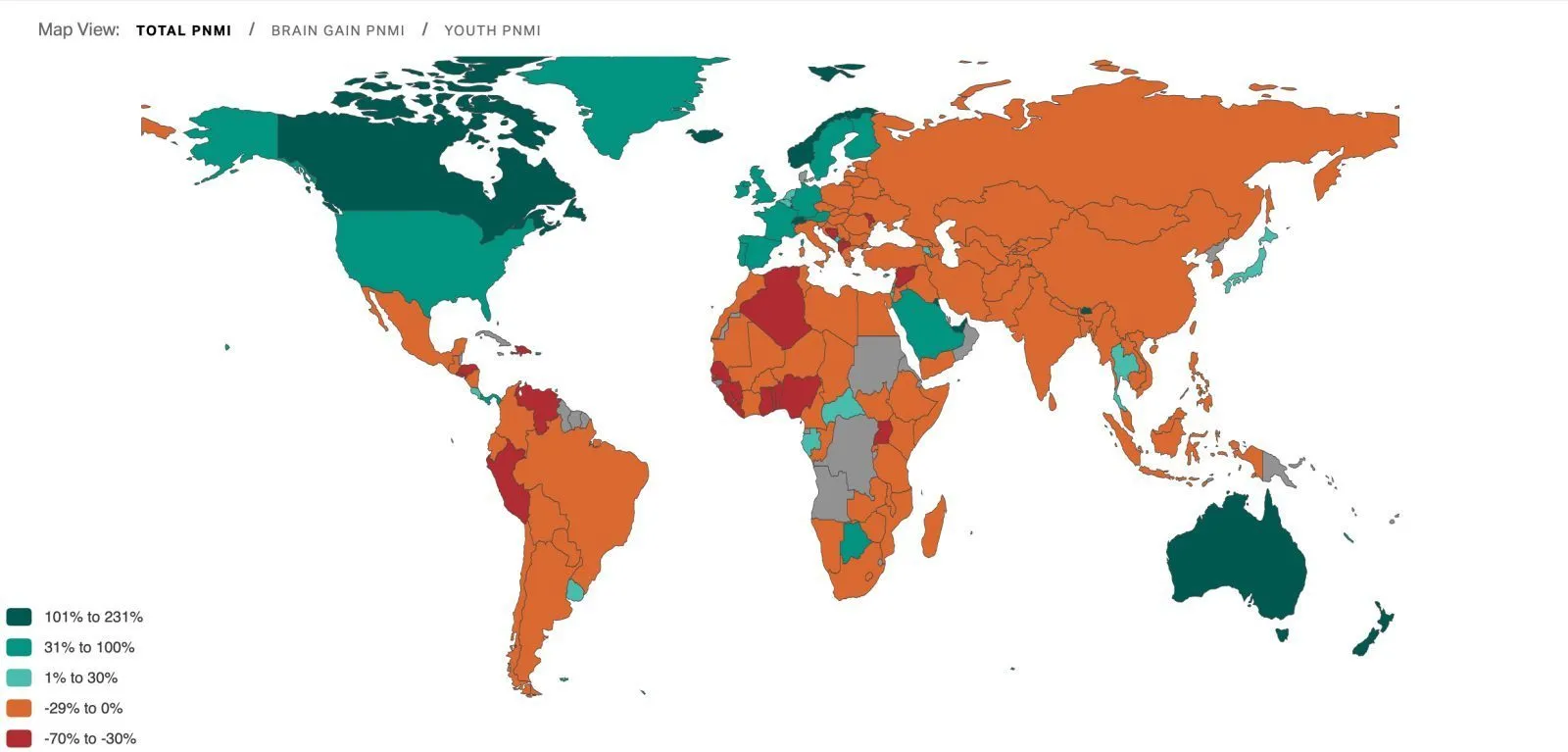
What this map shows is that there would be a huge rush for those dark green countries: New Zealand (231% population gain), Iceland (208% gain), and United Arab Emirates (204% gain), as well as Switzerland (187% gain), Singapore (185% gain), Australia (179% gain), Kuwait (169% gain), Bhutan (162% gain), Canada (147% gain), Luxembourg (131% gain), and Norway (109% gain).
There would also be modest increases in those lighter green areas: In North & South America, the United States would see an influx (46% gain), as would Panama (34% gain), Costa Rica (25% gain), and Uruguay (5% gain). Most of western Europe would see an influx, especially Sweden (98% gain), Greenland, (91% gain), Ireland (48% gain), and Germany (45% gain). Elsewhere, Saudi Arabia would see a 90% gain, Botswana a 35% gain, and Gabon a 23% gain.
But the rest of the world, all those countries in orange and red, would drastically lose people. We’re talking most of Latin America, almost all of South America and Africa, and almost all of Eastern Europe and Asia.
And would would happen to those countries as people moved in and out? In this world, countries can either compete—as in they can fix the problems and make their country a really great place to live and work in an effort to attract people to stay)—or they can crumble. And if they crumble, like those red countries probably will, what if the green countries could merge with them?
This is what happens in the corporate world. Successful companies often merge with or acquire failing companies, and then apply their working model to the less successful company that doesn’t, elevating both brands. Instead of letting one company die, with all those people losing their jobs, the more successful company salvages the brand and helps them succeed, by applying all the resources they have that will help.
In our country model, let’s just assume some of the Eastern European countries—which have been drastically depopulating since the 1990s—decide to merge with the Nordic countries. They keep their culture, their way of life, but suddenly they have access to free childcare, free education, free healthcare, just like the Nordic countries do. Well now instead of losing millions of people, they start gaining millions of people. Companies move in, residents now have jobs. They become dark green countries and start enjoying all the benefits of their parent countries. And the Nordic countries, who gain so many citizens in the process, become more affluent and more able to provide those services to all the people in their purview.
This kind of consolidation could get interesting. Nearly a third of Latin America would immigrate to the United States if they could—largely because of their corrupt governments. Might some of those countries prefer to just become part of the United States? If the US and Mexico merged, the US could export its government and police force, eliminating corruption, and eradicating crime. Some of its biggest companies and factories might relocate to Mexico where they have access to more workers, and those cities suddenly have access to jobs and wealth and security. Through mergers, countries could keep everything about their culture and their way of life, but they could install a better government—the kind they’d normally move for—without leaving their homes or cities.
Now, I’m not saying that Finland should buy Estonia. Or that the United States should buy Mexico. I’m saying that in a world where countries have to compete for citizens, they’ll be incentivized to become better places for people to live, to become green countries in their own right, and if they can’t, well they can always merge with better governments from a neighboring country and still be a green place to live—it’s their choice. Either way, no country would be left to flounder with bad or authoritarian governments, no access to resources, uninhabitable land, or a lack of economy. Just like companies do, countries could learn from each other, compete with one another, and even merge with one another if it’s beneficial. And all of the land on earth would become a really great place to live.
We could give power to communities
In the far future, countries might have consolidated to the point that there are only five left—they are basically continents. You might think that would be a bad thing—that, if there were only five governments in the world, those governments would have way too much amassed power, and way too much control—and if governments behaved the way they do today, that would totally be true.
But what if we actually give those big governments less power? Less control?
There are a lot of beneficial things governments provide their citizens—all those dark green countries provide citizens with military protection, education systems, healthcare systems, and infrastructure systems. But governments also struggle to make decisions that will affect a wide and differing population group, and they probably shouldn’t be the deciding party when it comes to the day-to-day details of how we live our lives.
Why should the United States government make a decision that applies to California the same way it applies to Texas? For that matter, why should Texas make a decision that applies to Austin the same way it applies to Houston? Those places have entirely different needs—and wants—from one another. That’s why, in a world where governments are allowed to expand and care for larger groups of people, I also want to take the bulk of government powers away from countries, and even states, and give them to cities. To communities.
In this case, the only role of government is to provide the basic resources citizens need to thrive—we’re talking military protection, education, childcare, healthcare, and infrastructure—and maybe a universal basic income. But we take the rest of government power away from countries and give them to cities.
That’s how Greenland works. Greenland is owned by Denmark, and Denmark provides the island with all the benefits of a well-established country: foreign security, publicly-funded education, publicly-funded healthcare, and pensions. Denmark also provides Greenland with a substantial annual block grant. But Greenland self-governs—they have their own legislature, autonomy over their own people, and can make the decisions that best benefit them. They have their own culture that is unique to them, and they get to decide what makes the best sense for their community.
Why shouldn’t all communities function like that?
Get every essay in your inbox
Weekly essays exploring a utopian future.
Join 23,259 subscribers
If countries are now incentivized to treat their citizens well, does that go hand-in-hand with countries no longer being able to interfere and cause each other misery?
For a lot of countries, making life better for their citizens would also entail kicking U.S./Canada/France out of their economic and political affairs. No more U.S. military bases scattered everywhere, no more Nestle water plants sucking up local resources.
Which is why I think those green places wouldn’t stay green for very long - they are green because they, currently, have power. After maybe a while of this experiment, that power would be gone. What does migration look like then? When people are no longer running from political and economic upheaval, will they stop moving? Or will they go back to their “original” homes (assuming this all takes place over a single generation), to enjoy a peace they didn’t think was possible?
It’s an interesting thought experiment, for sure!

Yes, it's highly theoretical for sure. I imagine that, at first there would be a mass migration. But then as countries become better places to live, people will either come back, or be enticed to move there from somewhere else. But whether you stay or go is highly dependent on whether you find one place to live better than another. So I imagine a lot factors go into that!
Gosh can you imagine how quickly the U.S. healthcare system would change if we really had to compete for citizens!? That alone makes the experiment worth doing. *blows air horn at Congress*
Right? I think the US would be in a very interesting position considering they’d lose a lot of the left to Canada and Europe, but they’d gain a lot of Latin America (while keeping a lot of the right). Could you imagine that US?
Exactly! But the thing is I don’t know how many of those Latin American immigrants would stay for long. If they’re coming to the U.S. to do essential labor, there are suddenly a lot of places that also need that essential labor. Because the borders are open and everyone’s had a huge population shift.
So why stay in the U.S. at all if there are countries with better worker protections, the same ease of migration, higher quality of life and slightly fewer racists?
This theoretical world is one where the U.S. faces consequences for the “it’s hard to become rich but super super SUPER easy to become homeless” economic model it’s been pushing. I think it would either pivot toward improvement (which takes a while) or...just become an agricultural hub, honestly.
But I think a lot of people would up and leave. And I don’t know if the people who stayed would make the changes that entice people back.

I get all these great book recommendations from you, Elle! Just bought and downloaded 'The Nordic View of Everything' -- looks like a fantastic read.
There's a story Warren Buffett tells that your post reminds me of. I heard him say it when I went to his Berkshire Hathaway annual meeting once, years ago.
He says, imagine what you would design the world you were about to be born into to look like if you could, in any way you wanted. But there's a catch. You *don't* get to decide whether you'll be born male or female, Black or white, in the United States or in a country like Bangladesh, neurotypical or neurodivergent, healthy or with a serious illness, etc.
He calls it the "ovarian lottery," the most important decision that will ever be made about your life and you get *no* say in it. It's purely luck. So, if you don't know where, how or to whom you'll be born, what kind of world would you design then? Gets you thinking, doesn't it?
I've heard Obama use that quote before too. It's a very interesting thought exercise, makes you realize how much of life is determined by where you are born. (Hence the need to focus globally, not nationally!)

Sounds like the idea of 'original position' that John Rawls formulated in his "Theory of Justice":
en.wikipedia.org › A Theory of Justice, plato.stanford.edu › original position
Very powerful ideas, and Elle's open borders/sales tax combo idea is definitely an interesting example where the idea of original position would be very relevant. If the underpinnings of your social structures have to serve to attract as many people as possible, you almost have to adopt the veil of ignorance by design.

I love all these thoughts. The Nordic View of Everything is one of my favorite books - it inspired my move to Europe, and I even got Anu Partanen to come on my podcast, which you might enjoy: secretlibrarypodcast.com › anu partanen
In addition, having to compete for citizens is such a brilliant idea. A while back, I read Too Like the Lightning by Ada Palmer, a book I think you would so love if I haven't yet recommended it- in this novel we are several thousand years in the future and self-driving pods mean you can travel anywhere on earth in half a day or less. So people can live wherever they want as they can work somewhere else without too much difficulty. As a result, nationality is no longer geographic, rather it's a membership you choose based on values and you pay taxes accordingly. You may not have the same citizenship as your neighbor, and you're allowed to change. So clever! Ada Palmer is a real visionary - I sound like a broken record, my apologies, but she was also a genius podcast guest should you be interested: secretlibrarypodcast.com › ada palmer
Have an excellent holiday!
Oooooh, thank you so much for sharing all of these resources! I'm definitely adding that novel to my list. (And I love Partanen! So cool you interviewed her!)
She's fantastic (Partanen). I honestly thought you'd read Ada Palmer's novels already, based on your thoughts on citizenship in recent posts. You will LOVE her work- big and juicy and I can't wait to hear what you think when you dive in. (I'm sure you have quite a stack going already)
My reading list really is getting crazy. But I’m off until my new job starts in January so I have plenty of reading time!

When I read “Opening our borders will solve just about everything,” I was 100% on board on a theoretical level. I haven’t commented yet, because I need to think and research some more to have something valuable to add. But now that I read this article, I see how little would change if countries competed for citizens.
As you point out, the green countries could “purchase” the red countries, but that’s not too different from what we have now. It even seems like a type of colonization.
In many cases, colonization brought improvements in healthcare, education, and agricultural practices, but also exploitative labor practices, the brutal suppression of uprisings, the systemic racial discrimination, and the displacement of indigenous populations. In a world where countries have to compete for citizens, what would stop a green country from exploiting red countries, so that they can gain more wealth and remain attractive?
China isn’t a green country in this article, but obviously, the country is attractive for businesses and, as a result, people. Angola, Ethiopia, Kenya, Djibouti, Republic of Congo, and Sudan have all borrowed money from China. I don’t see this scenario changing under countries competing for citizens.
Another example would be with the United States. You mention “We export our government and police force, eliminating corruption, eradicating crime.” I’m sure some people thought the same thing when: 1. The U.S. provided support to Pinochet’s regime, including economic aid and military assistance .2. The military junta led by General Jorge Rafael Videla took power in Argentina after a coup in 1976. The U.S. provided the junta with military training, intelligence cooperation, and economic assistance. 3: The U.S. supported the authoritarian regime of the Somoza family in Nicaragua for several decades, until the Sandinista revolution overthrew the regime in 1979. The U.S. provided military aid and economic support to the Somoza government. We could list some more examples when the USA funded atrocious regimes in Guatemala and El Salvador.
Also, when we look at Nordic countries, yes, they have some of the best social democracies in the world. But their cultures are rather homogenous, especially for Western ones. Will they behave the same way if they get a greater influx of immigration? Here in Europe, I’ve noticed an increase in populist ideologies and parties everywhere—Norway and Denmark are definitely no expection.
I’d love a world with open borders, and understand all the humanitarian and economic benefits, but if it results in countries purchasing others, I see it going full circle.
Is there something we can do to create more “green countries” without exploiting “orange countries?” Something that doesn’t involve cultural imperialism, but still spreads equilateral values?
You bring up a lot of good comments, and I was very aware when I wrote this that one country "purchasing" another might not sit right. At the same time, in this case it would always be a choice. People could choose to live wherever they'd like, at home or somewhere else. And countries could choose to become a better place to live and not sell. It wouldn't be the same as US occupying places militarily. It would be like the Cook Islands being part of New Zealand, or Greenland being part of Denmark.
And maybe it's sad, but I just don't see a future where we all preserve our cultures in our preserved countries. At some point I do think the world will become more homogenius as it mingles. It already has. Even with borders closed many countries have become "westernized or "easternized" and, in the EU, where there are somewhat open borders among themselves Eastern Europe has almost emptied out into Western Europe. I recently met someone from Slovenia and he said there's no such thing as Slovenian culture anymore because they all moved away. In the US, if Puerto Rico decides to become a state, many will move to the mainland and maybe they will lost their culture. Most of us who live in the US have probably already lost whatever culture we might have had once. I feel like the cat's out of the bag there?
As for countries going more populist-well that might happen. But in a world of open borders I wonder if they would all move to each other? And the people who are not populist would move away? I'm sure we don't know. But it's definitely interesting to think about!
There's definitely lots to think about there. With people moving around more, we have a greater mix of people, which means we should have more heterogenous cultures, but with American cultural imperialism, we can also say that things are more homogenous. And what will happen to populists? I'd take Europe as an example. We have relatively open borders, but when there's an economic downturn, populist thought spreads. If we want more open borders, we have to think of ways that it doesn't backfire and increase populist movements.
This may be dark, but sometimes I wonder if populism will win out. Just because countries like Russia are willing to go to war to spread their idealogy. And countries like the Nordic countries aren't. Which movements are more likely to spread?
As for "American cultural imperialism" - maybe it was intentional at first but I think now it's largely accidental. When cultures mingle they just become something different. But anyway, you inspired me to think about this more and I wound up writing an essay about it this morning.. be prepared to see yourself mentioned in a couple of weeks. And hopefully you'll chime in on the comments and let me know your thoughts!
Thank you, Elle! I'll definitely chime in. I'm looking forward to it.

I like your thinking. You're thinking.