
Founders can get much richer by selling to employees
This is how we create a wave of employee ownership.

Or subscribe to get every pamphlet too, from $50 a year.



 Join 23,259 subscribers
 n 2019, Julian Richer sold 60 percent of his company for £9.2 million and didn’t have to pay taxes on any of it.
The founder of Richer Sounds sold those shares to his employees—or more specifically, to an Employee Ownership Trust (or EOT) that holds those shares on behalf of employees. In the UK, founders can sell to an EOT without paying any taxes on earnings from the sale. There’s no cap, making this more lucrative than other exit options.
Richer became richer, but so did his workers. He retained 40 percent ownership of the company even as he slowly stepped away from day-to-day operations, watching those shares flourish under employee ownership. The company makes £10 million in annual profits and distributes 10 percent among employees.
The EOT tax break was introduced in 2014 to encourage more employee-owned businesses—it has. In the UK, there are now 1,650 employee-owned companies with 620 created just last year.
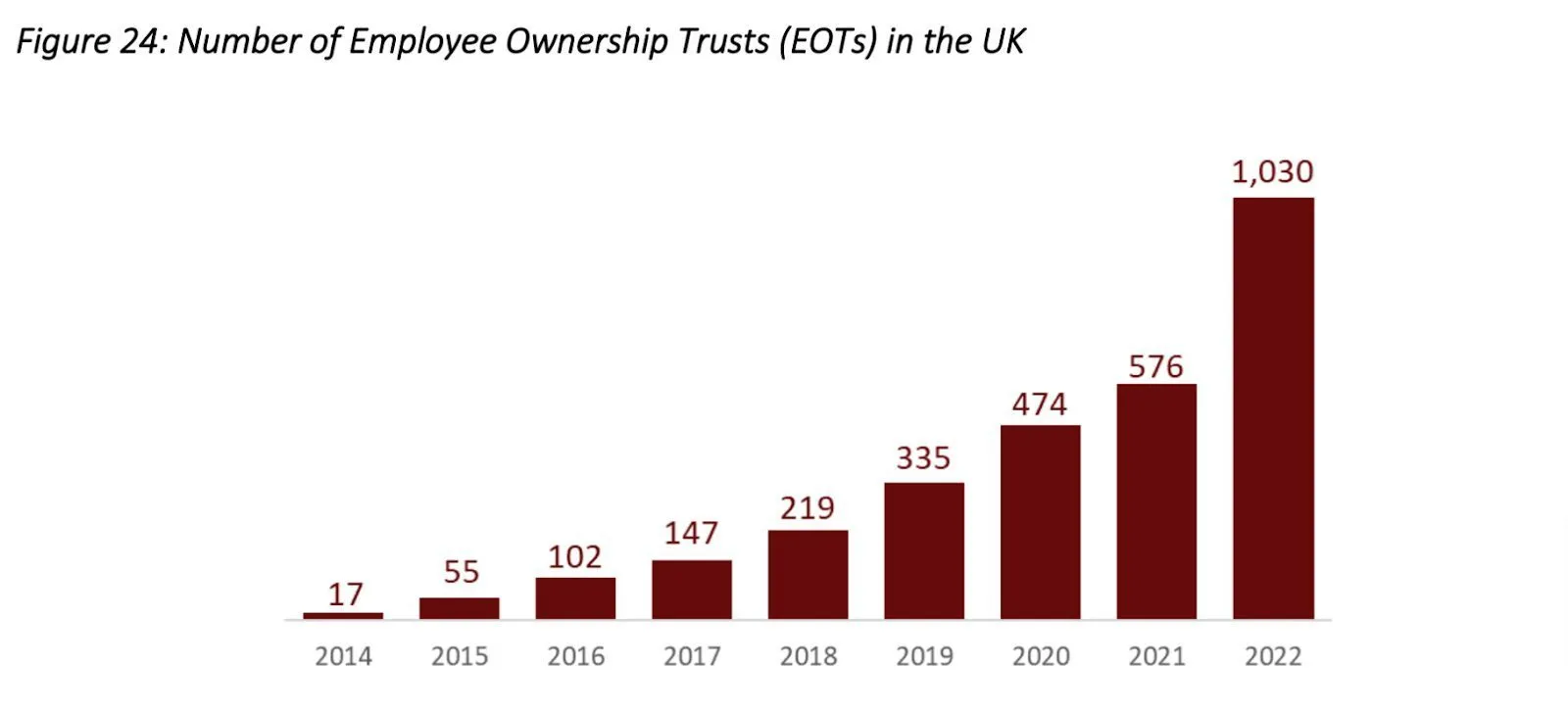
A report on the success of EOTs in the UK says growth of the program directly correlates to knowledge of the program. Most founders still don’t know it’s an option, but that’s steadily changing. As the program gets more press and founders become more aware of how much money they’d earn by selling to their workers, it happens more often.
Employee-owned businesses now employ 0.7 percent of total workers in the UK and drive 1.7 to 2.1 percent of economic activity. They contribute £12 to £15 billion in direct gross value added to the economy with a total contribution of £32 to £41 billion.
The UK is now producing more than double the amount of employee-owned companies than the US every year—620 to our 283. Given there are six times more companies in the US, a similar program could expect to create 3,720 employee-owned companies every year. With solid press and marketing, much more.
In the long term, this could be just the incentive that slowly turns every company into an employee-owned company as founders exit their businesses and employees take stake in the companies they work for, drastically altering the ownership of wealth in our country. If private companies in the US become just 30 percent employee-owned, the wealth of the bottom 50 percent would quadruple.
We need that to happen. In the US, $10 trillion in assets will change hands as baby boomers retire. The so-called “Silver Tsunami” affects half the privately owned businesses in the US with founders at or nearing retirement age—that’s 2.9 million companies employing more than 32 million workers.
Republicans and Democrats both want those businesses to transfer into the hands of workers. “Foreign investors currently own approximately 40 percent of US corporate stock, meaning that much of the profits currently generated by American workers are transferred to foreign stockholders,” the bi-partisan Employee Equity Investment Act reads. “That means, if nothing changes, many of these owners will sell their businesses to buyers in the M&A market—or close their doors—ultimately resulting in the loss of jobs and businesses in local communities.”
Which would we prefer? A future where half our companies are either closed or sold for parts, losing jobs and dismantling the legacies of so many innovative entrepreneurs in the process? Or one in which those companies are sold to workers, they get stock in the companies they work for and build wealth as they grow them, expanding the middle class while growing the economy, ushering in a new wave of entrepreneurs who can use their wealth to start new businesses and even sell them to their workers if they want to?
The latter is something both sides of the political aisle want. Employee ownership is better for founders, companies, and workers. In the UK, employee-owned companies are more profitable, perform better during periods of recession, and are more productive. They are 50 percent more likely to expand their workforce and 70 percent less likely to experience high turnover.
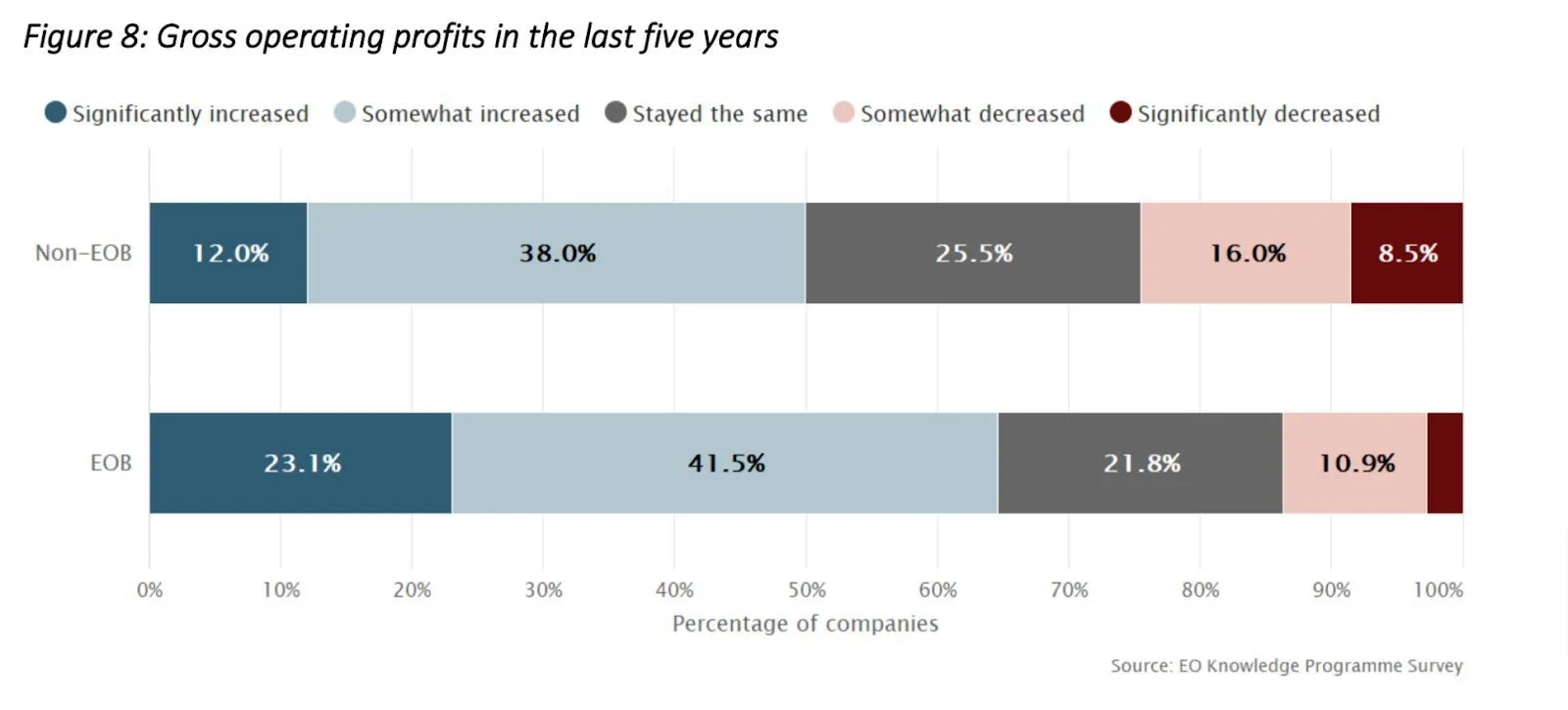
Workers at employee-owned companies earn higher annual wages (by £2,900 in the UK), receive dividends and bonuses twice as large, and receive more training for their jobs. Their companies make more charitable contributions and even make more environmentally-friendly choices—turns out workers don’t want their companies to pollute if they can help it.
The easiest way to create more of them is to make it a no-brainer exit option for founders. That’s why Canada has followed suit, copying the UK’s program by allowing founders to sell to their workers without paying taxes on up to $10 million of the earnings. Their new employee ownership program debuted in May of 2024, and founders will now earn $3.5 million more by selling to their workers than to another company.
Steve Storkan, Executive Director at the Employee Ownership Expansion Network (EOX), would like to see that happen in the US too. “Start with the Canadian version—$10 million is free—and see how it goes,” he says. “It starts with the US legislature… Some legislator has to stand up and say, ‘we need more employee ownership and look at what the UK has done, look at what Canada has done. We need to follow suit and make this easy.”
There are already incentives in place for US business owners. So long as the founder sells at least 30 percent of their shares to employees they can defer paying capital gains on the earnings in what is known as a “1042 rollover.” Earnings must be rolled into a qualified replacement property, like US stock, and can then be held indefinitely or until the death of the founder at which point it will go to heirs and they won’t have to pay capital gains either. The founder gets a lot of money without ever having to pay taxes on it and their workers become owners in the process.
“People who take advantage of that, it's dollars that they're probably never going to spend,” Storkan says. “For example, if I sell my company and get a check for $10 million, I might take $4 million of it and do a 1042 transaction and get tax deferral on that $4 million. The other $6 million I might spend, but if I haven’t sold my stock when I die, my beneficiary gets a step up in basis. So I end up selling my company, or that portion of my company, never having paid taxes on it. It’s good estate planning.”
These tax breaks make it easy for founders to sell to their employees—it’s a good business decision rather than an altruistic one. That’s important as nearly all employee-owned companies become that way because the founder wants to exit the company and chooses to sell it to their workers.
If they decide to go in that direction, there are three avenues founders can take: Sell to an existing employee-owned company (acquired), sell directly to workers and convert into an employee-owned company (stand-alone conversion), or gradually sell to workers over time as the company can afford to buy shares from the founder (non-leveraged incremental conversion).
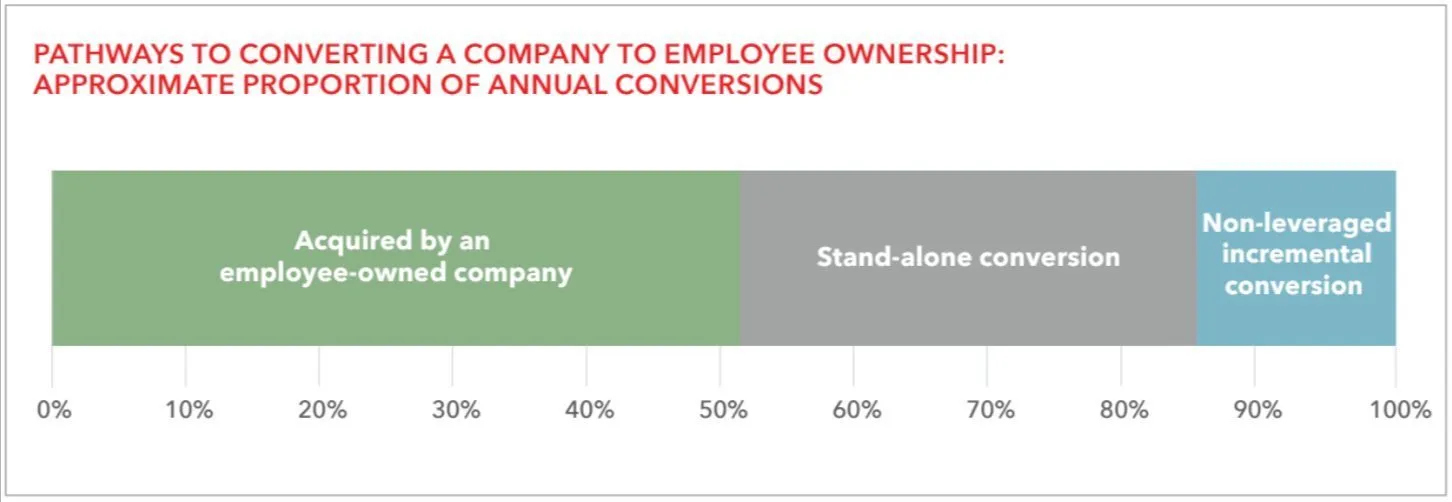
Selling to an existing employee-owned company is the most common, especially for smaller companies. The exiting founder gets their check—just as they would if they had sold to another company—but they can still take advantage of tax incentives and their employees can still become owners.
The other two options involve converting an existing company into an employee-owned company. Whether in the US, Canada, or the UK, that means establishing a trust that represents the employees. The trust then buys shares from the founder (for no more than fair market value) usually using a combination of company reserves, a loan, and seller financing. Over the coming years, the company pays down that debt, releasing those shares to the trust that holds them on behalf of the employees.
The problem is securing those funds. Most companies don’t have $10 million floating around that they can use to pay off the founder so they take out a loan. That’s what Richer Sounds did—their initial payment to Julian Richer was made using existing overdraft and loan facilities from their corporate banker.
If they can’t raise a big enough loan, they might ask the seller for a loan. In this case, the founder can sell shares to the company incrementally over time rather than receive the lump sum all at once. When the founders of Taylor Guitars sold 100 percent of the company to their employees in 2021, they used a combination of debt and seller financing to raise the amount needed. “We took out a mortgage, basically, to buy our company,” Taylor Guitars CFO Barbara Wight said at the time.
Both options work well for founders of medium-sized companies who plan their transition years and even decades before they want to receive their final payout, but they can be a deterrent for large companies or founders who want to exit in the near future. What bank will finance a $10 million loan? Or a $50 million one? And why would a founder take an IOU when they can get a check from another company immediately? Especially if they are looking to retire?
Or as Storkan asks: “How can we provide more capital so the selling shareholder can get their cash?”
Republican and Democrat representatives have worked together on the Employee Equity Investment Act (EEIA) that would utilize the existing SBIC program that currently provides loans for small businesses,to provide loans for much larger ones in the case that they are converting to an ESOP. The Act was introduced in the house and senate in May of 2023, but it is currently idling in place. It would have to be passed by both before it could go to the President and become law.
Another option is to work with mission-driven funds rather than individual banks. Transform Finance has identified 53 funds in the United States and Canada that fund employee ownership conversions—22 of them focus exclusively on that task. These funds provide a combination of debt and even equity financing, with investors earning their money back (with interest) over time.
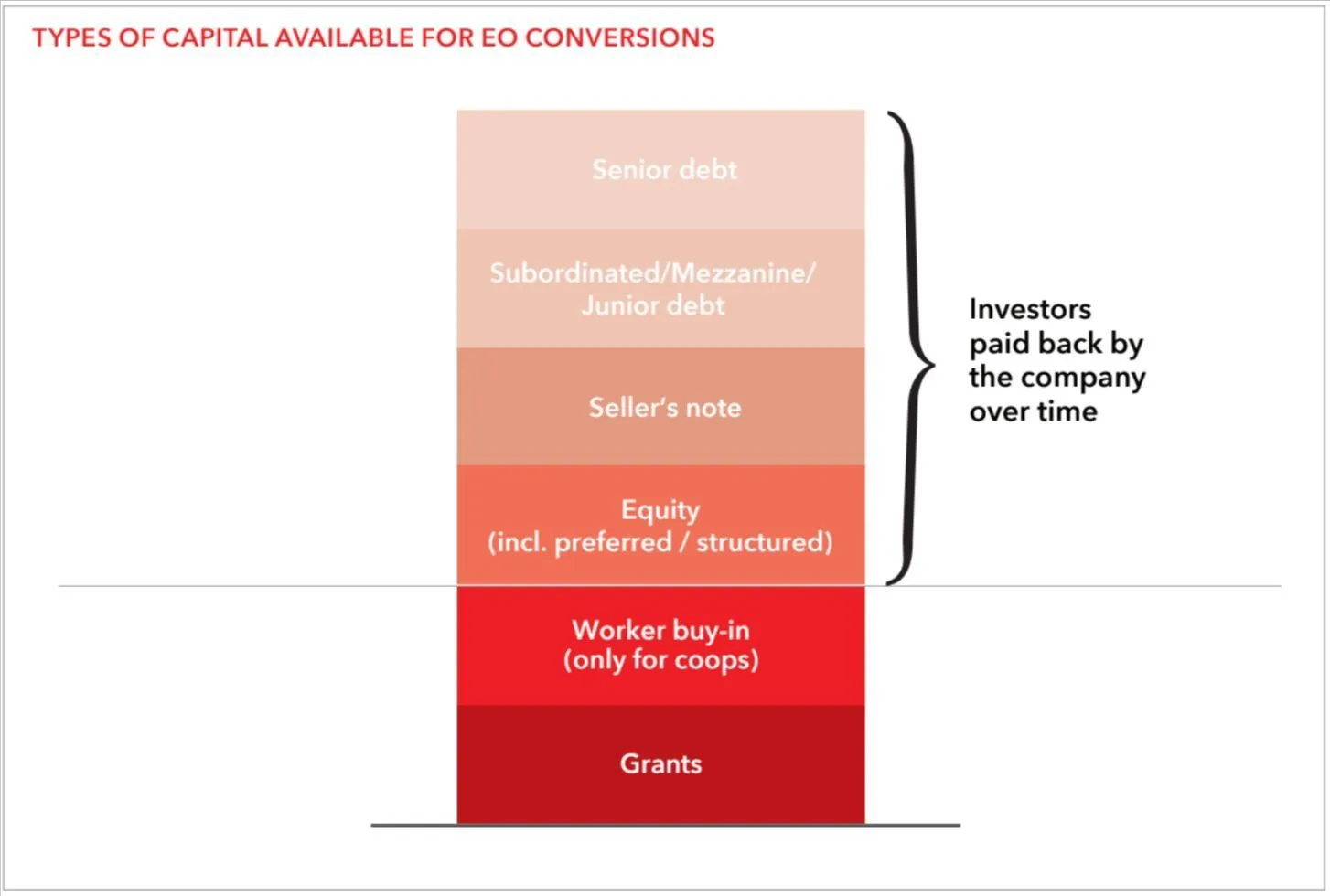
Transform Finance provides a comprehensive list of players in this space but notes that they are still early in development. “Half of the funds, where the fund size is known, are under $50 million in size,” they say in their guide to financing. “The smaller average fund size creates challenges in fundraising because many asset owners are not able to write checks under a certain size (e.g. $5 million), while simultaneously not wanting to take on more than 10 percent or 20 percent of the overall fund.”
These constraints could be alleviated as legislation drives more employee ownership conversions, and thus more investors and funds to this space. As growth continues we could create more employee owners even as we create more creative ways for investors to help fund them.
We just need more founders to exit to their employees.
“If I know about it as an option, I get a tax incentive to sell my business, and I don’t have to take a note myself because there's access to capital—now we're off to the races,” Storkan says. “I think all three of these things need to happen at the same time.”
For founders interested in selling to their employees, there are two options: In the UK, Canada, and US, the Employee Ownership Trust (or EOT) holds stocks in common on behalf of employees, distributing a percentage of that growth to employees as an annual bonus. In the US, we also have the Employee Stock Ownership Plan (or ESOP). Rather than having one profit-sharing pool, employees have individual stock accounts that accrue shares and value over time, similar to a second retirement account.
EOTs and ESOPs are both employee-owned, not employee-run. They change the ownership structure without changing the business structure. Executive leadership still makes decisions, just as they do at traditionally owned companies, even as employees are incentivized to help their companies succeed and earn dividends when they do. But there is also a third option available in all three places: Cooperatives are employee-owned and employee run. Workers vote leadership into office and share in the profits when the company does well.
“Whereas an ESOP is just a different structure of ownership,” Storkan says, “a worker cooperative is a different mindset.”
For this reason, most cooperatives become that way when the company still has less than 30 employees—it’s something they start out as rather than something they become. Storkan sees this as a good option for small groups of people interested in creating something together, but not as feasible for larger companies looking to convert.
“It’s a hard sell to take a business that's not running as a cooperative and talk about running as a cooperative,” he says. “We have a different idea about business here, we just haven’t been introduced to the concept of democracy at work and spreading the decision-making around. Those who want to sell to their employees as a cooperative are much more likely to have a European mindset.”
In Europe, cooperatives are a much bigger part of the equation. Their historical precedent makes them a more common startup option and I’m currently studying successful models in Spain and the UK for coming essays on the future of work and democracy. In the meantime, at a bare minimum, I think we need employee ownership. We need to popularize and incentivize founders selling their companies to their employees. We need to change the way wealth is owned in this country and around the world. And we can do that by making it a no-brainer exit option for founders, spurring a wave of employee ownership in one of the richest countries in the world as our largest population sets out to retire.
“Employee ownership doesn't mean we have to have democracy at work, it doesn't mean we have profit sharing and better jobs,” Storkan says. “We hope all those things come, but if I simply have shares in my account that no one can take away from me and when I retire or terminate my employment I get a check—I think that's enough.”
Let’s start there.
This is another essay in my capitalism series. Thank you for thinking through how we can make this system work better for humanity. I hope you’ll join me in the comments for further discussion.
P.S. If you can, please share this essay with a friend! Especially your business owner friends….
Thank you so much for being here.
Get every essay in your inbox
Weekly essays exploring a utopian future.
Join 23,259 subscribers

Well, this is encouraging 👏 Let’s do more of this in the USA.

Really interesting and informative and a smart way to help address economic inequality over time.

Nice piece Elle on the potential merits of employee ownership of firms as a “win-win” for both founders and employees. Here, tax incentives are created to make it more, shall we say, “lucrative” for founders to sell out.
In my view, one that I have promoted at Risk & Progress, is why don’t we just skip the steps and abolish all taxes on production, including income and capital gains? With no taxation on share sales, there would be no disincentive for founders to sell out in the first place.
We probably would need some kind of additional mechanism to make it easier to establish employee-owned businesses to truly level the playing field. But there is no reason not to try it.

Have you written about this elsewhere? I'd love to read more about this if so. Thanks JK! Your thoughts are always so insightful.
I have discussed the merits of Land Value Taxes as a replacement for other kinds of taxes: lianeon.org › just tax the land
I have a new essay coming soon on consumption taxes, specifically a new approach to VAT. LVT+VAT would generate more than enough revenue to remove all taxes on production, make us wealthier, and remove distortions...like the one you noted in your article. A lot of things get simpler and easier just by removing the tax in the first place.
Ah yes, I've read that one. I'll be excited tor read the coming piece as well. This is something I've thought a lot about.
I spent a great deal of time researching consumption taxes and conferring with fellow substackers, I am very excited about what is a rather dry topic. But it's important to get the tax revenue system right.

I agree this is good but ignores the elephant in the room which is the debt based economy
Have you seen any interesting solutions there?

Such a wonderful article! Thank you for researching and summarizing all this information! I really think employee-owned (and I'm a big fan of employee-run part as well) companies are the key to making capitalism work for everyone.
Me too!

I founded one of the investment funds focused on EO conversion you mentioned (SmallCapital.org) and this is one of the best summaries of the rationale and path forward I have read. Thank you!
Amazing!!!!! I'm curious: have you seen any equity deals yet? Or primarily debt deals?
We do equity+debt. SmallCapital puts a de-risking equity investment to enable the bank debt to finance the majority of the transition. Our focus is on small businesses that are being overlooked
Amazing, I might hit you up for a future piece…
Would love that!
I sold my company as an ESOP. It was kind of a pain in the ass. I think every employee should get a share of profits by default. It would shift the redistribution of wealth to happen at the source of wealth creation. The systems we have in place (in the US, at least) are far too complicated and costly to make it realistic for many smaller to mid-size companies to pull it off. Simplification (and a tax break!) would accelerate adaptation for sure.
It really should be much easier. The reason I haven't gone as far as to say that every employee should get a share of profits by default is that it might not be financially feasible for a company to do so until they are a bit larger. Maybe even large enough to be profitable enough to sell, at which point you can exit to employees? I'm not sure how that would work with smaller companies who aren't yet profitable? But I really love your idea and I want to think this through more.
You are correct, it wouldn't really work until a business reached a certain level of profitability. I would argue that labor would naturally become more productive if it were incentivised by profit sharing. Also, once the company became large enough, the mechanism of employee ownership is already established. The owner or "majority holder", as it were, could sell to the employees or an outside investor - the third party having a full understanding of what they're getting into.
And, this type of accounting wouldn't prohibit a public offering. It just that profits would be shared with labor.
Yes, that could be. It's definitely an interesting approach!
FYI: I shared your article with mnceo.org, an organization advocating for employee ownership in my home state of Minnesota.

Silicon Valley is a place of compensation innovation first and technological innovated second.
The proposal from Marco Rubio is a great patch on a very complicated process.
Hope the UK can leapfrog here.

So inspiring, thank you for writing this. This kind of structure gives me hope that we can transition to more just and equitable economics without the threat of war and collapse that would be far more painful to reach the goal of shared wealth. Filing away for my utopian novel idea!
I have the same hope. 🥰

Really appreciate this post and the mention of our recent report about investing in Employee Ownership! This is a great, clear, summary of some of the needs and tensions in the field. Thanks!
At Transform Finance, this work sits within our broader Alternative Ownership program which focuses on encouraging the adoption of corporate structures that share wealth and control with a company's stakeholders, not just its shareholders. In short, employee ownership is fabulous and it's also interesting to think about ownership being shared with customers, suppliers, community members or even with nature. I'm curious whether you've looked into those models such as purpose trusts, or granting nature a seat on corporate boards, etc. Those are interesting models when thinking about how capitalism could evolve. What do you think?
Yes! I am so interested in your Alternative Ownership program. And especially the idea of sharing ownership with nature—I'm working on a series about this now, have you seen that done anywhere? (Apart from Patagonia?)
I've thought a lot about the other ideas as well—for example, I would love to make my readers owners in my newsletter, and to earn a share of the dividends each year as my subscribership grows. Unfortunately, there's no good tech that can help me achieve it at the moment.
Excited to hear you're working on a series on this topic!
Faith in Nature, Insta Drive & House of Hackney have added nature to Board of Directors. This article is helpful: stevens-bolton.com › appointing nature to the board storm in a…
I also heard Ecosia has a similar set-up but I haven't looked into it further yet.
Those are all European companies...
In the US, perpetual purpose trust companies have also been set-up to support a range of different purposes and stakeholders such as Organically Grown Company, Berrett-Koehler, Firebrand Artisan Breads, Natural Investments and even Hobby Lobby. I don't know exactly which include nature as a purpose and/or stakeholders but a near complete list of PPTs/EOTs is here: dataverse.harvard.edu › file.xhtml.
Love to hear you're thinking about shared ownership for your newsletter. Patreon is probably the closest platform (where people could support, and get a reward down the line) but agree it's not quite set-up for this use case. The folks at RadicalXChange have been thinking about Partial Common Ownership as a way for artists/creators to share ownership of their work with contributors and community members: radicalxchange.org › pco art. Not a tech platform yet but the theoretical underpinning for it.
These are amazing resources, thank you so much! Adding them all to my research notes now.....

Brilliant article.
“ If private companies in the US become just 30 percent employee-owned, the wealth of the bottom 50 percent would quadruple.”
This stat is wild, alone this should be enough motivation for a country to pursue. What other gov intervention could claim this level of result!
In your research have you come across any examples of EOT startups and how they attract finding and investment?
Thank you Nova. Yes, Taylor Guitars, mentioned in this piece, found financing through two investment partners: Social Capital Partners in Canada and the Healthcare of Ontario Pension Plan.Tranform Finance lists some other options as well, but I'll share my in-depth reading list for this piece next week.
ultimately, if owners divest themselves of dying companies (not those listed here) is it not divesting their losses to the employees?
It's very difficult to sell a dying company, and I don't think it's feasible to sell a dying company to employees. The financials have to be good for the transaction to even work!

Great job outlining this in plain English! On the policy side, my understanding is the tax advantage in the US for selling to employees (1042 rollover) only applies to ESOP's which are a bit clunkier and more expensive to administer, so this defacto targets larger companies than can absorb that cost. EOT's are lighter weight and make more sense for smaller companies, so we need to extend the 1042 rollover to EOT's and other forms of employee ownership!
As I understand it, ESOPs only make sense when you have more than 30 employees (largely because of the transaction costs which are about the same as selling to a traditional company, but would be too steep for smaller companies). EOTs are definitely lighter weight and easier for smaller companies!
Happy to read that selling to employees has become a lot easier in the UK! I'm working on a TV series that's partly inspired by British IT pioneer Steve Shirley who sold her company to her (mostly female) employees. In her memoir she writes at length how complicated it was to set this up even though it was very clearly the right thing to do as she was acutely aware that she wouldn't be the owner of a successful company without the people working for her. However, she persisted and this made many women very wealthy when the company floated.

Degrowth is the answer!
I tend to disagree. elysian.press › we dont need degrowth for the environment
Your post has a classic tunnel vision error. Just focusing on CO2 emmissions. However there are other factors that degrowth is trying to fix... food waste, toxicity, inequality, poverty, water crisis, health, overconsumption, food security... you know I could continue. Also true that data centres can be powered by 100% renewable energy... but intangible assets do have a high carbon footprint associated with indirect emissions. Specially in the race for AI this will be a major contributor. In a sense I still do not get your point of why degrowth is not the answer... you are just arguing that there are other ways to grow the economy without killing the planet with little evidence on the specifics of why this is the case... anyway just a thought...
My article doesn't focus on CO2 emissions, it's focused on using the earth's resources. My work as a whole focuses a lot on how we can solve the other things on your list: food waste and security, wellbeing, and inequality and poverty (this post as an example of those last two). I just don't think a stagnating market is how we achieve that. You might be interested in the next two articles in this series for more specifics:
elysian.press › we need to grow the economy to advance
elysian.press › the ideal economy in 2100
Not my utopian dream, but a cool concept regardless. Thank you for sharing!

I’d also recommend studying Finnish cooperatives, Ryan Cooper has a good article on one of them prospect.org › 2023 10 11 cooperative that could s group…
Thank you!
Excellent piece! Clearly, the Gov entities need to broadcast this more. It's simply not known.
A great opportunity for wealth distribution and creation and a deft move against monopolies and Private Equity greed.

Fantastic, it might happen in Australia in about 1000 years time

Thank you. Very timely article and wish more owners knew about it. Agree with and David Roberts above that addressing income inequality and giving employees some control are awesome outcomes of this model. Wish my boss had done this before selling to private equity backed for profit healthcare company!! It was a disaster.
Truly, I can't imagine many founders are happy with the way things go when they sell their legacy to private equity!
An excellent article, Elle, something we all need to look into - I'll be recommending it to anyone interested in taking positive action on workplace democracy and improving working conditions along with a more humane economy.
Thanks for your fine work.
Thank you, A.P.!