

US states should have autonomy—like EU countries
All we need to change is taxation.

Or subscribe to get every pamphlet too, from $50 a year.



 Join 23,259 subscribers
 hat if US states had the same autonomy as EU countries?
Theoretically, Vermont could become a social democracy just like Malta—after all, they have the same population size and GDP per capita. California has the same population as Spain and is twice as rich by GDP per capita—they could afford to subsidize childcare, healthcare, and education just like Spain. Despite being our least populous state, Wyoming is richer than Sweden or the Netherlands on a per capita basis—it could establish a sovereign wealth fund just like Norway does, investing its surplus oil revenues for the benefit of its citizens.
The only reason US states can’t provide for themselves the way EU countries do is that, in the US, the federal government collects the bulk of tax revenue, not the states.
If US states could collect taxes and manage their own budgets the way European countries do, higher-tax states like California, New York, and Massachusetts might expand social programs like universal healthcare, education, and childcare. They might invest in public transportation, tech development, and renewable energy. Lower-tax states like Texas, Florida, and Nevada might replace income taxes with sales taxes; privatize public services like charter education, healthcare, and toll roads; and invest in infrastructure projects. There would be a lot of variation between states—Hawaii might limit who can purchase property on the islands, Utah might expand refugee resettlement programs, Wyoming might increase land conservation efforts for hunting and outdoor recreation.
European countries have this same kind of variation: Germany has fewer big cities, but many medium sized ones and thus invests its dollars in interconnected public transportation infrastructure. Norway has a lot of mountains and fjords, and allocates its revenues toward conservation and national parks. Because of their low-lying geography, the Netherlands invests significantly in flood control. Spain, which has more coastline than other countries, invests significantly in fishing infrastructure.
Small regional communities are generally better at deciding what they need, and where they need to allocate their money. Why shouldn’t the states do so too?
We don’t need to talk about secession to make this a reality, just taxation. The Bill of Rights already grants states the authority to self-govern—they have their own (much longer) constitutions, operate their own legislative bodies that make laws, and manage their own budgets. The only reason states don’t have the power to invest in social services or privatize them is that they don’t have the money to do it. The 16th Amendment, ratified in 1913, gave Congress the power to tax the population federally without apportioning it to states, then they expanded that access when they needed more money during the world wars. Today, 64% of our tax revenues are collected by the federal government with only 21% collected by the state and 15% collected by local governments.
How is that federal money being spent?
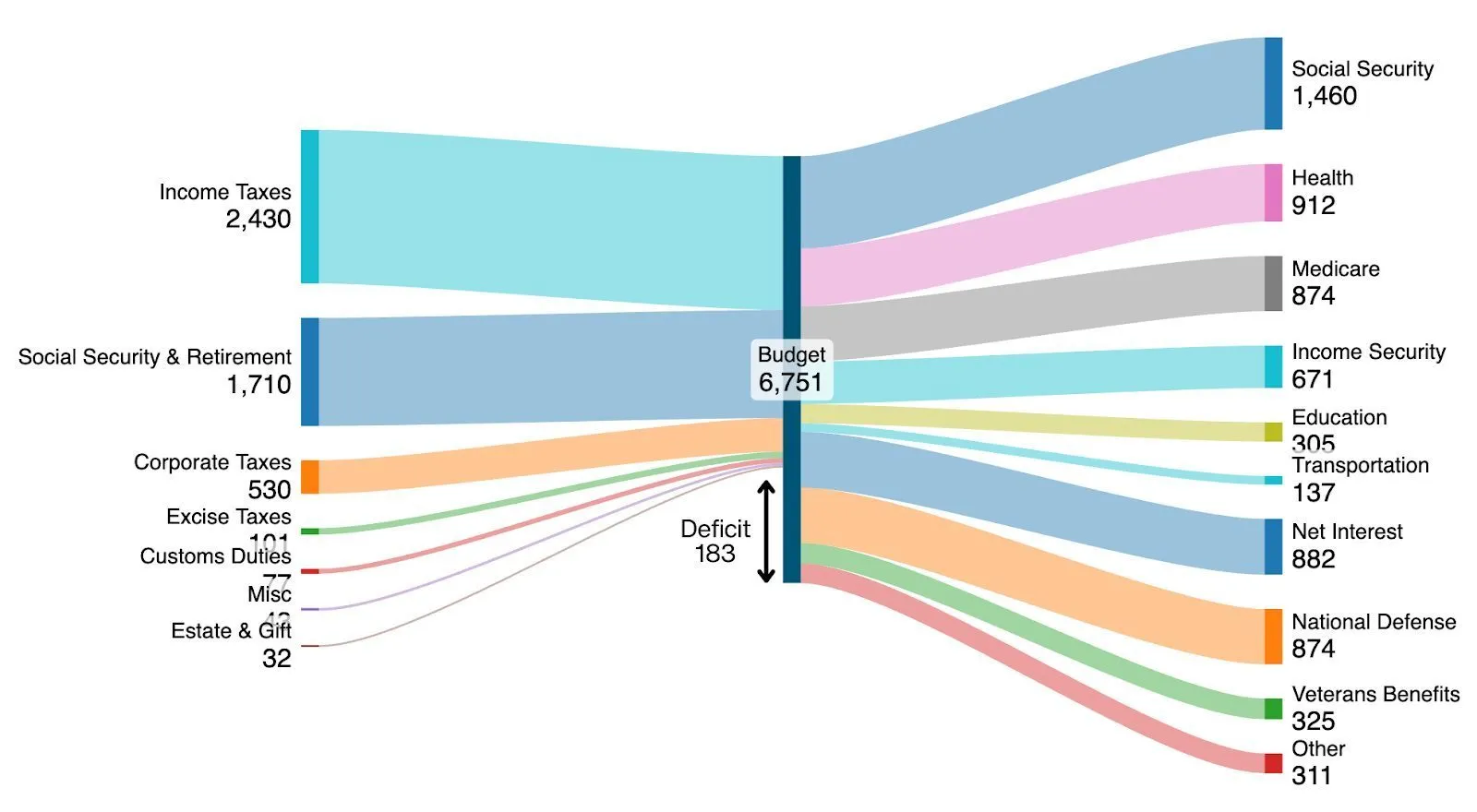
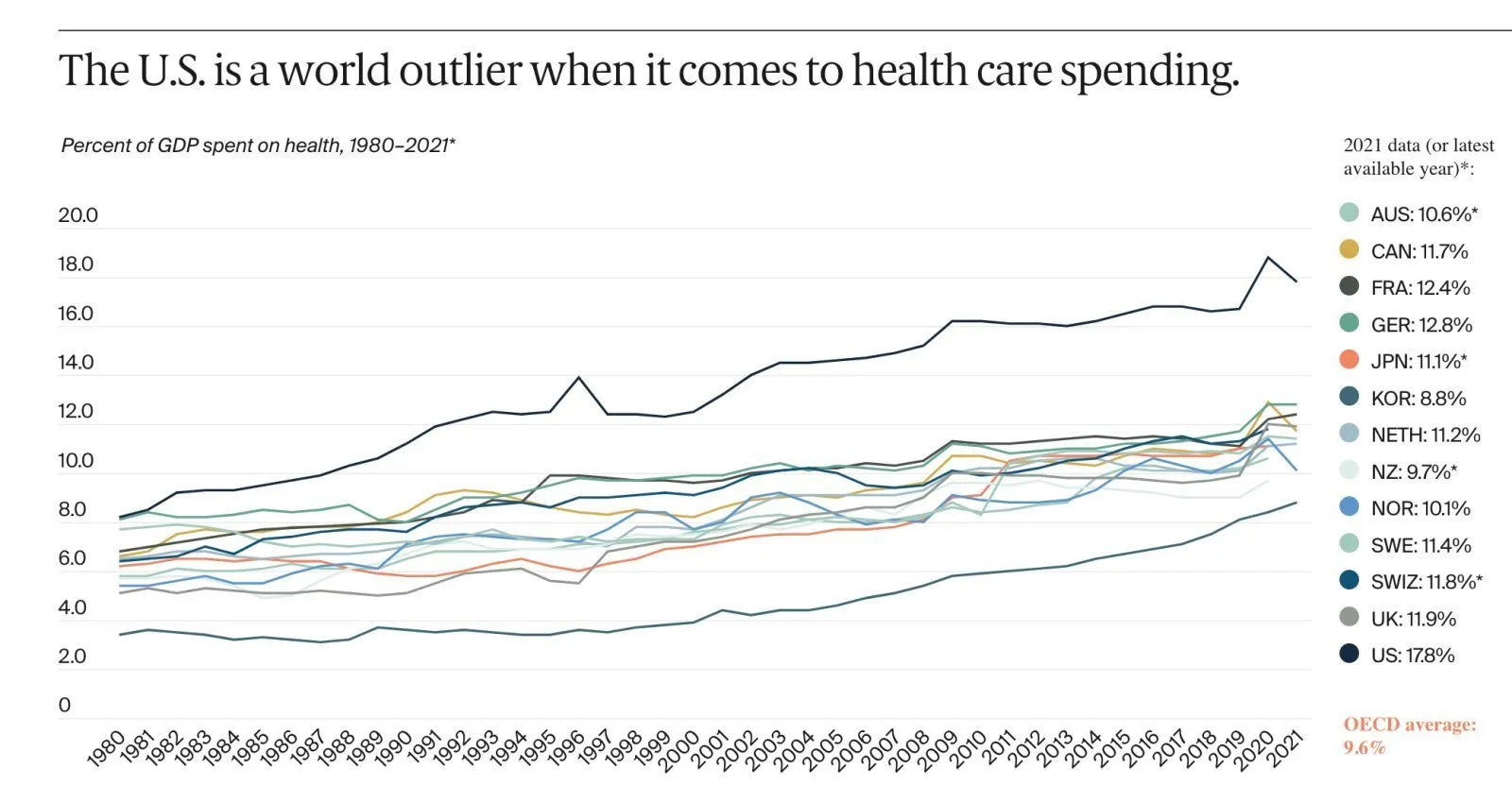
It’s a common misconception that richer states subsidize poorer states and that’s why we couldn’t give tax autonomy to states. But actually all states are funding the federal government which doesn’t spend that money in the best interest of states. To start, the federal government has a lower tax rate than every European country, (26.6% of our economy vs. 34.1% in Europe) which means it earns much less income. Then, we spend nearly $2 trillion more than we earn each year which puts all of the states in debt—resulting in that $882 billion we spend on interest each year. Because we don’t have universal healthcare, we spend double what any other wealthy nation spends on healthcare per person. The combined line items for health, Medicare, and Veterans Benefits make up $2.1 trillion of our budget and 18.3% percent of our GDP—Germany is the next highest country, spending only 12.8% of it’s GDP on healthcare.
What budgets are given or raised by the states are barely enough to fund the basics. Utah, for example, is richer than Germany, Sweden, and Finland by GDP per capita—our economy was worth $209.98 billion in 2021. If Utah was taxed the way European countries are (at 34.1% of their economy, on average), our state would have earned $71.60 billion—enough to provide our citizens with universal healthcare, universal childcare, universal education, and all the rest. Even if Utah was taxed the way the US is (at 26.6% of our economy), it would have earned $55.85 billion, more than enough to accomplish a lot of the same. Instead, that $55.58 billion went to the federal government who then gave us only $5.48 billion back. Along with what we were able to raise in state taxes, Utah earned only $20.3 billion in revenue—that’s only 9.67% of our economy we get to keep and use while European countries keep 34.1% on average.
That difference means Germany can afford free college education, Utah can’t.
While it’s true that poorer states benefit more from what programs we do support at the federal level, that’s only because the US federal government exempts the poor and the rich from taxation, and only provides social services to retirees and the poor. Other countries tax everyone and extend tax benefits to all citizens. Mississippi, for instance, is the poorest US state by GDP per capita and thus taxes its residents the least (9-10% of their GDP) and receives the most welfare aid from the US federal government in the form of social security, Medicaid, and unemployment benefits (making up 34.2% of its GDP). But Italy is even poorer, with a lower GDP per capita than Mississippi1, a lower median income2, and a higher unemployment rate3, and yet they tax their citizens much higher (42-45% of their GDP) and spend that money on a better quality of life for all citizens.
Italy has universal healthcare while many Mississippians are uninsured. Italians have better public education and free university tuition while Mississippians have low ranked public schools and can’t afford college. Italians enjoy excellent public transportation and high walkability in their cities while Mississippi residents must rely on cars. Italians get four weeks of vacation per year, five months of maternity leave at 80% pay, and 35 hour workweeks. Mississippians work 40+ hours a week, get no vacation days, and don’t have access to maternity leave unless their employers choose to provide them—which they don’t because most of the jobs are low wage jobs.
Might poorer states prefer to use their tax dollars for the best benefit of their citizens? They do! Many poorer states, like Mississippi, have voted to expand Medicare access only to be blocked by the federal government. Many, including West Virginia and Alabama, have wanted to use broadband grants to expand internet access to rural areas but federal regulations favored private companies who didn’t implement them that way. Might richer states want to use their tax dollars for the benefit of their citizens too? They do! Vermont voted for universal healthcare in their state but was blocked by the federal government. Many states, including California, Oregon, and Washington, have voted to subsidize childcare but the federal government wouldn’t give them the budget.
That the federal government has to make one budget that works for all of the states is exactly why it doesn’t work for any of them. New York does not have the same needs as Hawaii, Mississippi does not have the same needs as California. Every state wants to do different things with their tax dollars but they’re forced to compromise at the federal level. Gridlock means few get what they want. Legislators sneak funding for projects in their own districts (earmarks) into federal projects to gain favor with voters, but that makes the whole budget more expensive for all of us. Our budget becomes filled with line items individual states need, but all of them don’t.
Rich and poor states alike would be better served by a federal government that allows them to raise and allocate their own tax dollars in a way that works best for them. After all, every one of the line items in our federal budget is managed by individual countries in Europe, and I think that’s better. I think democracy works better in small groups where their vote counts and addresses their direct needs. After all, there were only 3.9 million people in the United States when we wrote the Constitution—the average size of a US state today—and yet that same Constitution now governs 331.9 million. Is it any wonder we find it complicated to agree? To define what life should look like for everyone, much less try to write a budget together?
But at the state level, everyone agrees! According to Pew Research, 66% of Americans view their local governments favorably, 54% view their state governments favorably, and only 32% view the federal government favorably. And people generally like their state governments—75% of Republicans living in Republican states view their state governments favorably and 70% of Democrats living in Democratic states view their state governments favorably.
If we’re happy with our state governments but unhappy with our federal government, why shouldn’t states be empowered to act in the best interest of their citizens?
The most common rebuttal to this idea is that people would move, and that’s true. When the Schengen Agreement opened borders between European countries in 1995, western European countries with strong economies (Germany, France, Netherlands) saw an influx of workers looking to increase their incomes, and companies moved headquarters and production facilities to countries with lower labor costs and business-friendly regulations. There were a lot of benefits to this—pay wages increased as people either moved to be closer to good jobs or companies moved closer to them, and the free movement of workers contributed to economic growth within the EU by optimizing labor allocation and enhancing productivity. There were also detriments—Eastern European nations faced brain drain as their skilled populations moved for better opportunities.
This effect also happens in the United States where free movement of people between states means people and companies can move for economic advantages. See Tesla and Oracle relocating to Texas for lower taxes and better business regulations, or workers relocating to Austin, Seattle, New York, and Miami for job opportunities. Today, both the US and Europe are reversing the effect of brain drain by offering tax incentives to remote workers and funding to entrepreneurs interested in starting local companies. Now that economic hubs have become too expensive to live and remote work has been on the rise, reverse migration is happening. Post-pandemic, many workers have left high-cost cities (like San Francisco) for lower-cost states (like Texas, Florida, Colorado). European migration has similarly shifted away from expensive cities like London and Paris to cheaper regions.
Over time, movement is equalizing.
If US states could raise and manage their own taxes and remit a portion of their earnings to the US federal government, just like the EU does, states could more easily provide for their citizens in a way that works best for them, and citizens can more easily live in the states that most appeal to them. And if we continue to keep all of the things that our federal government is really good at—like having a single currency managed by a strong federal bank, federally managed economic policy and trade, and a national military—the United States could continue to provide for the greater country better than the EU currently provides for the European continent. We could enjoy the autonomy of EU countries, even as we keep the unity of the United States. It’s the best of both worlds.
I think this should work the way the Basque Country does. This autonomous region of Spain collects its own tax dollars and retains 90% of its tax earnings locally. It then remits a portion of its economy—around 6.24% of GDP—to larger Spain, which provides welfare services like social security, as well as the management of international trade and defense. Spain then remits an even smaller portion of the country’s tax earnings—about 1% of gross national Income—to the EU for global coordination. In this case, the tax authority is the local authority—the one closest to us. Local governments earn the largest share of our tax dollars and provide the most services, while the state and federal layer earn a smaller share, and providing only a few services to a wider group of people.
This is the exact opposite of the way revenues flow in the US where the federal government is the tax authority, and thus the richest entity, taking 60-65% of total tax revenue, while states earn only 20-25%, and local govenrments only 10-15%. US cities and states have limited to no fiscal autonomy, and the federal government has all of it. But the Basque model flips that script, ensuring that money is made by and for the benefit of residents, even as smaller shares go to larger entities to fund national and even continental needs.
If US cities had tax autonomy, they could support everything we need locally without state and federal grants—including housing, hospitals, schools, transportation, robust master-planning with green space, beautiful architecture, and city design. If the state earns a percent of that, it could support social services like healthcare and education and social security, as well as law enforcement and courts, just as EU countries do. And if states remit a percent of their economies to the federal government, just as EU countries remit a percent of their economies to the EU, it could fund national defense, foreign policy, currency and central banking, international coordination, as well as higher law enforcement and courts.
A transitional plan could make this easier to implement. For instance: Even as we allow states to collect taxes and remit a portion to the federal government, we could also ensure that remittance is high enough to keep more popular federal programs in place, including social security and the military, agricultural investment, and our ability to pay down our federal debt. EU countries currently contribute only 0.7% to 0.8% of their gross national income to the EU, while the US federal government earns up to 20% of its GDP in tax revenue. There’s no reason we couldn’t find a middle ground that accomplishes what we need to achieve federally even as we allow states to better manage their own budgets locally.
Personally, I would start the remittance at 17-20%, so the federal government can still operate on its current budget during the transition period. Over time, as the nation pays off its debts and hands social welfare programs like Social Security over to the states, the federal remittance could become much smaller, perhaps only 5-10% of state GDPs.
I think this idea is more popular now than ever. As the US federal government takes a red pen to the federal budget, states will receive even fewer benefits than they previously did. If states need money to do anything, they’ll have three options: Keep trying to sneak more things into the federal budget (which no one wants and the federal government can’t afford), raise state taxes (which won’t be enough), or demand that states be able to tax their own economies (which are all rich enough to fund most of the things states could want to do).
Maybe if states get mad enough they’ll demand that last option. After all, Texas relies on federal aid from FEMA more than any other state, but as DOGE cut FEMA leading up to Hurricane season, who is going to help them with disaster relief? Texas is rich enough to fund relief on its own if only it had more power over taxation. Similarly, when DOGE made drastic cuts to the NIH, gutting medical research funding, 22 states as well as universities, hospitals, and research institutions sued the federal government. But these are states that are rich enough to work together and support medical research if only they had access to the full extent of their own economies.
For all we need to cut federal expenses, we also need to raise state incomes, and this might finally be the breaking point that forces states to realize: We have richer economies than most countries in the world. We could afford to do everything we want to do ourselves if we just had control over our own taxation. And frankly, we’d rather tax our own state economies than give it all to the federal government who is wasting it all away.
We have reached the limits of what the federal government can do, and while it might have been important to consolidate financing during the world wars, there can be no doubt the federal budget has gotten too big and too expensive to be of any help to the states today. There’s a reason populist politicians are so popular right now—from Bernie Sanders to Donald Trump: No one is happy with the American federal government and everyone wants it to be different. If we’re going to slash and burn the federal budget maybe it’s also time for states to raise and earn their own incomes.
Maybe they’ll finally demand it.
Thanks for reading,
Elle Griffin
$35,000 to $40,000 in Italy vs. $40,000-$45,000 in Mississippi
€32,000 in Italy compared to $50,000 in Mississippi
7.5% in Italy, 3.5% in Mississippi
Get every essay in your inbox
Weekly essays exploring a utopian future.
Join 23,259 subscribers

Interestingly enough, I'd argue that the EU needs to begin acting more like the Federal US while you're simultaneously arguing the US should act more like the EU... I think the best-case scenario is probably somewhere in the middle for both.
The US Federal government is taxing too much and is "too federal", meanwhile the EU really should increase its taxation and power at the federal (if you could call it that) level.
The numbers in your article are astounding:
"EU countries currently contribute only 0.7% to 0.8% of their gross national income to the EU, while US state citizens currently contribute 26.6% of their income to the federal government (on average)."
Perhaps the best path for both EU member states and US states is something like 5% ?

So you would eliminate Social Security, Medicare, national defense, and payment on the national debt? Because 5% isn’t going to cover any of those.
No.... Maybe... Yes... Maybe not...
At least some of this could be pushed to the state leve like healthcare. Military arguably should be at the federal level with maybe more robust state militias, even the EU should increase taxation at the federal level and consolidate more military into a central European defense. Not sure what the number is, but in this hypothetical scenario we're describing it's not as high as it currently is and higher than the Europeans

I agree that there is a good middle ground here—we can learn from both models! As far as the right amount to remit to the federal government, in the US we could even start with where we are now. Even if states remitted up to 20% of their economies to the federal government (about what the US federal government earns now), some states would raise their total tax burden to earn 30% or even 40% of their economies in revenue. The federal government would continue earning what it earns now, but states could potentially earn much more. Over time, as states take on social security and healthcare and the deficit is lessened, the federal remittance could go down.

Fascinating! This isn't the response to Musk's hostile takeover I imagined, but it would certainly be an effective one if implemented. I hope the unraveling is halted before we lose the capacity to try things on this scale. I also hope that state governments that have traditionally conspired against their constituents will be properly accountable to them instead.
There's a lot of hoping going on for sure. But states do have some power to fight back!

Your article became the subject of our dinner conversation tonight. We talked about what different states might do with their newfound taxing authority.
There might first be a partisan rush to finally do what red and blue states have wanted to do for a long time. But I think the national partisanship would cool, and reality would kick in with another wave of proposals. People might begin to think less about what fits their ideology and would begin to think more about what works for them. The people, not the bureaucrats, in one state might work for what another state has implemented irrespective of whether the state was (hopefully) formerly red or blue. It would really act to lower the temperature because people would be more empowered at the state level.
Speaking of red, conservatives should like it. It seems like charter schools writ large. States would have to compete, and theoretically they’d all get better watching 49 other civic laboratories at work. We’d have niche states! Moving vans and Realtors, indeed, would have increased business. So might trains and planes: people might travel more because maybe states would be more like foreign countries—exotic instead of homogenous. Maybe the private sector would follow the states in focusing on local needs. Barnes & Nobles as a trendsetter in this regard! I’m dreaming big here, but maybe regional and even local accents would start to develop again.
The Commerce Clause would need to be revisited, and the Privileges and Immunities Clause would become a hot item again in Constitutional Law.
Your proposal also appeals to a certain states-rights impulse, and that gives me pause. Even a conservative political theorist like Harry Jaffa thinks that the clamor for states’ rights has a still-meaningful connection with slavery. We may have to also beef up the Constitution’s clause guaranteeing a republican government in each state. We’d especially have to make sure that “We the people” doesn’t become “We the states.” Perhaps we’d require constitutional conventions in each state separate from the state legislatures, as we did during the Constitution’s ratification, once a proposed amendment came out of Congress or out of a national convention. Maybe we could balance the proposal in part also by doing away with the Electoral College.
I like the idea of taking power and money away from the federal government, though. We were talking tonight about how much the federal government spends to make as many states as possible happy, and the result is incoherent with little bang for the buck compared to, say, Canada. Earmarks would take a huge hit, happily.
The political crisis in our country is dark, but big thinking like this may have its moment because of it. I certainly hope so. We tend to make big constitutional changes every 90 years or so after a civic crisis (see, e.g., the work on patterns in English and American history by William Strauss and Neil Howe).
This proposal, I think, is in the spirit of the American revolution. Thankfully, I won’t see federalism the same way again.
There are certainly a lot of things we could do alongside an idea like this one (like the ideas you mention), but I wanted to start with taxation because technically a lot of our autonomy could come from that one change alone without changing much else. We would still be the United States, we would still be one country, we would still have the electoral college and all other things (for better or for worse), just the federal government would be operating with less money and the states would be operating with more.
You're right that big ideas tend to happen at moments of key inflection, and we're definitely at one of those now!
"To allow the states to tax, we need to repeal the sixteenth amendment." Don't you mean, to prevent the national government from taxing?
Currently, taxing takes place at every level, but the Federal government just has a greater capacity to tax somehow. But it's probably due to the complaint you mentioned: free movement of businesses and capital--no state can even levy much tax without risking capital and business exodus.
The same problem applies to workers. A state taxes higher--fine, it also spends more and attracts businesses that want to hire more workers. But this leads to greater unemployment because the incoming workers displace the local labor force. Why? Because of free movement of people.
Extrapolating this back over to capital and business again: State A raises taxes and increases spending on the commonweal, making said state more attractive for business. Or it cuts spending and services such as education that are producing diminishing returns, making the state lean and attractive to business. This creates... unemployment of businesses and capital competing for the same pie. I give you that more likely than crowding out, crowding in will occur, but we want to cover the risks.
Then, without putting up tariff barriers between the states, we are still stuck with a national version of globalization: the economic unit still isn't the individual state, but instead is the national corporation, just as now, the economic unit is no longer the nation state but exists only in the international gap between the democratic nation states.
Moving away to another topic:
Where will the extra dollars come from to fund taxation in a thriving, growing set of economies except from deficit, or else, coin, spending at the national level. The money being taxed locally: yes it goes right back into the local economies, but don't we need to provide for growth in the money supply? It is true the banks provide this with their credit creation for loan customers, purchases of corporate bonds and so on. But one would have thought the money the national government adds to the money supply is important. Note that prior to QE, when for a while the Federal Reserve "Bank" was, I think, a bit free, our central bank always issued physical currency by buying bonds issued by *the Treasury*. Aside from this limited hangout, paper cash, the U.S. money supply comes from deficit spending and private bank credit. Cut federal spending, and don't we decrease stability in the system by relying solely on private bank credit? Note, the states taxing and spending "merely" recirculates a fixed quantity of money, which, perhaps, doesn't contribute to growth in the supply of dollars, *assuming* that is important. I say, "assuming," because after all, that is how Treasury auctions work in relation to Federal Reserve account balances, and yet, the non-bank money supply is contributed to thereby: I estimate a fifth to a third of domestic cash (bank account) dollars are created by government deficit spending. So it's not minor. Especially, if we consider it as the more stabile portion of dollars.
Ah, but I just stopped reading in the middle to interject! I will continue. A little bit jealous, because your writing ability is pretty smooth by comparison to my own!
Yes, you're right. Preventing the federal government from taxing.
Why would freedom of movement (which we already have) lead to greater unemployment? When more workers enter a market, more people spend in that market too, so more businesses become successful and hire more people. Despite a never ending influx of workers, Germany's economy has always grown. Locals wouldn't lose jobs to incoming residents, the area would gain jobs overall.
And then if I'm understanding you correctly, I believe you are saying that trade internationally would still happen federally between the US and other countries, then yes I agree with that. The EU can negotiate trade for all of Europe too, even though the smaller entities manage their own economies too.
As for the second topic: The states would still have to fund the federal government with a percent of their economy, just as the EU does. So the federal budget would still exist, it would just be spent on a more refined group of things, again like the EU. It wouldn't make us less stable, just more lean. That remittance would have to cover important things like paying down the deficit.
In other words: It doesn't have to work the way the US does, as we've seen with the EU there are other methods of organization that also work. And we could find a happy medium between what we are doing and what they are doing!
1. Because freedom of movement, of people, allows businesses to ignore the local workforce. This would be exacerbated by a good economic environment, whether produced by lean government or ports and bridges, together with attractive public services that draw-in workers from other regions. Or at the least, we have a break-even effect. I mean there’s more aspects, some on the other side, but to simplify.
2. Actually, I didn't mention international trade, except perhaps as example. I mean: interstate trade. It also is devalued by interstate commerce the same way labor is: whatever a local government does to aid it's own locality is diluted by the influx of businesses that take advantage of it, and local businesses suffer also by the new competition, albeit being a short term benefit to consumers until the cross-border economy becomes the new economic unit and monopolization commences only on a larger scale.
3. Yes, but from WHERE does growth in the total quantity of non-credit money come from? Simply reallocating state taxes over to the federal government doesn't change the quantity of dollars, which quantity we need to *grow*! Where do the businesses in an economic boom get the money to pay their state taxes? It's all built on bank credit--how unstable!
By "stable," I am not referring to the *quantity* of spending--let it be as you say--you have all good ideas!--but merely to that part that is in deficit! The deficit is where state money comes from; the rest is bank credit. I estimate the current ratio of domestic state dollars to credit money, just talking about bank account money, is two to five. (International dollars are all credit money, I guess--a hundred thirty trillion?)
As for the Europeans: most ordinary Europeans would argue, I think, that the austerity-based Euro currency concept doesn't work--deficit spending limits as an arbitrarily derived percentage of GDP, which GDP *shrinks* in a bad economy! Although, you make a good case they are in many respects doing a better job of it than we are! I am not here to deny your essay! Sure, it's great! Don't worry. Just to present the other points surrounding the topic.
If I'm understanding you correctly, I see no reason why deficit money shouldn't still be part of the mix at the federal level, especially during economic downturns or to invest in public goods. It's an interesting idea to make that the central use for federal management of the treasury. (Especially over bank loans!)
Yes. You've got my idea:
If there is sufficient dollar demand in the economy, coming from state taxes and business demand, the Federal government doesn't require ANY taxes in order to spend--the states don't have to literally pass the money on upwards! In theory. We can talk details, of course...
You know, it's not a one-for-one, spending and taxes, or else we would still have the same MQ as in 1792! Not that we actually "need" any money at all, as there are other ways to hit the nail on the head.
Or if we really aren't just playing at State sovereignty, which I think we might be, we give them some sort of monetary independence. The era of coins and bills is probably over (or I can't get my head around my replacement idea for that). So:
-- Either we let them issue payments to banks in state tax credits--let the banks state the dollar to state "currency" exchange rate, no problem.
-- Or we leave dollar denomination, but let each state open a payments clearinghouse, a kind of mini-central bank, less all the bank woo, through which state taxes must be paid. Such a clearinghouse could even bypass the banks and allow businesses to make business-to-business payments on it.
So the (my) proposal to deal with the zero supply of stable (think 2008 financial crash, 1929...) state-issued money growth inherent in your proposal is:
We don't send *any* tax money upwards to the central government, so the whole of the (small) federal government budget is: DEFICIT spending.
----------------
Why? We can't get any growth in STATE (government) MONEY in any other way than deficit spending, defined as spending more than received in taxes.
Why? Because if taxes equal spending, no growth in state (government issued) money has occurred, as we are only spending out of existing money, with no new money creation, as output (fiscal spending) is exactly counterbalanced by input (taxes). A plus and an equal minus equals zero non-credit dollar growth.
What about the infamous "debt"? It's not the debt but the interest rate on it. If we can lower the interest rate low enough, Treasury bonds constitute free money. How to do this? End the Fed, moving any necessary functions back under the Treasury.

I really like this idea. Everyone seems to be demanding more power and authority for the states, and having them operate fiscally as their own countries and enabling them to spend their own tax dollars in the best ways to serve their individual citizens more effectively makes great sense. Each state is different and their citizens want different things. Let’s make it happen!
Exactly, could be interesting!
One last question. The vast majority of the federal budget is Social Security, Medicare, defense, and interest on the debt. Presumably those would stay federal.
So you would either be looking at a very small slice of federal spending going back to the states, with little change in federal taxes, or else having to sell the elimination of Social Security and Medicare. Which seems extremely unlikely to be popular.
Even if the Federal government's remittance was nearly 20% of every state's economy, (approximately what it earns now) its budget wouldn't be enough to cover all of its expenses. So that part will need to change anyway.
BUT, even if the Federal government's remittance was nearly 20% of every state's economy, some states might tax at 30% or even 40%. So the federal government would still earn roughly what it's currently earning, but some state incomes would increase drastically. This could be an interesting option.
It's worth noting that I do think we need to change how we fund social security. It isn't a sustainable strategy to tax current employees to pay for current retirees' social security. There number of retirees is growing and the workforce is shrinking so the math doesn't work out. Singapore's social security system, however, takes money out of an employee's account and puts it in their own social security account. They get their own accrued money when they retire, which makes much more sense.
The US does not have more retirees than workers, and is not expected to have more retirees than workers in the forseeable future. About 1 in 6 Americans are over 65, and many of those are still working.
The working age population is not shrinking. It’s growing. The US born working population is shrinking, but it’s more than offset by immigration at any level of immigration being discussed. But old people are living longer and while they also work longer, that does eventually reduce the number of workers per retiree.
You could cover the gap by removing the cap on earnings and adjusting the full retirement age, or a variety of other fixes. I am not sure private accounts would fly politically, but that’s another option.
Ahhh sorry, my blanket statement was too blanket!Here’s a more accurate accounting:
In 1960, there were 5.1 workers per beneficiary.
By 2000, it was 3.4 workers per beneficiary.
By 2035, it’s projected to drop to 2.3 workers per beneficiary.
The workforce is shrinking and the beneficiaries are growing because Baby Boomers retiring, we have birth rates and longer life expectancies, and we have slow workforce growth relative to the growing retiree population. The result is that social security is currently projected to run out in 10 years-ish.
There are many ways to solve this including the ones you mentioned, but many OECD countries around the world are struggling to pay for this budget line item so something will have to change!
The workforce isn’t shrinking yet. It literally hit a record level this year. See fred.stlouisfed.org › LFWA25TTUSM647N
What is declining is the ratio of workers to the total population, because of, as you stated, boomer retirees, longer lifespans, decreased birthrates.
Social Security doesn’t exactly run out of money in ten or so years - it drops below being able to fully pay benefits unless adjustments are made, meaning it would pay about 75% of promised benefits rather than the full amount.
Agree this is a universal problem. Productivity improvements, such as suggested by increased use of AI, could help, but it’s not a solved problem.
“Because we don’t have universal healthcare, we spend double what any other wealthy nation spends on healthcare per person.”
FYI, the largest source of the difference in our spending levels on healthcare is the MUCH higher salaries US healthcare workers get.
To get to the international average, we would have to cut the pay of nurses, lab techs, radiology techs, and doctors down to international averages.
Can you explain more about that? I broke down healthcare expenses in the US for a previous article and came to a different conclusion. Largely that it is private insurers driving up the cost of nearly every line item. If we paid for all healthcare out of pocket it would be about 20% cheaper. I also mapped out Utah's plan to offer universal healthcare for the state, it has an innovative way of replacing Medicare and Medicaid. You can find that one here if you're interested—I'd love to know your thoughts!: elysian.press › states could have universal healthcare
Noah Smith did an article in December that covers this pretty well. noahpinion.blog › insurance companies arent the main
About 65% of private health insurance enrollees are in self-funded groups, where the business funds the claims and the health insurance company serves as an administrator and does not benefit from claims paid or not paid. They also often administer public insurance like Medicaid.
Ahhh yes, I see what he's saying. It's true, the cost of nearly every healthcare thing we could want to do in the US is higher in the US than elsewhere. BUT, they also do that because they can because it's paid for by insurance. Noah Smith's solution to the problem is still to do what European countries do: Negotiate for lower prices from providers as a country.
They do it because the US is a higher income country, with a shortage of medical personnel, where a GP averages about 270k per year, a specialist doctor about 400k, and a nurse practitioner about 130k. Healthcare is the fastest growing sector of the economy and we still have shortages. Cutting salaries in half is going to hurt a lot of people, many such as RNs not rich, and is not going to help shortages.
The average salary of a doctor in the UK is about 184k equivalent. Overall salaries are around half-ish of ours.
We also pay much more for drugs, which has been used to subsidize drug development. I am agnostic on whether that’s ideal or worth the impact on our own, but it is another factor in our higher level of cost.
The Utah plan is from a group in Utah, not Utah itself, and appears unlikely to pass.
“That difference means Germany can afford free college education, Utah can’t.”
Germany has a much lower percentage of students going to college, and a much higher percentage in non-college vocational training. It also has a much higher percentage of students living at home rather than on-campus, and thus less emphasis on amenities.
Those are the main reasons Germany can afford free college education. They are educating proportionately fewer students, and doing so in a more frugal way. If we want to do that, it does not require tax changes.
Yes, exactly. When the state is paying for schooling, they don't care about on-campus amenities or dorms. Instead, they offer things like vocational training and schooling that is are more efficient and directly educates individuals for the workforce. It is the private funding of education that has made it so expensive and inefficient.
My experience with UVA, a pretty decent state school, is that they care a LOT about on-campus amenities and dorms, apparently because that affects their ranking. A school with the dorms and perks I had at UVA in the eighties, which were rather Spartan, would plummet in the rankings, because teenagers care about that, a lot.
Basically, every school in the US, public and private, would have to make the same choice, either voluntarily or by limiting financial aid to tuition, fees, and books.
Totally. If a U.S. state wanted to support free vocational training, they would probably start with making community college free and ramping up vocational schooling. I don’t think the private/public universities would change their tack! Again, universities care about those things because parents and students do. The state cares more about providing vocational training and helping everyone have the skills they need to get a good job after school.