

Mondragon as the new City-State
This cooperative could be its own country.

Or subscribe to get every pamphlet too, from $50 a year.



 Join 23,259 subscribers
 ondragon is the largest group of worker cooperatives in the world.
With 92 cooperatives in the industrial, financial, retail, and educational sectors, the group earned €11 billion in revenue last year with more than 70,500 workers.
Each of those cooperatives are owned and democratically run by their workers, who vote their leadership into office and share in the profits when their cooperatives do well.
In fact, Mondragon works a lot like a federated nation-state made up of smaller city-states. Perhaps that’s why science fiction authors like Ursula Le Guin, Kim Stanley Robinson, and Cory Doctorow have all used the corporation as a model for the utopian nations in their books.
Could we eventually create a capitalist paradise where democratically run companies use their profits for the good of their worker citizens? Could that even replace our existing governments?
“Years ago our founders had this kind of vision—to have a ‘world cooperative economy,’” Germán Lorenzo, who works in global public affairs, told me when I visited Mondragon’s headquarters. “An ideal utopia would be a full cooperative world—people own the means of production, there’s a fair distribution of wealth.”
In 1956, one Catholic priest began building it—starting with the Basque Country.
Father José María Arizmendiarrieta was just 26 years old when he was sent to the parish of Arrasate-Mondragón for his first (and what would be only) assignment in 1941. It was just after the Spanish Civil War and the country was under the control of the nationalist dictator Franco. Arrasate was destitute with high levels of unemployment and economic hardship. People needed money, which meant they needed jobs.
So Arizmendiarrieta created them.
What started as one employee-owned business became a network of them as his followers kept starting new businesses and adding them to the network. They worked like an incubator, founding a university that would train entrepreneurs, then a bank that would fund their visions. They built manufacturing companies that would give them high-paying jobs, a housing company as they grew, and a preschool where their children could get an education while they worked.
Each new startup arose out of the needs of the community, and each one was owned by its workers. Eventually, they bought up an entire mountain and expanded to neighboring cities. As they grew and joined the EU they became more competitive worldwide, founding tech companies and R&D facilities. Today, three out of every 10 cars use Mondragon components, 90% of the world’s aircraft use their technology solutions, 60% of the world’s trains are built using their machines, and more than a third of Europe’s solar panels are made using their technology. You can find Mondragon brands in Audi cars and Tour de France bikes, technologically advanced hospitals and electric vehicle charging stations, green energy power solutions and water management facilities.
Mondragon has spread throughout the seven cities of the Alto Deba region. No matter what you do for work here you are probably working for a cooperative, and no matter what you spend money on you’re also supporting one. You might work as a computer engineer for a tech cooperative, deposit your paycheck into a cooperative bank, and spend it at a cooperative grocery store or on cooperative-built cars. Your home might be powered by a cooperative-run energy company, your children might attend a cooperative school or university, and your parents might live in a cooperative retirement community.
As they say in the Basque Country: “Life is cooperatized here.”
Over time, these cooperatives have federated together as Mondragon Corporation. Each cooperative is part of a larger division, and each division is part of the larger federated group. A cooperative that makes hubcaps, for example, might be part of the larger auto parts division, which is part of the larger Mondragon Corporation.
The profits generated by each cooperative are put to work for the benefit of the greater whole. Each cooperative pools 14-40% of their gross profits with their division (depending on the division), and gives another 14% to Mondragon Corporation. The rest are invested back in the cooperative (60% of net profits), distributed among their employees (30% of net profits), and donated to social organizations in their communities (10% of net profits).
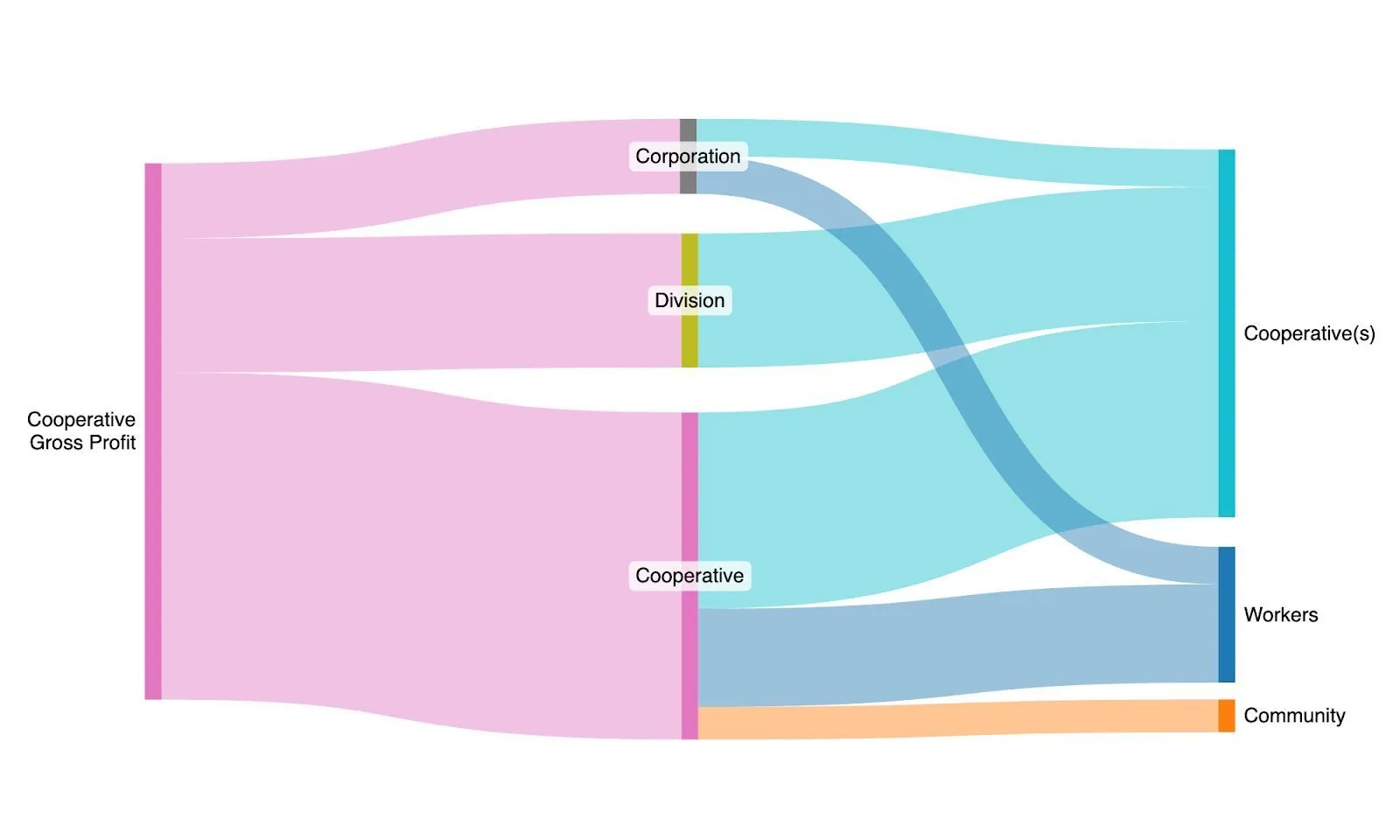
The bulk of cooperative profits stay with the cooperative and its workers, but there are benefits to being part of the larger organizations. Divisions use surplus profits to account for losses within the group, and the Corporation uses half its revenue to invest in their businesses (and start new ones) and the other half to provide social services for workers.
When the Spanish government issued a regulation in 1958 that cooperative owners would no longer qualify for the country’s social security program, Mondragon created its own. They founded Lagun Aro, a social welfare arm that provides pensions for workers and their families, as well as disability services when they can’t work. Eventually, it created its own healthcare service, providing medical care for workers and their families.
When there was a massive downturn in the economy in the 1980s, 20 cooperatives were forced to close their doors, but other cooperatives in the portfolio were thriving so Mondragon just transferred people from one cooperative to another, paying for the education each worker needed to fulfill their new roles. On the whole, jobs rose.
If workers can’t be relocated, Lagun Aro will pay a percentage of their salary for up to 24 months—though Lorenzo tells me this has never happened. The most recent cooperative to shut its doors was an appliance company that once had revenues of €1.3 billion. When Fagor shuttered 10 years ago, Mondragon had to relocate close to 2,000 employees from one cooperative to another, and they did.
“In a crisis situation, where other companies send people home and they waste their time watching videos and smoking, what we do is train them inside, and retrain the force,” Lorenzo says. “People keep working. That's important.”
As their founder used to say, “There are no useless people, only underutilized ones.”
The area has become much wealthier as a result. “A large number of cooperative jobs are industrial so their income level is high,” cooperative communications officer Ander Etxeberria Otadui explained in a video series about the organization. “Studies that analyzed Alto Deba at the beginning of the 1970s already showed that the per capita income was significantly higher than average for the province. Today, it has one of the highest average incomes in the Basque country. Plus it’s more equal.”
As a rule, the highest-paid workers at Mondragon cooperatives earn only six times more than the lowest-paid workers. A worker’s position on the payscale, between levels one and six, also determines their share of the profit-sharing pool. Lorenzo estimates that the president of Mondragon is the highest-paid position with a salary of around €200,000. Managers and directors earn between €80,000 and €120,000.
Workers buy into their cooperative when they become employees, investing up to €16,000 into a “personal capital account.” They pay 30% of that investment upfront, with the remainder taken out of their paychecks over following 2 to 7 years. After two years with the organization, workers can decide to become “members” and start earning interest on their investment, historically at a rate of 7.5% annually. If the cooperative does well, they might earn much more than that. Workers can pull this money out of their accounts when they leave the cooperative or retire.
“It’s a fact that the cooperative system uses wealth in a much more fair way,” Lorenzo says. “Our Gini Coefficient is similar to Sweden or Norway or Denmark, it’s very low. That means the cooperative system, in fact, is a much better way than the capital system for the world.1”
When I asked, at an informational lecture, if people ever leave for better pay, Lorenzo said few do. When another asked how they keep motivation high throughout employees' lengthy careers, Lorenzo recanted: “Your question is asked from the perspective of somebody who is working for somebody else. Here you are working for yourself. We have a higher level of self-consciousness.”
If workers want to try something different they have the autonomy to move elsewhere. Lorenzo started his career in global purchasing and imports for Eroski, Mondragon’s retail brand. Eventually, he moved to Hong Kong where he spent four years working in business development for Intergroup Far East, Mondragon’s international sourcing office. When he returned to Spain, Lorenzo headed up the Asia-Pacific unit for Mondragon Corporation. Craving a change of pace, he then moved to Mondragon University’s business school where he spent a couple of years helping with their entrepreneurship program. Now, he’s working in global public affairs and communications, developing Mondragon’s corporate diplomacy and internal communications.
“I can’t say they didn’t give me room to move,” Lorenzo says. “My wife says they gave me too much.”
Every cooperative in Mondragon’s portfolio is an essential business—these are manufacturing companies, energy companies, agricultural companies, medical equipment companies, banks. They grow our food and power our cities and build our transportation systems. Their research and development groups invent machines and robotics that improve our world. There are no fast fashion or telemarketing companies in their portfolio. This cooperative of cooperatives is run by workers who directly build the things society needs while directly benefiting their communities with the profits they earn making them. They are self-governing locally even as they compete globally, with plants around the world and products and services sold in 150 countries.
The result is that Mondragon has created something of a self-sustaining government—and a pretty good one, I might add. Each cooperative functions like its own democracy, with workers functioning more like citizens. Cooperatives average 250 workers and larger ones often split off into separate cooperatives with separate democracies.
Every year, workers (internally called the “General Assembly”) meet to review prior years’ management, decide how to allocate profits or losses, and approve annual accounts. They vote their board of directors into office (called the “Governing Council”) who, in turn, vote their CEOs into office (called “General Managers”). General Managers hire their own executive team and make periodic reports to the Governing Council who can confer or revoke their powers as necessary. Positions of leadership serve a renewable four-year term and will be removed from office if they aren’t doing a good job.
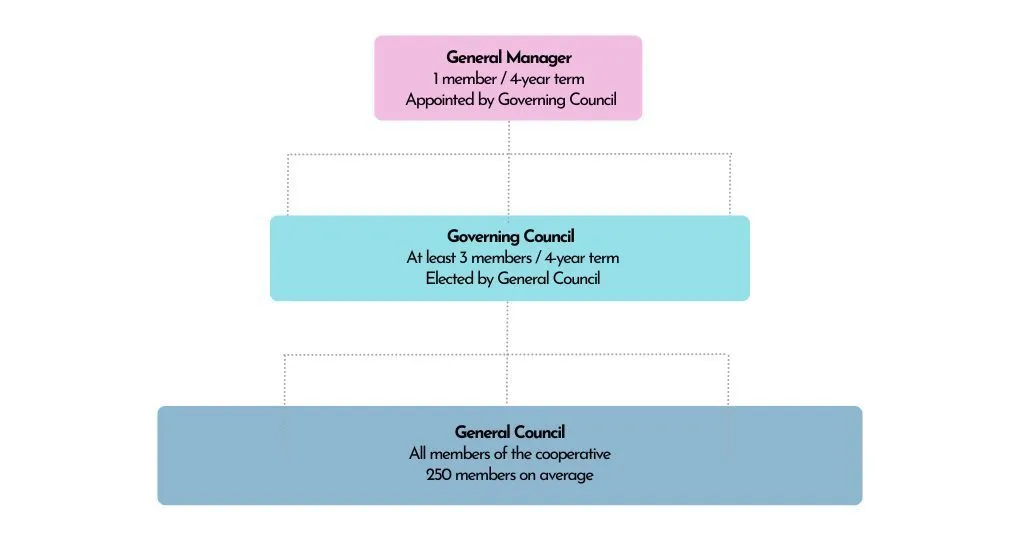
The parent company works similarly: “Congress” is an assembly of representatives from every cooperative. They vote for the “Standing Committee,” who appoints the “President,” the head of Mondragon.
Each cooperative pays for workers’ education at Mondragon University, itself a cooperative in the Mondragon network. There’s even a bootcamp program for General Managers—a sort of entrepreneurial “CEO school”—where executives have the support they need to run financially successful companies, and have the opportunity to learn from executives at other cooperatives who have done so.
Together, they’ve even formed a constitution: The “Rules of Congress” outlines the articles of their organization and includes the corporation’s strategic plan—or “socio-business policy”—which is prepared and voted on every four years. During the time of my visit, Congress was getting ready to meet about the organization's plans for 2025 to 2028. (Reminiscent of my essay: “We should vote for plans, not politicians.”)
Each democratically-run organization is supported by the larger democratically-run Mondragon. Workers at Mondragon cooperatives are guaranteed a job and an income. They are taken care of when they can’t work, provided with universal healthcare if they get sick, receive universal education that trains them for any job, and are provided a pension when they retire. There is no unemployment, no poverty. No one is sitting around collecting handouts from everyone else, they are all actively working and contributing to the system.
And unlike governments, the cooperative provides all of these things with profits, not by taxing income.
Workers at Mondragon still get income taxes taken out of their paychecks, and cooperatives still pay corporate taxes, but at a much lower rate than traditional companies. And those tax dollars go to the Basque Country, itself an autonomous region that uses them (plus VAT taxes on goods and services) to fund things the corporation can’t: like infrastructure and elementary education.
Mondragon’s democracy was, in many ways, a precursor to the ones that would eventually come to Spain. The organization was in business for 19 years by the time Franco died in 1975 and Spain started transitioning to a democracy. The Basque Country was established as an autonomous region in 1979 and they elected their first parliament in 1980.
As the largest employer in the region, Mondragon and the Basque Country evolved together, and they remain very intertwined. “When they try to change the co-op law, they call us,” Lorenzo says. And when Mondragon wants to change cooperative law, they call the Basque Country.
To this day, the two work reciprocally for the benefit of the region. Workers can now choose between Mondragon or Basque healthcare, and they have access to Spanish social security programs along with their Mondragon pensions. Lagun Aro fluctuates to fill in the gaps of government as needed, and the government fluctuates to supply the needs of the region. The Basque government also contributes a quota (called a “cupo”) to the Spanish government to fund defense, foreign affairs, and larger national projects that benefit the whole country.
In this way, Mondragon acts as a self-governing city-state within a larger state and nation. Each individual cooperative has the most authority over workers’ lives, even as layers of Basque and Spanish governments provide larger, but more lightweight methods of governance for the greater whole. The structure works a lot like the one I outline in my essay: “Decouple federal government from nation-states.”
“We work at three levels: With the Basque Government, with the Spanish Government, and with the European Government,” Lorenzo says. “Our aims are global, we want to create wealth, jobs, and develop a better strategy. Every government loves that idea.”
If the model is a good one, detractors say it can’t be replicated outside of the Basque Country, and there’s some truth to that. Once employees are here they tend to be lifers, but getting them here has proved a real challenge. Lorenzo says they hire about 30% of their workforce from Mondragon University, but they need to hire more engineers than they can find in the Basque Country, and that means recruiting abroad.
This is logistically challenging, but also culturally. “In the US, I have to buy a million-dollar house and $100,000 car, and have 80,000 products,” Lorenzo says. “The capitalist world is built on selfishness, individualism, being number one. We can’t attract the kind of hard talent that wants to make money and be number one.”
Living expenses are much lower in the Basque Country than they are in the US, but so are salaries and that can be a tough sell. Dreams of becoming a billionaire are nonexistent. When I published an essay about employee ownership, one person commented: “Why the hell should anybody still start a company and want to become an entrepreneur when he needs to give stocks to every employee he hires? This is completely stupid. If you want to become rich, become an entrepreneur.”
Mondragon is a different mindset. “We feel that our collective ‘us’ is more important than ‘me,’ but they are more independent, individualistic people,” Lorenzo says. “So it takes some time to really convince people that this system is worthwhile. They see sometimes that we are a compromise for a full life, so we have to think in new ways, adapt our system.”
In Europe, cooperatives like Mondragon grew up alongside consumer co-ops like John Lewis & Partners in the UK. The Alta Deba region of the Basque Country isn’t so different from the Emilia Romagna region in Italy where cooperatives like SACMI and Manutencoop are highly networked with one another and cooperatives make up a third of the region’s GDP. In Brazil, Unimed recently became the largest worker cooperative in the world by revenue (Mondragon is second), providing an alternative to capital-based health systems.
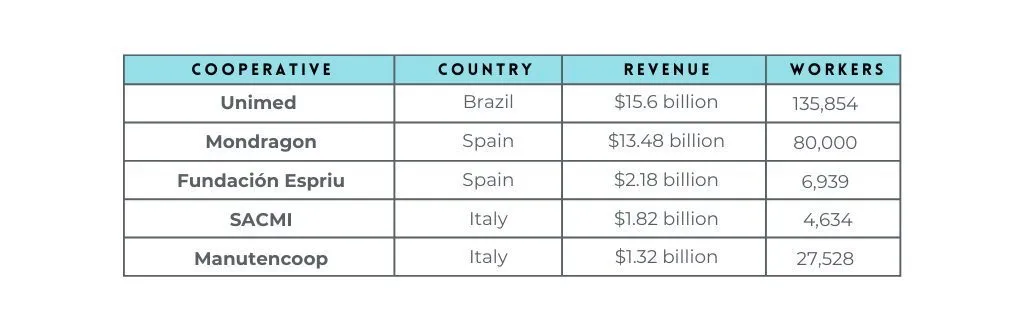
While, in most of the world, capitalism grew up alongside the Rockefellers and the Carnegies of the world, cooperatives in Europe and South America were creating a much better form of it, but it’s a stark contrast. Try convincing the Jeff Bezos’ of the world to start a cooperative. Conversely, try convincing a Mondragon manager to keep the stock for themselves and become a Jeff Bezos. The two models come from two very different worlds.
“I think it is possible to replicate, but it requires people who believe in the model and know how to replicate it,” Lorenzo says. “Before he opened the first co-op, [Arizmendiarrieta] had spent nearly 15 years preaching. He was educating, he was creating mindsets. It’s not a copy-and-paste issue, I don’t think it’s that easy.”
If it’s education we need, Lorenzo admits Mondragon has fallen short. “We’ve been very good at doing, but not very good at telling these last 50 years. That’s why I’m sure your article will give us a good position.”
Even as a journalist, information on the company has not been readily available. The books I read on the subject are only available at company headquarters, the biography of its founder is only in Spanish. Knowledge about the model is limited to academic journals, a sparse Wikipedia page, and a spattering of mainstream articles that extol the benefits of cooperatives without diving deep enough to explain why they’re interesting. After emailing the corporation for a year, I was only granted an interview if I could attend one of the company’s in-person media days which are hosted once a month. I had to buy a plane ticket, rent a car, drive six hours from the Barcelona airport, and rent a hotel nearby to get a meeting—a large expense for an independent journalist.
It makes sense—cooperatives are businesses first and cooperatives second. They have to compete with other companies on the market, and win, to make a profit. Only then can they use that profit more equitably. “We bought the chairs in this room from a company that’s a cooperative,” Lorenzo illustrated, “but we got them because they were the best price and quality, not because they were from a cooperative.”
Mondragon can’t afford to spend all their time proselytizing. What founders do come to study the model might put it into practice, but if they only create one cooperative that benefits 100 workers, Lorenzo says they miss the point. They need to create a network of them to fund new startups, create new jobs, provide social services, and transfer workers between companies. It is the combination of cooperatives that makes the whole thing self-sustaining, not the individual ones.
There are very few of those. As of 2017, there were only 11.1 million worker-owners globally, out of 3.39 billion total workers—that’s only 0.33% of the working population, and it’s not growing.2 Employee ownership is rare, democratically-run cooperatives are rarer still, and a whole network of them? Mondragon and Unimed are really the only ones.
Because of this, Lorenzo thinks we won’t create a world of cooperatives as the founders once imagined. “I think this is fiction because at the end of the day, there are forces in the world that are difficult to scale up.”
If cooperatives are still a niche movement, the movement to make capitalism work better for more people is massive.
As is well documented in Thomas Piketty’s work, inequality has been on the rise since the 1970s when wealth taxes were skewered and executives started getting paid in stocks. Those who owned capital (such as real estate, stocks, and bonds), got much richer, and because they got much richer, they bought more capital. Return on capital exceeds the rate of economic growth, meaning those with significant wealth saw their fortunes grow faster than the economy, the rest didn’t.
A widening gulf now threatens to become much wider and the result is outrage. When the rich can afford mega-yachts and a well-paid software engineer can’t afford a house, we see a rise in the same “eat the rich” mentality that once cost Marie Antoinette her head. In the US, only 40% of those ages 18 to 29 view capitalism positively. Democrats think better of socialism than capitalism, 67% of young Brits do too. According to a Wiley’s worldwide survey, most countries are now anti-capitalist. Their top reasons why are all related to inequality.
The most popular proposed solution is a wealth tax, but that could be enacted by one president only to be thrown out by the next one (or used to fund military endeavors rather than social ones). More extreme options involve eradicating capitalism altogether by returning to subsistence farming and bartering or giving the government control of the economy—we’ve tried both options and neither fared better for humanity than our current capitalist system.
One option, however, has.
Mondragon provides us with a successful, working model. It’s not throwing out capitalism, it’s creating a better form of it. It is still private individuals who own capital, but more of us become owners. Companies are still getting wealthy, but that wealth is put to better use. Rather than create a few rich people only to tax them on the back end, we allow everyone to get richer on the front end. We don’t get there through revolution, just evolution. Instead of descending into “late capitalism” we start building “mature capitalism.”
We need to channel all of that anti-capitalist sentiment into a better capitalist solution, and we can start with what is already working. Most worker cooperatives are concentrated in Asia (8,573,775 worker-owners) and Europe (1,554,687 worker-owners) where cooperatives are a more widely accepted business model and offer a democratic solution where there are less democratic governments—we should build more of those. Though there are significantly fewer in the Americas (982,285) and Africa (37,836), recent policy changes have incentivized employee ownership in the US, Canada, and the UK, as well as transferred ownership to 307,000 workers at 118 firms in South Africa—we should build more of those too.
Around the world, we need founders to start new cooperatives and sell existing companies to employees—we need our governments to incentivize both options, and it’s in their best interest to do so! If we can create more employee-owned companies, maybe we can slowly start edging out the shareholder-owned ones. If we can create a critical mass of them, maybe we can even start federating them together as Mondragon once did. If we can create more democratically-run companies, maybe then we won’t need our countries as much.
With Mondragon-like clusters of profitable, democratically-run businesses, what we currently call government could be sufficiently stripped down to infrastructure and militaristic support.
Anarchist, socialist, and capitalist thinkers alike have gotten behind this solution, with sci-fi authors imagining a world of cooperative city-states. “It’s funny that they use our ideas at all kinds of levels,” Lorenzo says. “Socialist, anarchist, capitalist—at the end our aims are very legitimate. We want to increase wealth, create jobs, and try to develop, in a way, a better world.”
I still think we could get there—that we could create a world of cooperatives. It is at least one of our options. The future is long and capitalism is still new. It is still transforming into something better and evolving into what it will become. Humans are demanding a fix to inequality and companies like Mondragon are providing a successful blueprint we can follow.
In a 2021 book about the founding of Mondragon, authors Armin Isasti and Isabel Uribe thought Arizmendiarrieta’s vision wasn’t yet done: “We need to imagine the future, consider alternatives, form new collectives, and be able to see beyond ourselves. We need to return to utopian thinking; we need people who have the courage to be utopians as José María Arizmendiarrieta was. Far from being satisfied with completing Arizmedi’s utopia, let us continue to yearn after a world in which imagination and hope are alive and active.”
Arizmendiarrieta himself believed that vision was the first step. “Most of what has been achieved through conscious and responsible human effort has been, in first instance, a beautiful ideal,” he said. “And only that.”
So long as we can imagine that beautiful ideal, maybe we can even create it.
This article is part of my book We Should Own The Economy, which I am researching in public.
Thank you for being here,
- 1
Lorenzo is referring to the Gini coefficient for the Basque Country and Guipuzkoa province specifically, of which Mondragon is a large part.
- 2
Many articles use stats about cooperatives as a whole to paint a picture of a growing movement, but those numbers include consumer and producer cooperatives which are not the same thing. You might be a “member” of your grocery store or outdoor retailer, for example, but the dividends you receive give you a discount on goods, not stock and profit sharing in the company. Worker cooperatives are a much smaller portion of the pie—on the World Cooperative Monitor’s list of the top 300 cooperatives by revenue, only five were worker cooperatives.
Get every essay in your inbox
Weekly essays exploring a utopian future.
Join 23,259 subscribers

Yes!!!!! I actually am working on a follow-up article about why I think companies are better than network states as a model for future nationhood (if we do it right).
As for finance capital, I'll talk a little bit about this in future posts, but basically they crowdfunded their very first bank, and then used that bank to then fund every startup they created. Once they federated the cooperatives together, every cooperative started contributing 14% of their gross profits to the parent company, and today the parent company uses half of that revenue to fund the startup of new businesses, or invest in businesses that need to be infused with more capital for growth. They are basically their own VC.

That makes a lot of sense.

Great article Elle. Thank you for the audio. It reminds me of living at the monastery and there lies the difficulty - If everyone is of the same mind then it is possible, but as mentioned people have different aspirations and in my experience wanting less is a place for more contentment, but we have been raised to want more and so the difficulty remains. It does take training to want less while wanting more is the default, no effort required. I loved that you mentioned Ursula Le Guin. Fantastic author. I must investigate more on what she did with her work.
Thanks Xanda, I'm glad the audio worked well for you. I can keep doing it if people prefer to listen! I appreciate the difficulty, but I do think that derivatives can work in other places. Employee ownership, for example, seems a good compromise for countries that maybe aren't as attuned to cooperatives.
Sure, but the problems is that there are so many countries not attuned and it is a monumental undertaking to build the infrastructure for people to be able to do it. Do you have any documents where for guidance on setting up something based on employee ownership? Thanks
Yes, that's true, and part of why I'm writing about it. I'll share all of the resources I've been reading for this series soon!
Thank you.

This is so interesting, and I'm glad you're at a point where you can fund your exploration of this kind of thing. As I'm reading through, I'm just thinking "where do I sign up?" 😂
Sign-up to work at Mondragon? 😆
Totally! Can you get me an interview?
Ha! Sure! 😆
I can't decide what I love more, here! The article itself or the comments discussion! I feel like I'm reading a Cliff's Notes of economic evolutionary thought in late stage capitalism and what comes next for local, state, and global economics and finance. I want to spend time digesting all of this and researching more. And this kind of avid engagement and dialogue is exactly why I will keep throwing money at this work. The capitalist in me appreciates exchanging my funds for the services and goods being provided here and the optimistic futurist in me recognizes the enormous potential of this collaborative creation and distribution of knowledge by all of us who engage with Elle's products and services. Thank you!!
Lee, I can't tell you how much this means to me. Thank you so much for taking the time to thoughtfully engage with my work. I so resonate with the struggle of, "yes capitalism is the best economic theory we've experienced so far, AND it could work so much better!" I'm still piecing together what that could look like, but I'm grateful to explore that here with so many incredibly smart people!

Awesome article, Elle, and I’ve been looking forward to it! I wish we had more of this in the US. I used to work in a minor capacity for SAIC when it was employee owned and I always try to buy my flour from Bob’s Red Mill, and I buy my sugar from the farmer-owned Michigan Sugar (although that’s different, I know).
I was going to say the same thing as the earlier commenter: that this is really a form of socialism, not capitalism. The Wikipedia definition of socialism is quite broad and covers social ownership of the means of production, which includes employee ownership: en.wikipedia.org › Socialism (And since the workers are owners of the company, they do own the means of production, right?)
It’s right there in your article when the Mondragon official told the questioner it’s a whole different mindset than the individualist focus on getting rich. Actually maybe it’s a step beyond socialism to communism, when the state will “wither away,” which is essentially what you’re proposing. But socialism and communism are scary words, so maybe “employee-owned capitalism” is a better way to sell the idea.
But that’s all really a question of semantics. Let’s just focus on the practical aspects of bringing this model over to the US. You’ve gone a long way to making this model better known.
Anarchists, socialists, and capitalists all want to claim the model 😆 But in reality I think it incorporates something of all of them which is why employee ownership is such a universally accepted idea.
Maybe it’s a model that transcends all our prior definitions. “Employee-owned capitalism” is a label that would probably have wide appeal and avoid those scarier words.
Yes! I do think it transcends all definitions.
Oh! There’s also a bit of anarcho-socialist-capitalist employee ownership at the very end of _Ship of Fools_, and it’s enacted by a libertarian.

“But that’s all really a question of semantics. Let’s just focus on the practical aspects of bringing this model over to the US. You’ve gone a long way to making this model better known.” Excellent advice Larry.
I believe it goes beyond semantics, I think the correct names for what you're doing help to identify who your allies and your opponents are. If you're proposing a socialist solution then logically your allies are other socilaists, unionists and labour organisers. Your opponents are the capital markets and the employers' associations. That kind of clarity helps get practical results through the formation of appropriate alliances and actions, it's not just an academic debate.
There are no opponents and allies here. We can all get on board with this solution.

Elle, you say in your post , "Knowledge about the company is limited to educational materials, a sparse Wikipedia page, and a spattering of articles that extol the benefits of cooperatives without really explaining how they work". I don't want to sound nasty and school-marm-ish here, but actually a lot has been written about Mondragon, mostly by academics, but also in the last few years in the general media, say, by Nick Romeo for the New Yorker and P. Goodman in the New York Times. The Financial Times I believe also sent a journalist here in recent years. Here's a list of just a few.
Arando, S., Freundlich, F., Gago, M., Jones, D. C., & Kato, T. (2011). Assessing Mondragon: Stability and Managed Change in the Face of Globalization. In E. J. Carberry (Ed.), Employee ownership and shared capitalism: New directions in research (pp. 241–272). Labor and employment relations association at the University of Illinois Urbana-Champaign.
Arregi, A., Gago, M., & Legarra, M. (2022). Employee Perceptions About Participation in Decision-Making in the COVID Era and Its Impact on the Psychological Outcomes: A Case Study of a Cooperative in MONDRAGON (Basque Country, Spain). Frontiers in Psychology, 13. frontiersin.org › fpsyg.2022.744918
Azkarraga, J., & Cheney, G. (2019). Mondragon: Cooperatives in Global Capitalism. In S. Berger, L. Pries, & M. Wannöffel (Eds.), The Palgrave Handbook of Workers’ Participation at Plant Level (pp. 205–220). Palgrave Macmillan US. doi.org › 978 1 137 48192 4 11
Basterretxea, I., Cornforth, C., & Heras-Saizarbitoria, I. (2022). Corporate governance as a key aspect in the failure of worker cooperatives. Economic and Industrial Democracy, 43(1), 362–387. doi.org › 0143831X19899474
Bretos, I., & Errasti, A. (2017). Challenges and opportunities for the regeneration of multinational worker cooperatives: Lessons from the Mondragon Corporation—A case study of the Fagor Ederlan Group. Organization, 24(2). doi.org
Cheney, G. (1999). Values at work: Employee participation meets market pressure in Mondragon. ILR Press, Cornell University.
Freundlich, F., Leceta Ruiz de Alegría, I., Loyola, A., & Legarra, M. (2023). The Mondragon Corporation and its member company Soraluce: The accomplishments and challenges of broad, networked employee ownership over six decades. In G. Hernández & R. Zuloaga (Eds.), Ownership in the Americas: A Path to Shared Prosperity. ITESO-Instituto tecnológico y de estudios superiores de occidente.
Kasmir, S. (1996). The myth of Mondragón: Cooperatives, politics and working-class life in a Basque town. State University of New York (SUNY) Press.
Mathews, R. (1999). Jobs of our own: Building a stake-holder society. Pluto Press Australia.
Stikkers, K. W. (2020). Institutionalizing the Common Good in Economy: Lessons from the Mondragon Cooperatives. Humanistic Management Journal, 5(1), 105–115. doi.org › s41463 020 00093 8
Whyte, W. F., & Whyte, K. K. (1991). Making Mondragon. The Growth and Dynamics of the Worker Cooperative Complex (2nd edition). ILR Press.
You are so right, and I read some of these materials in my research. I admit that I lumped many of these into my "educational materials" point which was maybe too vague. What I meant more specifically is that, though Mondragon has been a successful working model for decades, the case study still isn't as well known internationally as it should be. Apart from a few articles written in the mainstream media (the ones you point out), most of these are PDFs written for academic and niche journals. My point was that there need to be a lot more of us working to make Mondragon a much better understood and more widely known model internationally, because it's very much one we should all be learning from. I apologize if that wasn't clear, and I appreciate you pointing out these additional resources for other readers who want to research the model and dig deeper.

Thanks for sharing this list Fred, really appreciate this list
Hi. Very interesting exchange. Thanks to Elle and the other participants. I've been working in Mondragon for many years and most managers I've heard talk about this say quite openly that they created foreign subsidiaries to protect employment / the co-ops at home in the Basque Country. If their conventional competitors located in low-wage countries and significantly lowered their production costs, then the co-ops are, at some level, obligated to do so. ... though it is a complicated debate. Many agree with German Lorenzo about the lack of suitable legal structures (and financing mechanisms) for worker co-ops in many countries, though some commentators argue that other kinds of legal structures could be used to share ownership in those places. Other multinationals that share owneship broadly with employees in their home countries have found ways to do it in at least some of their foreign subsidiaries. W. L. Gore (of Goretex fame) is an example. ... Many think it is partly a question of priorities and risk aversion. The issue has arisen several times over the years in Mondragon group-wide debates, but serious action has not been taken. Some enteprising, committed Mondragon co-op will have to "take the plunge" at some point if others are to begin to be persuaded. It's a tough one.
Thank you so much for this perspective Fred, I so appreciate it! I'm very curious about the idea of how this model can be replicated both within and outside of Mondragon so this is helpful to understand.
A truly comprehensive story with beautiful but useful graphics

Been daydreaming about a similar concept for a while. I have never heard of Mondragon until now! Thank you so much for this write up. Really opens my eyes to a proven framework. Excited to learn more about Mondragon and how I can attempt to replicate their systems here in the US.
Thanks Kade!!! So glad it was helpful! More posts coming....
What a concept! I have always promoted employee owned businesses. Out goal and process should become activist in pursuit of this kind of reality. Wonderful essay!
Thank you so much! I'm so with you there!

This is super interesting! I feel like I'd vaguely heard of Mondragon before but I definitely didn't know what they did. I hope information about them can be more widely spread in the future, starting with your essay of course!
Their story got me to reflect about capitalism too. Like many, I'm quick to blame capitalism for everything that's wrong with the economy today but it's worth remembering that we might not have to abolish it completely to find a better solution. Thank you!
We definitely need these ideas spread far and wide, because we certainly don't need to abolish our entire economic model to make it better!
If only revolution & anarchism weren't so romantic... (kidding)
Honestly though, I think some people think that way!

This is a good article about Mondragon. It has always been one of my models for a co-operative socialism. The early US populists would have called it "co-operative democracy." Like others here, I have a small quibble over the use of "capitalism," which requires the primacy of the market for capital (not other kinds of markets). Over the past decades, I have worked on keeping my mind free of ideology, but I still can't see how a society of worker co-ops is in anyway compatible with the capital market. They seem fundamentally opposed. That may be a semantic quibble, and I agree with those who say, whatever works to change the system.
I think cooperatives are clearly within the idea of capitalism. They still have private ownership, free-floating prices, voluntary paid labor, voluntary investment, and voluntary customers. I would also assume that they can raise capital from corporate bonds and potentially raise capital from the owners.
The only real difference that I see is that the owners and the employees are the same people. If some people want to call it a type of “socialism” then I have no objections, particularly if they are willing to go with all the other capitalistic characteristics that I listed above.
The best way to run a decentralized society is by understanding and maximizing collective intelligence using swarm intelligence systems. Like so open.substack.com › how to fix corrupt government in
What does this have to do with the article?

The audio was great — pls keep including that!
Thank you for this feedback. I'll keep doing that!
Great article. I generally am not big on utopian ideas, but this article does get me thinking about alternate versions of capitalism that preserve almost all the benefits of capitalism while reducing some of the more negative effects.
I can definitely see how the model might have difficulty recruiting highly-skilled labor and top-quality managers. With presumably lower salaries and the need to “buy in” with a significant amount of cash, I think this would be a competitive disadvantage. But it does seem great for lower- and middle -skilled jobs.
I do wish that there were more ESOPs and cooperatives. Perhaps an elimination of corporate taxes for them would be a reasonable incentive to get them going. With proper publicity, this might be something that both the Left and Right can agree on.
Thanks Michael! One interesting thing is that they believe that highly skilled labor and top quality managers can be taught rather than recruited. After all, management positions are voted into office, not recruited from elsewhere. But Lorenzo hinted that the model might need to be tweaked in other ways going forward and I could see buy-in being one of those ways. I agree that there should be more ESOPs and coops and that we should incentivize them!
Thank you for your article Elle. It is very helpful to something I am working on as a project. I will send you a link when it is ready and of course you will be fully credited.
Thanks Steve!
This is a great article, and the most comprehensive and readable one on the Mondragon Cooperative network that I have ever seen. Congrats.
As it happens, I lived in Oñate, a small town near Mondragon, in the early 1980s. Even then I heard talk about the co-ops.
I ended up becoming a journalist and newspaper reporter interested in these sort of subjects. In my last book, The Surprising Design of Market Economies (Texas 2012), I have a chapter on worker-owned cooperatives as a better kind of capitalism. You might enjoy reading it. I focua mostly on Minnesota, which for the USA is the most co-op centered.
Oh very cool, thanks Alex! I’ve heard that about Minnesota.
Thanks for the article Elle, came across you from Michael Shumans substack.
It's great to hear a more recent analysis of Mondragon. I've got an earlier book on Mondragon called 'Jobs Of Our Owm' by Race Matthews from 1999 that part inspired me to do what I do today with the Food Connect Shed in Brisbane Australia.
In the Australian context and this current business paradigm I'm trying to blend the best of Associative Economies with the example of Mondragon and other cooperatives of autonomous enterprises.
Thanks again
Rob
Hi Robert, sounds like you are doing some cool work! Anything that can be more Mondragon-like is headed in the right direction, in my opinion. 😍
Totally, I wish I had the basque fervor for community solidarity over her down under that they have.
They're a pretty wild and passionate protective of their culture the Basque. I'll never forget being told 'Before God, were the Basque' from a time perspective that is :)
Oh I so agree. As I mention in this post, even Mondragon founders later became discouraged that the youth weren't as diehard about solidarity. And some countries (like mine, the US) are far less so!
Omg don’t even start on that. How your are keeping positive through all that is very inspiring Elle
Have you looked at how L’Aubier in Switzerland is organised Elle ?
It’s one of my favorite inspos
Really fascination financial model
No, I haven’t even heard of it!!! What are they doing!?? Do I need to study it?
Absolutely you do :), circles of entrepreneurs who are highly financially and economically literate capitalized by the public. below is an excerpt from our latest report 'Regenerating the Regions'
4. L’Aubier (Switzerland)
L’Aubier is a food-focused farming and hospitality enterprise located in Switzerland, based on the economic philosophies of Rudolf Steiner. The legal structure is described as the ‘Right On Corporation’. It comprises a sophisticated 2000 member participatory model made up of a Public Limited Company, an ‘Ideal Purpose Association’ and a business partnership.
• Founded: 1979
• Scale: Dairy, Fromagarie, Bakery, Restaurant, Commercial Kitchens, Eco- resort with seminar rooms & conference centre, Farm Shop, Cafe, Coffee roasting, Training Academy, small Eco-hotel plus residential eco-housing and apartment estate.
• Model: True Price, whole of supply chain, vertically integrated, community owned.
• Operations: ‘Associative of Enterprises’ operating under the Associative Economics principles with 50 employees.
• Community Impact: Significant sustainable and ecological commitment to the region with a high value on financial literacy training and application.
• Unique Features: Financial sophistication - 735 Shareholders, 617 Bondholders, 150 Direct Loans and 140 ‘Subscriptions’ totaling CHF1.0 million (2024 situation)

Absolutely fascinating.

Wonderful and inspiring, thank you!
Brilliant- thank you for this

Well that was just awesome!
My Great-great grandfather started a cooperative factory in Rochester New York in the 19th century. Made stoves and heaters, and was thriving and well-regarded.
Wow, that is so cool!!!!!!

Thanks for this deep dig. I've been meaning to read the Isasti / Uribe book and Arizmendiarietta's "Reflections" for clues on whether something Mondragon-shaped might be possible outside the uniquely Basque sociopolitical context.
I spent some time in Cuba in '14-16 and there was hope its agricultural cooperative model applied to "urban cooperatives" would create a structure for things like small manufacturing and even professional services, but alas.
I've been thinking a lot about this and I have some thoughts. A piece I'm working on that will publish in May is about how we can create modern Mondragons. Current limitations to the cooperative model make it incredibly difficult to scale, at least in places like the United States. But Arizmendi was up against similar rules and regulations and had to find loopholes around them, we will have to do the same and I have some ideas about how we can do that. Still researching though....
I look forward to reading it! I had a nice conversation the other night with someone working in this space, essentially consulting to businesses that are making the transition to being worker-owned, or with some alternative structure.
A fun thought experiment is whether offering Boomer small-to-mid-sized enterprise owners an offramp to pass the company to employees would be a preferable legacy to private equity and subsequent rot and shame.
Yes, employee ownership as a succession strategy is our main off-ramp. And I've written about that before here: elysian.press › founders can make millions selling to…
I'd also love to see it become our main exit event. But that's what I'm currently researching!

Based on changes in economic policy in Cuba of late, there will definitely be urban manufacturing cooperatives in Cuba. IMnotsoHO.

Excellent write-up on Mondragon by Elle Griffin.
Thank you Andy!

Capitalism gives Capital a bad name. There is nothing wrong with Capital – it is a brilliant tool for creating wealth – but has just been expropriated by the greedy.
This is a brilliant article and piece of research. Thanks Elle. I live in Spain now and have seen Mondragon's impact. A really hopeful alternative to the current mess we live in.
I also love your point, in a nod to the libertarians, that if we opted for coops and social enterprises as the main form of business organisation (leaving a small wild sector where the sociopaths etc who currently run our world could eat each other in unfettered uber capitalism), then government could be much smaller – it would not need to do what it does now – mop up the mess made by Capitalism.
Many congrats on this piece Elle and your work.
Exactly, capital is good! The problem with capitalism is that there are not enough capitalists. That’s what organizations like Mondragon are trying to change.
Thanks for the kind words about my work. More to come!

Brilliant piece!
I work for Symbiota (symbiota.coop), the UK-based worker co-op behind the Dandelion events platform (dandelion.events) and I take huge satisfaction from working in a co-op!
Thank you, and wow that’s very cool!

🙏

Thank you very much for this article! I was hoping this economic system was more portable. Sounds like any gains to a more equitable Capitalism are going to be more painful than I hoped
Don’t worry, I have a follow up coming this fall that details a better way toward creating more Mondragons than creating more cooperatives (which is nearly impossible with our current systems!)

Thank you for keeping a fire going for the example of Mondragon & other cooperative initiatives. You have been extremely generous with all your thoughtful responses to inquiries and exclamations about what the Mondragon collaborative is or isn’t in term of how it fits or not in certain current political societies. Personally, I sense a deep pragmatic spirit that favors positive outcomes for the people involved in the work, with both capitalistic and socialistic patterns used when and if appropriate based on the collaborative entities’ experiences, needs & vision.
Part of what attacks me to Mondragon is Fr. Arizmendi’s deep faith in the dignity of each individual human being & their specific call to work in their times & circumstances. Somehow he was able to convey to and imbue in his fellow collaborators the same commitment to each other.
There’s something more than a specific methodology or educational program behind all this effort to humanizing work and social life.
Yes, exactly. Arizmendi was a humanist, and believed in human dignity for everyone. I wrote a follow up about him and his ideology that led to Mondragon if you’re interested: elysian.press › the cooperatist manifesto of mondragon
Elle, it is the day before the Trump US Presidential inauguration. This article resonates with MAGA ideas. Maybe the US will move in this direction as the dust settles from Trumps cleansing actions. Food for thought and something to consider.
Great article, thanks.
Thank you for this piece. Very interesting to learn more about Mondragon.
Glad you enjoyed it!

Okay so I finally got round to reading this and it puts forward a good case for the mass-cooperative model.
My biggest criticism, I guess, is how we get from here to there - there's a clear destination but no obvious path to get there. Whether this is an impenetrable obstacle or merely a hurdle to overcome - well, I suppose we won't know until we try!
I think the path there is:
1) Incentivizing the model as outlined in this post: elysian.press › founders can make millions selling to…
2) And with that incentive in place, more founders choosing to make their companies coops and selling them to employees.

Coming to this a bit late from ACX. The question foremost in my mind is: how do they hire and fire people? It's great that within their selected group of employees they are so collegial and still manage to make a profit. But sustaining that collegiality while still succeeding in a competitive market demands the ability to exclude people who aren't going to be net positive contributors for whatever reason. And that exclusion inherently limits how egalitarian they can really be in the larger scheme of things.
Mondragon does have the ability to lay people off, and in some cases they have also offered early retirement packages. But laid off people also have the right to appeal.
As people don’t become members until two years after working at the company, it is unlikely that they would become laid off after that point. It would be more likely that they would reskill or join other parts of the organization to which they are better suited.
Ok, but those are the easy cases. What I mean is things like:
— How do they screen during hiring for people who will actually work productively despite not being able to make 10x money for 10x productivity?
— How do they fire people (fire for cause, not lay off) who either have an attitude problem or some other issue that caused them to become unproductive or negatively productive (e g. malfeasant)?
If they claim the latter case never happens I call BS. You can make it rarer with good management (including very selective hiring!) but you can't avoid it entirely in any org of sufficient size.
By laid off, I mean fire. They can absolutely still fire people.

I’m curious what makes this a capitalist model? It seems like it’s an instantiation of the idea of workers control on the means of production. And is perhaps inspired by the anarcho-syndicalist organizational forms that rose up during the Spanish civil war?
I see that they have clearly had to think about how to build productive companies in a larger capitalist context. But the capitalist class structure where a small group of employers control most of the wealth at the expense of the majority sounds absent from their community based on the description. Their emphasis on creating new mindsets toward life and wealth also has a revolutionary feel, and strikes me as resistant to a number of aspects of capitalist culture (prioritizing self interest, consumerism).
Just a few thoughts. I’m curious why folks think this is capitalism?
I think the misunderstanding here is in how we think about capitalism. It is often thought of in the same vein as communism, as a way to structure society, but capitalism is really far more observational than prescriptive. Our (western) society really isn't capitalistic in the way a communist society is communist.
Current society really doesn't care or prescribe how companies should be run or owned. You can start companies with a single owner, owned by many shareholders, owned by nobody as non-profits, or indeed employee owned, society really doesn't care either way.
But we can observe than when people get this freedom to structure companies however they want, the vast majority end up structured by the capitalistic model with owners and employees. There can be many reasons for this, and we can think that this is an unfortunate outcome, but the really interesting question is if there could be a better model, and if more people knew about it, could it eventually take over as the dominant model.
Employee owned companies are interesting because they could potentially end up being that better model.
That makes sense and yes I agree! I think in my view a central feature of the capitalist model is the separation between owners (capitalists) and employees (workers). In that relation the owners have the power over the company and are not really answerable to the workers. The interesting thing to me about this setup is that it breaks down this divide. The workers are the owners, and the people who manage the company are answerable to their democratic power. It seems like a promising approach!
I so agree, I think the breakdown of this divide is really interesting. And it can happen right now within our existing business structures without having to overhaul our whole economic system!
This is very well said. Capitalism isn't an ideology like socialism or communism, it's what naturally evolved out of our desire to trade with one another. Companies compete on the market, and the owners of them become wealthy (or not) in the process, but how the company is configured on the backend doesn't really matter to that process.
However, we are starting to realize that there are alternative ways of configuring companies on the backend that might be better, and there are things our governments can do to incentivize those models (even while the other ones still exist.) Until now, there has been an incentive to wind up with the "owners and employees" model because of the simple fact that the other models didn't exist as a business structure. At some of its subsidiary plants in China, for example, Mondragon isn't legally able to make those plants cooperatives so they have to give those workers their "profit sharing" through annual bonuses. Cooperatives and employee owned businesses only started getting these incentives in the last few decades!
Thankfully, I think we are starting to see these as better alternatives and we are seeing that reflected in government policies!
I actually think that employee owned businesses are much more common than we are usually aware of. It is easy to look at cooperatives like Mondragon, and notice how different they are, but employee owned businesses are actually all around us and have been around since the start of capitalism. They are just not noticed, because they are largely reserved for high-skill/high-compensation businesses, like law, accounting, finance, and medicine.
General Partnerships are a very (if not the most) common way to structure businesses composed of high-skilled individuals, and are all around us. There may be some variation in their structure, some with all employees as partners and some with distinction between partners and salaried employees, but all are without external ownership.
Some, like Venture Capital, even have found ways to get outside investment without giving up ownership and control. They do this in the form of Limited Partners (LPs), that invest money in the business to get a share of the profit, but without getting any say in how the business is run.
I think it could be very interesting to do a deeper dive on the similarities and differences between this and the co-op model. There might be a more encompassing model to be found in the intersection.
It's true that there are plenty of cooperatives and employee-owned businesses, but that doesn't make them common. Today there are roughly 6,322 employee owned companies in the US. There are 1,030 in the UK. And as I show in this post, there are only 11.1 million worker-owners globally, out of 3.39 billion total workers—that’s only 0.33% of the working population. Very miniscule.
General partnerships are interesting, but that doesn't mean they provide equity to employees. There are certainly prominent tech companies that do, and you're right that it would be great if we could include some of those in our stats—I'll look into that. Still, most equity packages are reserved for senior employees, not all employees. And at private companies most employees won't see the benefits of that equity unless the company sells or goes public so it's kind of imaginary until then. But you are very right that it's a segment worth investigating.

After reading the first third of Too Like the Lightning, there's one thing I've been mentally chewing on related to company-states. If they have to compete in a fair market, it makes them susceptible to disruption. And if they're susceptible to disruption, what happens to the 'state' side of the organization? For example, if Nokia or Blackberry had been a company/cooperative/state when Apple came out with the iPhone, I feel like the commercial disruption would've happened too fast for a graceful migration of the state/social parts of the org. Put another way, growth in large companies happens slowly, but disruption happens really fast.
I guess if everyone is structured as a coop, then you can just go work for the disruptor coop. But then we run into the problem that structuring a company that way in the early stage inhibits growth.
While reading TLTL, one thing that keeps nagging at me is the thought of 'what happened to all the upstart competitors? Do they all get bought/die? If so, what's pushing innovation forward?'
Anyway, great post. Really loving the longform content again :)
Hmmmm good questions!!!! I think, if Nokia and Blackberry were networked Mondragon-style, ideally those employees could have moved to another (non phone related) business in the portfolio when they failed. OR they would have had an R&D company, as Mondragon does, that would have researched and known this ahead of time so that their BlackBerry could have have innovated and competed with the iPhone. Or yes, move to a competing co-op.
In Terra Ignota, I do believe there used to be other upstarts that got merged into the larger ones. (The Olympian’s into the Humanists, for example) But I still don’t know what benefits the hives are providing their citizens, especially with them spread across the planet. So I’m not really sure why you would pick one over another apart from personality reasons really? But I’m excited to talk about this with the group!
And thanks for the vote of confidence on the long form. I’m loving writing it!
I think disruption in most historical cases only applies to one industry or one product niche at a time. Whereas the coop of coops model like Mondragon holds business assets across diversified industries. This makes the larger organization much more resilient to disruption.
Now with that being said, AI and robotics are likely to disrupt nearly every industry and market segment simultaneously when they reach a threshold sophistication level. So that is a whole new can of worms, but capitalist society is positioned much more poorly to implement this technology for the benefit of the masses than a cooperative state like Mondragon.
Even in the current presidential election here in the US, AI has been almost entirely absent from the conversation. The level of disruption coming to modern American society is unfathomable and if we do not make swift changes in how we organize our societies, we are likely to experience a civil war or revolution.

I appreciate your effort Elle. Travelling all the way from the US. Just one question... Why do you think they are not as transparent with their information? you say they only keep it in Spanish and in their HQ? If it so good why not share it with everyone? Why keep it locked up? Just curious to know your view.
They are very transparent with their information, and it’s certainly not “locked up.” The books about the corporation were simply made for their educational center and their universities, which are in Spain and in Spanish.
Interesting... But can we buy their books? Or access this information without being part of their universities? I would like to read them!!
Not right now, they don't have a bookstore. I'm working on seeing if we can get more of this work translated and into other markets!
Well, if you want help translating or whatever you need, I'm a trustworthy Spaniard ;)

Brilliant article! Your outlines of the cooperative’s structure and implications for a fairer economic system were clear and persuasive. Your writing makes a strong case for the potential of cooperatives to transform our approach to capitalism, leaving me with much to think about...as ever.
Thank you so much Jon 🥰

You speak of this as a capitalist solution, but it does not have room for any capitalists. Worker ownership is a socialist solution.
I disagree. See my reply to a similar comment.
Under capitalism, capitalists are able to own businesses and receive passive income from the work of others—managers, etc. How does that work with co-ops?
Yes, they are able to do it, but there is nothing inherent within the system.
Yes, a government that made such a practice illegal would correctly be defined as “socialist.”
The proof is that there are many coops with capitalist nations. I would argue that the only way for coops to grow is within a capitalist system.
As I mentioned in another response (which may be hard to find at this point):
I think cooperatives are clearly within the idea of capitalism. They still have private ownership, free-floating prices, voluntary paid labor, voluntary investment, and voluntary customers. I would also assume that they can raise capital from corporate bonds and potentially raise capital from the owners.
The only real difference that I see is that the owners and the employees are the same people. If some people want to call it a type of “socialism” then I have no objections, particularly if they are willing to go with all the other capitalistic characteristics that I listed above.
A market system is not the same as a capitalist system. The point here is that with a co-op, the workers benefit, not a rich owner. The owners are the people who actually do the work. A co-op cannot be passed from one rich person to another for the sake of profit. It exists to benefit its workers. Yes, co-ops can exist within capitalism, but the fact there are few shows how difficult it is to have something that goes against the economic interest of the privileged class.
Just while digging around on further research, I thought you might find this description of a visit to Mondragon by an American visitor like yourself of interest. She points out some criticisms of Mondragon, most saliently that the foreign subsidiaries are not in any way organised as co-ops.
medium.com › mondragon through a critical lens…
"most troubling, was the issue of international workers who are not members of the cooperatives. As with many successful firms, regardless of structure or industry, much of the growth in recent years has come from international markets, which now account for 70 percent of Mondragon sales. This has necessitated hiring new workers in those new markets. Few, if any, of these new workers have been offered membership in the cooperatives. As a consequence, they do not participate in the benefits of worker-ownership. While they are reportedly treated well they do not participate in the governance of the firm and are not eligible for many of the other unique benefits of the cooperatives."
This is indeed troubling, if the idea is that Mondragon's co-op model is to be exportable around the world yet foreign subsidiaries are just capitalism-as-usual, essentially a type of commercial colonialism.
The reason why many Mondragon subsidiaries are not cooperatives is because cooperatives do not exist as a business structure in most other countries. Lorenzo said, for example, that China doesn’t have the option, so their plants there have to give employees their “profit sharing” as annual bonuses instead.
OK that seems fair enough, if there is no legal way to implement it then they can only do the best they can do.
Do you know what nations those subsidiaries are located in? Are they mainly to take advantage of cheaper labor, or are there other causes?
I don’t know, as that’s not mentioned in the source I have, but Elle has mentioned China.
Years ago Fagor, the electrodomestic arm of Mondragon, went bust. It was subsequently rescued, but it raised alarms about the brittleness of a business based entirely in Spain. This may be behind the expansion to other nationss.
I admire and fully share your passion for the co-op model, but I find your conceptual confusion very perplexing. A co-op is not a capitalist enterprise, by its nature it's socialist. A capitalist enterprise has the capitalist(s) who own(s) the corporation, and the workers under the capitalists' orders who are exploited to create a profit. That's what capitalism is.
So this sentence is a theoretical nightmare: "Could we eventually create a capitalist paradise where democratically run companies use their profits for the good of their worker citizens?"
Such a paradise would by definition not be a capitalist paradise, it would be a socialist paradise.
This is not a mere semantic issue. If we're not clear about what we're doing, we'll just end up with a new coat of cosmetic on the same old capitalist dystopia that we have now - let's call it pinkwashing by analogy with the greenwashing that disguises environmental destruction with shiny green labels. It's a bit like that commune in The Last of Us, where even some of the members it still think they're all-American capitalists, and can't recognise what they really are.
youtube.com › watch
So keep up the good work but please be honest with yourself about what you're actually doing - you're promoting a socialist transformation of society, and good for you!
It is true that there are many socialist thinkers who use Mondragon as an example of socialism, but that is not the true definition of the term. Socialism means that the means of production (the economy) is owned by the state. The most common textbook case study of this is the USSR.
Capitalism, on the other hand, means the means of production are owned by private individuals. As in, companies are owned by people, not the state. In this way, Mondragon is as capitalist as Google or Apple. The only way they differ is how they use their profits. The means of *distribution* might be socially owned, but not the means of *production*.
A similar example of this might be the Nordic countries: their means of production is capitalist (that is, the economy and the wealth it generates is owned by private individuals), but their means of distribution is social (that is, the government then uses that wealth for the greater good). This is often called a social democracy.
So yes many claim the ideas here are socialist (and maybe they are in distribution), but they are actually capitalist in production.
That said, there’s a reason anarchists, socialists, and capitalists all want to claim the model. Perhaps we’ve finally found something that incorporates something of each of them. Something that transcends all three of those terms.
I disagree with your definition "Socialism means that the means of production (the economy) is owned by the government."
There are many forms of socialism, from the statist socialism that you describe here to the libertarian anarcho-syndicalist socialism that you're actually working towards but cannot recognize as such, due to some kind of unwillingness to recognise what it is.
A co-operative by definition is the means of production owned by its workers.
A capitalist corporation by definition is the means of production owned by a private owner or any number of such using a stock or share mechanism to split ownership. This corporation then employs workers to generate added value which generates surplus. The workers do not own the corporation or the means of production, they are exploited by them.
We've been working through Schneider, you and I, and Schneider like you is focused on pragmatics and is extremely light on economic-political theory. But even he recognises what's going on when he quotes Bauwens, who works to create co-ops in Bolivia:
[Sorry using an e-book, no page number possible]
"He believes that cooperatives are the event horizon. They’re bubbles of peer-to-peer potential that can persist within capitalism, and they can help the coming transition proceed. They can decentralize production through local makerspaces while continually improving a common stock of open-source designs. They can practice open-book accounting to harmonize their supply chains and reduce carbon emissions. Open intellectual-property licenses can help them share their resources for mutual benefit. As these networks grow, so will the commons they build, which will take over roles now played by government and private markets. Soon all the free-flowing information, combined with co-op businesses, will turn the economy into a great big Wikipedia or Linux—by anyone, for anyone. The industrial firm, whether capitalist or cooperative, will dissolve into collaborations among peers. Bauwens calls this process “cooperative accumulation.”"
Schneider "Everything for Everyone" Chapter 7
It's clear from this description that capitalist and co-operative are separate ways of conducting an enterprise in this model, and the co-operative is seenas a transition into something that is not capitalist.
I think the general confusion here is that people imagine that "public ownership" is the only alternative to "private ownership", therefore socialist = state-owned, where in fact "worker ownership" is another distinct mode of owning the means of production, leading to a ground-up form of non-state socialism. The role of the state is to fade away under this model of socialism, just as is described in Marx's work.
To me, this comment is besides the point. This model is different than the one Marx proposed, it’s also different from the one Milton proposed. You could call it anarcho-socialist if you want. You could also call it anarcho-capitalist if you want (there’s a book by this name that would make that case if you’re interested). You could call it anarcho-social-capitalism if want! But extending all of these terms to try to encompass democratically run employee owned companies is trying too hard to make this into an ideology rather than what it actually is: a working model that all of these ideologies can get behind.
I simply disagree that capitalism is in any way compatible with this model - if it ever became a serious alternative to capitalist orthodoxy, then capitalists would shut it down - buy it out and close it down. It's best seen as a ready-made alternative for when the transition occurs.
Anarcho-capitalism is just a silly term for a silly thing that wouldn't interest me in the least. I've argued with such an-caps before and they have literally nothing. Their arguments are not even arguments but overwrought cowboy fantasies.
Being "post ideological" is a choice, but it's really quite illusory because political ideologies are not simply words in a book which you can somehow live without, or agree to differ on, they are active schemes to organise society.
Exactly 👆🏻
This is the problem of ideology. It reduces commentary and debate to preset norms and definitions which crowd out any new thinking. Both capitalism and socialism are degenerate terms distorted by whichever power group wants to gain influence by employing these norms. Cooperatives are different to either conventional capitalism or socialism. They continue to evolve in their unique conceptual space and resist easy categorisation, it is one of their great strengths. We should study them and learn from them, but attempting to impose definitions upon them for ideological reasons limits our appreciation of new thinking and directions. Let’s learn from them, not define them.
Yes! It seems to be a model that transcends our prior definitions. So maybe “employee ownership” is a good label. It could be “employee-owned capitalism,” but capitalism is as scary a word for some as socialism and communism are for others. “Employee ownership” takes the ideology out.
I like that
Employee ownership cannot by definition be capitalism which requires owner and worker to be distinct roles.
So employee ownership is a fine name for it, but that is by definition a form of socialism, scary as the term may appear (not so much in Europe where lots of centrist parties are known officially as socialist).
Americans have an ingrained fear-repulsion-complex of the word socialism which basically nobody else in the world has. In Europe both supporters and opponents both basically see it for what it is, not as Satan himself.
Studies show that "Medicare for all" has an 80% acceptance from the public in the US, while "socialized medicine" has an 80% rejection. Yet they're exactly the same thing.
But single-payer Medicare for All would essentially be the same thing.
This exactly! 🙌🏻🙌🏻🙌🏻